
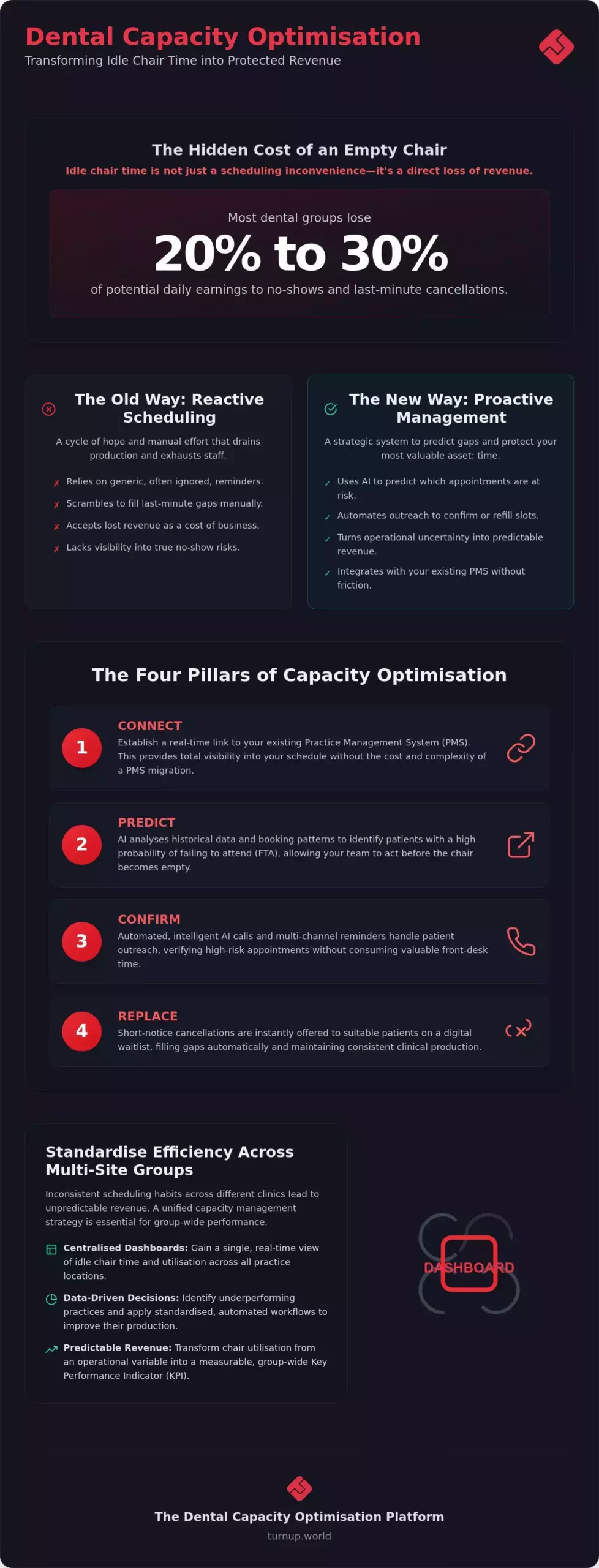
What if the 20% to 30% of daily earnings lost to idle chair time wasn’t an inevitable cost of doing business, but a solvable failure of foresight? Most dental leaders accept high no-show rates and manual waitlist management as the frustrating price of operating a busy clinic. You send reminders, yet chairs remain empty whilst your front desk team struggles to fill gaps at the last minute. It’s a reactive cycle that drains production and exhausts staff across your entire group.
This guide demonstrates how to move beyond basic scheduling and implement true dental capacity management. You’ll learn how to transform idle time into protected revenue through predictive analysis and automated workflow optimisation. We position TurnUp as the essential capacity optimisation platform that helps practices protect and recover chair time by predicting no-show risks and automating patient outreach. We will explore how centralised visibility and AI-driven recovery can stabilise your group’s production without the upheaval of a PMS migration. By the end, you’ll have a clear framework for turning operational uncertainty into a predictable, high-performance engine for every chair in your practice.
Key Takeaways
- Shift from reactive scheduling to proactive dental capacity management to protect revenue and eliminate costly idle chair time.
- Leverage predictive AI to identify high-risk no-shows before they occur, allowing your team to recover lost production time through automated outreach.
- Standardise clinical efficiency across multi-site groups using centralised dashboards that provide real-time visibility into chair utilisation and scheduling gaps.
- Optimise your operational workflows without the friction of a PMS migration by integrating intelligent automation alongside your existing clinical systems.
What is Dental Capacity Management?
Dental capacity management is the strategic optimisation of clinical time and physical chair availability. It’s the difference between merely booking appointments and actively protecting your most perishable asset: time. Whilst traditional scheduling focuses on filling the diary, capacity management treats every minute of chair time as a unit of production that must be defended against no-shows and short-notice cancellations.
Generic appointment reminders are no longer sufficient. They rely on the patient’s existing intent to attend, failing to address the underlying risks of non-attendance. In contrast, true capacity management uses data to predict which appointments are likely to fail, allowing teams to recover that time before the gap occurs. This shift is critical for practice valuation. Idle chair time directly erodes EBITDA, making a proactive approach essential for any DSO looking to scale.
The Shift from Reactive to Proactive Scheduling
Reactive scheduling is a game of chance. It relies on manual reminders and hopes for patient compliance. Proactive management uses predictive insights to identify gaps days in advance. Instead of reacting to a missing patient, teams use automated outreach to confirm high-risk slots or refill cancellations from an intelligent waitlist. It’s about staying ahead of the schedule rather than chasing it.
Why Capacity is the New Currency for DSOs
For multi-site groups, chair utilisation is the ultimate KPI. Standardising dental capacity management ensures predictable revenue across the entire organisation. Centralised visibility allows leaders to identify underperforming locations and apply automated workflows that keep chairs filled. In this model, capacity isn’t just a clinical requirement; it’s a measurable business driver that increases group-wide efficiency without requiring a PMS migration.
The Four Pillars of Effective Capacity Optimisation
Modern dental capacity management relies on a structured framework that replaces manual guesswork with automated precision. This approach transforms the schedule from a static list into a dynamic revenue stream. By focusing on four distinct operational pillars, practices can recover lost production time before it impacts the bottom line.
- Connect: Establishing a real-time link with your existing Practice Management System ensures total visibility without the need for a complex PMS migration.
- Predict: AI identifies patients with a high statistical probability of failing to attend (FTA) by analysing historical trends and booking patterns.
- Confirm: Intelligent AI calls and multi-channel reminders automate outreach, ensuring high-risk slots are verified without manual effort.
- Replace: Short-notice gaps are instantly filled from a digital waitlist, matching the right patient to the right chair.
Predicting No-Show Risk Before it Happens
Generic reminders treat every patient the same, which is inherently inefficient. Effective capacity optimisation assigns a risk score to every appointment based on historical behaviour. This allows front desk teams to focus their energy on the specific appointments that actually require intervention. By identifying these risks early, you can protect your chair time before the gap even appears, ensuring clinical resources are never wasted on unconfirmed slots.
Automating the Short-Notice Cancellation Recovery
Manual waitlist management is often too slow to be effective. When a cancellation occurs, the system triggers a 10-minute reservation window. It automatically contacts suitable patients from the digital waitlist, allowing them to claim the slot instantly. This removes the administrative burden from reception teams and ensures that short-notice gaps are filled with surgical precision, maintaining consistent clinical production throughout the day whilst reducing staff stress. If you are still relying on staff to manually call through a list when a slot opens, your dental waitlist management software approach may be costing you significant lost production.
Standardising Chair Utilisation Across Multi-Site Dental Groups
Multi-site groups often suffer from operational drift. Each clinic develops its own scheduling habits, leading to inconsistent chair utilisation across the organisation. One site might be proactive with manual calls, whilst another relies on basic, ineffective reminders. This fragmentation makes dental capacity management impossible to measure or improve at scale. Without a unified approach, your group’s production is at the mercy of individual practice behaviours.
Centralised dashboards solve this by aggregating idle chair time into a single, real-time view. Operations leaders can immediately see which practices are protecting their production and which are leaking revenue. To achieve true group-wide efficiency, organisations must establish a clear Capacity Maturity Level™ across all sites. This framework moves clinics away from reactive, site-specific habits toward a standardised protocol that ensures every chair is treated as a high-value asset.
Aggregating DSO Data for Operational Insights
Centralisation allows for the direct comparison of no-show performance and cancellation recovery rates between locations. By identifying top-performing sites, you create internal benchmarks for the entire group. If one clinic recovers 80% of short-notice gaps whilst another only manages 20%, the data highlights exactly where operational training or automated support is required. This visibility transforms anecdotal reports into actionable business intelligence that drives predictable growth. For a detailed framework on eliminating this inconsistency, explore our guide on standardising procedures across dental practices to synchronise workflows and boost group-wide profitability.
Empowering Centralised Scheduling Teams
The right technology allows a single centralised team to manage capacity for dozens of locations simultaneously. This hub can monitor high-risk appointments and trigger AI-driven outreach without burdening local front desk staff. It streamlines the workflow between centralised operations and local clinics, ensuring brand consistency and operational precision. To see how your group can standardise its operations, explore our DSO dashboard solutions and start recovering lost production time today.
Implementing a Capacity Management Strategy Without PMS Friction
Many dental leaders believe that modernising dental capacity management requires a painful, group-wide PMS migration. This is a myth. Switching Practice Management Systems is a high-risk, high-cost endeavour that often fails to solve core scheduling inefficiencies. TurnUp’s Front Desk Copilot eliminates this friction by working directly alongside your existing clinical systems. It acts as an intelligent layer that enhances your current setup rather than replacing it.
Transitioning to automated capacity management does not require operational downtime. Implementation is surgical and precise. Your team does not need to relearn clinical charting or billing. Instead, they gain a specialised co-pilot that handles the heavy lifting of schedule optimisation. By positioning the platform as a tool for empowerment rather than a replacement, you ensure immediate staff buy-in and a smoother cultural shift toward data-driven operations.
Reducing Front Desk Admin through AI Automation
Manual confirmation calls and waitlist management are repetitive, low-value tasks that drain staff energy. AI automation handles these workflows with tireless accuracy. It manages confirmations and rebooking in the background, only surfacing the appointments that require human intervention. This shift frees your reception team to focus on high-value patient interactions and in-practice care, improving the patient experience whilst maintaining a full schedule. Understanding how to create a productive dental schedule through procedural block scheduling and dynamic waitlist backfilling is the architectural foundation that makes this level of automation possible.
Next Steps for DSO Operations Leaders
The first step toward optimisation is understanding the scale of your current losses. Conduct a capacity audit to identify exactly where production opportunities are slipping through the cracks across your sites. Once you’ve quantified the idle chair time, request a demo to see your own no-show risks predicted in real-time. This data-driven foresight is the foundation of a modern, efficient dental group that prioritises protected revenue over reactive scheduling.
Secure Your Clinical Production
Transforming your schedule from a series of bookings into a protected revenue stream requires a fundamental shift in operational philosophy. By adopting dental capacity management, your group moves beyond the limitations of generic reminders. You gain the power to predict non-attendance before it happens and recover lost production time with automated precision. This isn’t just about filling gaps; it’s about standardising efficiency across every clinic in your organisation.
The transition is seamless. You can implement predictive no-show prevention and automated short-notice gap recovery without the risk or cost of a PMS migration. TurnUp integrates with your existing clinical systems to act as a silent, reliable engine for growth. It’s time to eliminate the uncertainty of idle chair time and empower your front desk teams with intelligent automation. Protect your chair time with the TurnUp Front Desk Copilot and take control of your group’s operational future. Consistent, predictable revenue is within your reach.
Frequently Asked Questions
What is the difference between dental capacity management and an appointment reminder app?
Capacity management is a strategic optimisation of clinical time, whereas reminder apps are purely reactive. TurnUp’s platform predicts no-show risk and automates the recovery of short-notice cancellations. It isn’t just about sending a text; it’s about protecting the chair’s production value. By identifying gaps before they occur, it ensures that your clinical resources are consistently utilised rather than relying on patient compliance alone.
How does predictive AI identify which patients are likely to miss their dental appointments?
Predictive AI analyses historical patient behaviour and booking patterns to assign a risk score to every appointment. It looks for statistical indicators that suggest a high probability of a failure to attend (FTA). This allows your team to focus their energy on the specific slots that require intervention. Instead of manual guesswork, you use data-driven foresight to protect your schedule and recover lost production time automatically.
Can I implement capacity management software without changing my Practice Management System?
Yes, TurnUp is designed to integrate with your existing Practice Management System without requiring a complex PMS migration. It works as an intelligent layer alongside your current clinical systems, providing real-time visibility into your schedule. This eliminates the operational downtime and high costs associated with software overhauls. DSOs can standardise their dental capacity management across multiple sites whilst maintaining their established clinical workflows.
How much revenue does the average dental practice lose to missed appointments and idle chairs?
Industry standards suggest that dental practices can lose between 20% and 30% of their daily earnings to idle chair time and missed appointments. These losses directly impact your EBITDA and overall practice valuation. By implementing a proactive dental capacity management strategy, you can transform these lost opportunities into protected revenue. Automated recovery of short-notice gaps ensures that your chairs remain productive, even when cancellations occur at the last minute.
Is dental capacity management suitable for NHS practices with UDA targets?
Capacity management is essential for NHS practices struggling to meet Units of Dental Activity (UDA) targets. Since every missed appointment is a lost opportunity to record activity, protecting chair time is vital for contract fulfilment. TurnUp automates the process of refilling gaps from a digital waitlist, ensuring that clinical time is always used to treat patients. This efficiency helps practices manage their contractual obligations whilst reducing the administrative burden on staff.