
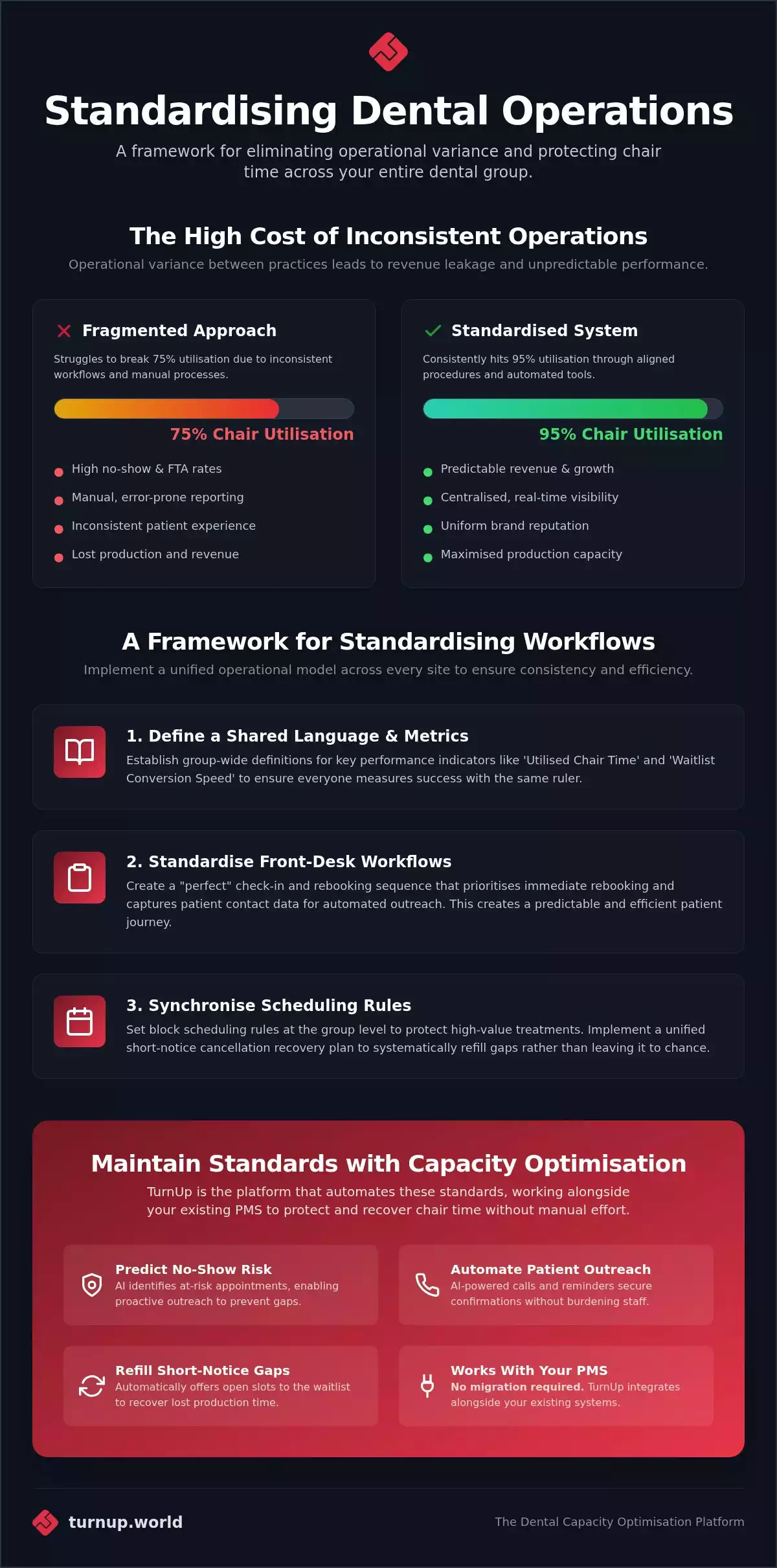
Why does one practice in your group consistently hit 95% chair utilisation whilst another just five miles away struggles to break 75%? The variance usually isn’t down to clinical talent. It’s the result of operational friction. When front-desk teams use different methods to handle no-shows, you lose the ability to scale efficiently. Standardising procedures across dental practices is the only way to eliminate this inconsistency and protect your most valuable asset: chair time.
You already understand that a fragmented approach makes group-wide reporting a manual nightmare. This guide provides a framework to synchronise workflows across every site to boost group-wide profitability. You’ll learn how to build a predictable operational model that reduces no-show rates and provides centralised visibility into capacity. By using a capacity optimisation platform like TurnUp, you can automate these standards alongside your existing PMS without the risk of a full system migration. It’s time to stop reacting to gaps in the diary and start recovering lost production time.
Key Takeaways
- Eliminate revenue leakage by aligning workflows to ensure consistent chair utilisation and patient experiences across every site in your group.
- Establish a scalable framework for standardising procedures across dental practices by defining unified protocols for waitlist management and utilised chair time.
- Roll out operational changes via pilot practices whilst positioning capacity optimisation as a tool to reduce manual workload and stress for front desk teams.
- Maintain high standards through automated platforms like TurnUp; protecting chair time with AI driven no-show prevention that works alongside your existing PMS.
Why Standardising Procedures Across Dental Practices is Crucial for Performance
In a DSO environment, standardisation represents the alignment of operational workflows to ensure consistent chair utilisation and patient experiences across the entire group. It goes beyond simple administrative checklists. Effective standardisation ensures that every site operates as part of a unified machine rather than a collection of independent surgeries. By implementing a formal Standard Operating Procedure (SOP) for scheduling and patient outreach, groups can eliminate the operational uncertainty that drains revenue. Standardising procedures across dental practices ensures that growth doesn’t come at the expense of efficiency. Operational standardisation is the foundation for scalable dental capacity management.
Variance between sites often leads to “leakage” where one practice thrives whilst another suffers from high no-show rates. Without a centralised approach, DSO data aggregation and analysis remains a manual, error-prone task. Standardised procedures allow for precise performance forecasting. This enables executives to identify exactly which practices are underperforming and why, rather than guessing based on fragmented reports.
The cost of operational variance
Inconsistent scheduling rules create idle chairs and lost production time. If one front desk team manages cancellations differently from another, the group loses visibility into its true capacity. This fragmentation also damages brand reputation. Patients expect the same level of proactive communication regardless of which location they visit across the country. When outreach is inconsistent, trust erodes and patient retention drops across the estate. A structured approach to dental appointment cancellation recovery is essential to prevent these gaps from becoming a permanent drain on group-wide profitability.
Moving towards a Capacity Maturity Level
Scaling a DSO requires a shift from reactive management to a proactive operational framework. This transition is often measured by your group’s operational maturity. Understanding what is your Dental Capacity Maturity Level? is a vital first step in standardising procedures across dental practices. By identifying your current stage, you can move away from manual firefighting towards an automated, high-output model that protects every minute of available chair time.
A Framework for Standardising Operational Workflows and Scheduling
Success in a DSO starts with a shared language. You cannot manage what you don’t measure consistently. Establishing a group-wide definition for utilised chair time is the first step in standardising procedures across dental practices. This ensures that every clinician and manager evaluates performance through the same lens. Beyond definitions, you must define a unified protocol for short-notice cancellations. This isn’t just about filling gaps; it’s about a systematic approach to waitlist management that recovers lost production time automatically. A centralised reporting structure then allows operations leaders to see these capacity gaps in real time across the entire estate.
Standardising the front-desk workflow
Manuals are often ignored when the phones are ringing. You need a “perfect” check-in and rebooking sequence that reception teams follow instinctively. This sequence should prioritise immediate rebooking and the collection of patient contact data for automated outreach. Every practice manager must report on specific metrics weekly: Failed to Attend (FTA) rates, waitlist conversion speed, and unallocated chair hours. Standardising these touchpoints creates a predictable patient journey, ensuring that every interaction protects the group’s revenue potential.
Synchronising scheduling rules
Groups often struggle to balance local flexibility with group-wide efficiency. Block scheduling rules should be set at the group level to protect high-value treatments, whilst allowing individual practices to adjust for local patient demographics. A unified short-notice recovery plan is essential for every site. Instead of leaving gaps to chance, use a capacity optimisation platform to synchronise the patient confirmation journey. This reduces the risk of FTA appointments by predicting no-show risks before they happen. Standardising procedures across dental practices ensures that even when the front desk is busy, the system continues to recover lost production time without manual intervention.
Implementing New Procedures Without Disrupting Patient Care
Rapid change often triggers resistance at the practice level. To mitigate this, start with a single pilot practice to refine your approach. This allows you to identify local friction points before standardising procedures across dental practices on a larger scale. Use staccato communication to explain the “why” behind the change. We are protecting chair time to ensure the group’s financial health. Frame the transition as a staff benefit. Capacity optimisation isn’t about adding tasks; it’s about eliminating manual firefighting and reducing front-desk stress.
Integration is the key to a smooth transition. TurnUp acts as a silent engine that works alongside your current PMS. It doesn’t require a disruptive data migration or a change in clinical software. Instead, it automates the patient outreach and waitlist recovery processes that usually consume hours of receptionist time. By removing the need for double-entry, you ensure that the new standards are followed without increasing the daily workload.
Gaining buy-in from local practice teams
Local teams often worry that standardisation erodes their “personal touch”. Address this objection head-on. Automated systems don’t replace human judgement; they empower it. By predicting no-show risks and refilling gaps, the platform handles the administrative heavy lifting. This frees your receptionists to focus on providing high-quality, face-to-face care. It’s about using technology to protect the human elements of the practice.
To ensure your staff are fully equipped to follow these new protocols, visit Knowledgefront to explore digital learning solutions tailored for large-scale organisations.
Training for consistency
Static manuals are where operational standards go to die. Interactive training is far more effective for dental teams who learn through action. Use live demonstrations to show how automated waitlists can recover lost production time in seconds. For broader context on scaling these operations, refer to our Dental Capacity Management: Guide for Practices and DSOs. Consistency is a habit, not a document. Standardising procedures across dental practices becomes second nature when the technology does the heavy lifting for the team. If you want to see how these workflows look in practice, explore our capacity optimisation solutions today.
Maintaining Standards Through Automated Capacity Optimisation
Manual auditing is a slow, reactive process. It fails to catch errors as they happen. During peak morning rushes, even the best front-desk teams struggle to follow every protocol. Standardising procedures across dental practices through automation removes this human vulnerability. By deploying TurnUp as a digital “Front Desk Copilot”, you ensure that no-show prevention and capacity recovery protocols are executed flawlessly. Every time. This proactive approach shifts the focus from checking if a manual was read to confirming that the chair is actually filled.
The role of AI in procedural consistency
AI-driven outreach ensures every patient receives a consistent, high-quality confirmation experience. Predictive AI identifies high-risk appointments across your entire estate. This allows for automated intervention before a gap ever appears in the diary. Automated waitlist management then refills short-notice cancellations without requiring manual phone calls from the reception team. For a comprehensive operational framework on how to systematically address these gaps, our guide to strategic dental appointment cancellation recovery outlines how to shift from reactive manual lists to automated capacity optimisation. This level of foresight eliminates the operational uncertainty that manual workflows leave behind, protecting your production time with surgical precision.
Visibility for DSO leaders
Visibility for DSO leaders
For DSO leaders, centralised dashboards provide a single source of truth. You can monitor chair utilisation and no-show performance across the entire group in real time. This data-driven authority allows you to spot trends and address revenue leakage before it impacts group-wide profitability. For a deeper understanding of how to transform fragmented reporting into actionable intelligence, explore our guide to DSO data aggregation and analysis across your estate. TurnUp functions as a silent engine, keeping chairs filled whilst working alongside your existing PMS. This technology-first approach allows for a “plug and play” integration when acquiring new practices. It ensures every new site immediately adopts your standards for capacity management without the need for a disruptive PMS migration. To further support this standardisation, Apptimized can be used to automate software packaging and deployment, ensuring all clinical and administrative applications are consistently managed across the estate.
Operational variance is the silent enemy of DSO profitability. Moving beyond fragmented, site-specific workflows is no longer optional for groups looking to scale. By standardising procedures across dental practices, you create a predictable framework that protects your most valuable resource: chair time. This transition doesn’t require a complex PMS migration. Instead, it relies on synchronising your scheduling logic and automating the administrative heavy lifting that often leads to revenue leakage.
TurnUp provides the surgical precision needed to predict no-show risk and maximise chair utilisation across every site in your estate. It functions as a silent engine, ensuring your high standards are met even during the busiest periods. You can now recover lost production time and gain centralised visibility into your group’s true capacity without increasing the burden on your local teams.
Optimise your group capacity with the TurnUp Front Desk Copilot and transform your scheduling operations into a high-performance engine for growth. The future of your DSO is automated, efficient, and fully utilised.
Frequently Asked Questions
How do I start standardising procedures across multiple dental practices?
Start by selecting a single pilot practice to test and refine your operational workflows before a wider rollout. You should first define clear, group-wide metrics for success, such as utilised chair time and Failed to Attend (FTA) rates. Standardising procedures across dental practices requires a phased approach that focuses on high-impact areas like patient confirmation journeys and waitlist management to ensure early wins and staff buy-in.
What are the biggest challenges when standardising DSO operations?
The primary challenge is overcoming the friction between centralised management and local practice autonomy. Staff often fear that standardisation removes the “personal touch” or creates more manual work. You must address these objections by framing operational changes as a way to reduce front-desk stress. Inconsistent data reporting between sites also presents a significant hurdle, making it difficult for operations leaders to gain a clear, real-time view of group-wide capacity.
Do I need to change my Practice Management System to standardise procedures?
No, you don’t need to undergo a costly and disruptive PMS migration to achieve operational consistency. Platforms like TurnUp are designed to work alongside your existing Practice Management System as a silent engine. This allows you to implement group-wide standards for no-show prevention and waitlist recovery without the technical risks associated with data migration. It ensures your teams can focus on capacity optimisation using the tools they already know.
How does standardisation improve dental chair utilisation?
Standardisation improves utilisation by eliminating the variance in how different sites handle gaps in the diary. When every practice follows the same protocol for refilling short-notice cancellations, you reduce idle chair time across the entire group. Standardising procedures across dental practices ensures that no-show risks are predicted early and waitlists are managed systematically. This creates a predictable flow of patients, protecting your production time and boosting group-wide profitability.
Can automation help maintain operational standards in a dental group?
Automation is essential for maintaining standards because it removes the risk of human error during busy periods. Whilst manual checklists are often ignored, automated platforms act as a “Front Desk Copilot” that follows no-show prevention protocols every time. This technology ensures every patient receives the same high-quality confirmation experience. It also provides DSO leaders with centralised dashboards to monitor performance and capacity across all sites without needing manual audits.