
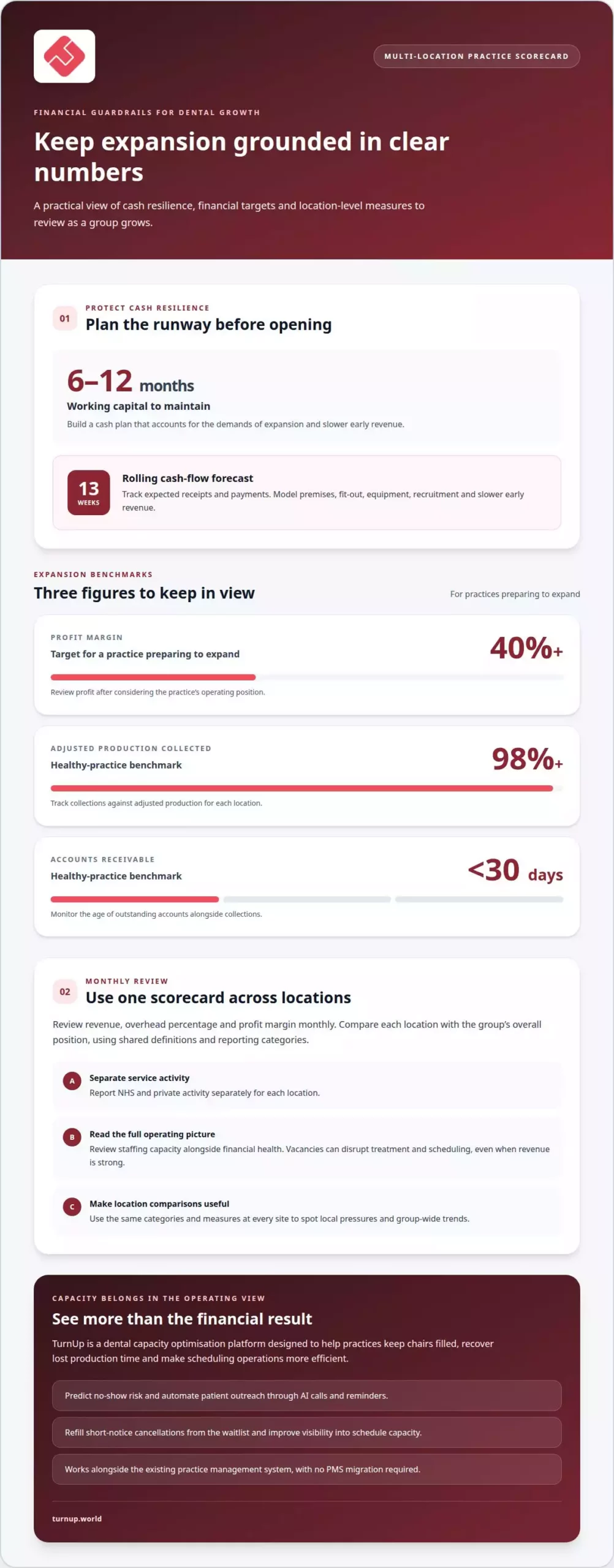
Culture scales through clear standards, not the founder’s constant presence. Scaling a dental practice to multiple locations means defining shared ways of working, empowering a capable leader at each site and keeping performance visible across the group. Plan for financial resilience too, with six-twelve months of working capital and a 13-week rolling cash-flow forecast.
It’s natural to expect a new location to extend what already works. But growth also spreads leadership attention, staff capacity and operational oversight. Consistent patient experiences depend on deliberate systems that work across sites.
This guide explains how to protect culture while centralising administration, which financial and operational measures to monitor, and how to weigh the reach of a new site against its added costs and complexity. You’ll get a practical framework for deciding whether to expand, what to standardise first and where local leaders need room to act. The aim is controlled growth, with a clear view of each location’s contribution and where the operating model needs strengthening.
Key Takeaways
- Build a consistent culture with shared operating standards and local leaders who can put them into practice.
- Centralise repeatable administration, while keeping clinical decisions with clinicians.
- Use a regular scorecard for financial, operational and team performance to spot issues across locations early.
- Weigh the reach and growth potential of a new site against its added costs, leadership demands and impact on existing practices.
1. What’s the biggest challenge in multi location dental practice management?
The main challenge is keeping patient care and daily operations consistent when leadership attention is divided. With two locations, an owner can only be physically present at one at a time. Clear processes, capable local managers and shared performance data reduce reliance on informal oversight.
In England, assess the applicable registration and compliance requirements with the Care Quality Commission (CQC). Scotland, Wales and Northern Ireland have separate regulatory arrangements. Map each location’s services and accountable leadership against the requirements that apply in its nation.
Standardise the practice management system (PMS) before expanding. Use consistent appointment types, scheduling templates, patient records, billing workflows and reporting categories so teams can compare activity across locations. A central dashboard can help owners spot differences in chair utilisation, cancellations and revenue without relying on separate spreadsheets.
Cloud-based practice-management software can give authorised teams access to shared records and operational information across sites. Set role-based access, train staff on shared workflows and agree how updates are recorded. The system should support consistent administration without taking clinical decisions away from dentists.
Expansion needs a cash plan as well as a technology plan. Maintain six-twelve months of working capital and use a 13-week rolling cash-flow forecast to track expected receipts and payments. Model property, fit-out, equipment, recruitment and slower early revenue; funding may come from loans, investors or reinvested profits.
For a UK dental group, assign named owners to tax reporting, payroll and employment processes, and patient-data access, retention and secure handling. Use consistent procedures across locations, with responsibilities clearly divided between managers and central teams.
There is no single cost for opening a second practice. Build a GBP budget covering premises, fit-out, equipment, staffing, technology and working capital. Then test how changes to those assumptions affect cash flow and the opening plan.
Use a repeatable expansion sequence: assess the site, model funding, standardise systems, appoint and train its manager, then monitor performance after launch. A new-site checklist helps teams apply the same operating standards while giving local leaders room to manage day-to-day delivery.
2. Centralising administrative functions
Centralise repeatable work, not every decision. A shared team can manage payroll and benefits administration, accounting, financial reporting, revenue-cycle oversight, vendor management, procurement and human resources policies. This reduces duplicate processes and gives owners one operational view across locations.
Start by assigning each task to a central owner and a site-level contact. For example, central finance can standardise invoice coding and reporting, while each practice manager approves local purchases within agreed limits. This keeps financial oversight consistent without slowing routine decisions at the practice.
Use one reporting structure for production, collections, accounts receivable, staffing and operating costs. Define each measure once, including its data source, reporting period and accountable owner. Use the same categories in location-level reports so leaders can compare performance and identify where support is needed.
Build scalable workflows around clear hand-offs. For example, a cancellation should follow the same process at every practice: record the change, notify the relevant team, contact suitable patients and update the schedule. Centralised scheduling and communication can coordinate these steps, while local teams handle patient conversations and clinical priorities.
Keep clinical authority with dentists. Central teams can standardise documentation, coding, billing and administrative procedures, but should not dictate clinical decisions. This division protects professional judgement while supporting operational efficiency and a consistent patient experience.
Review the model as the group grows. If central approval delays a time-sensitive local action, adjust the decision boundary; if site reports differ, fix the shared workflow first. For clearer comparisons of chair utilisation and available schedule capacity, capacity insights and chair-utilisation reporting can support operational decisions across locations.
3. What financial metrics are most important for multi-location practices?
Track financial health alongside staffing capacity: a clinic can report strong revenue while vacancies disrupt treatment and scheduling. Review revenue, overhead percentage and profit margin monthly, then compare each location with the group’s overall position. A shared scorecard helps leaders distinguish local pressures from organisation-wide trends.
For a practice preparing to expand, target a profit margin of 40 percent or more. A healthy practice collects at least 98 percent of adjusted production and keeps accounts receivable under 30 days. Monitor overhead against total income, and review enterprise profit after corporate expenses. These measures show whether growth rests on sound operations.
Report NHS and private activity separately for each location. Assign an owner to each relevant contract and track its performance alongside private treatment, billing, collections and available capacity. This gives leaders a clearer view of how each service mix affects staffing needs and financial results across sites.
Define ownership, management and clinical leadership as distinct responsibilities. Owners set investment priorities; operational leaders coordinate budgets, recruitment and shared processes; clinical leaders oversee treatment standards. Name a manager at each practice to handle day-to-day decisions and escalation, so the organisation doesn’t rely on one dentist to resolve every issue.
Recruitment and retention need regular measurement. Review productivity, turnover and team engagement quarterly, then investigate patterns by role and location. Staff costs typically account for 24-30 percent of collections, so compare workforce capacity with patient demand before adding shifts or changing incentives. Avoid targets that reward volume at the expense of patient experience.
Develop leadership infrastructure before gaps appear. Train practice managers in scheduling, billing, team feedback and performance reporting. Structured leadership development is associated with 23% higher profitability and 31% lower staff turnover. As the CEO delegates routine decisions, keep accountability clear: define which choices sit locally and which require group approval.
4. Benefits and disadvantages of operating multiple dental practices
A second location can reach patients in a new geographic market and grow group revenue. It also adds fixed costs and increases economic risk. Before scaling a dental practice to multiple locations, compare the expected contribution with the resources the new site will draw from existing operations.
Choose the route that fits your growth objective. A new practice gives owners control over the site, design, equipment and culture, but requires funding its build-out and patient-base growth. Acquiring an established practice may bring patients, staff and referral relationships, though the transition can disrupt each. Improving an existing clinic avoids a new property commitment.
The main risks are underestimating the new site’s demands, stretching leadership too thin and letting the original practice decline unnoticed. A common mistake when scaling a dental practice to multiple locations is monitoring only the new clinic. Compare revenue, patient flow and schedule performance at both locations throughout the expansion.
Before committing, assess market opportunity, funding, operational readiness and the impact on existing teams. Review local demand and referral relationships, then test whether your practice management systems, protocols and administrative workflows can support another site. Identify who will monitor each location and respond to performance changes.
Growth brings reach and potential revenue, but not automatically a better-run organisation. If cancellations or no-shows leave chairs unused across locations, explore ways to protect and recover chair time as part of your expansion plan.
TurnUp World: Dental capacity optimisation platform for dental practices and multi-site DSOs
TurnUp World helps dental practices and multi-site DSOs protect chair time and recover capacity lost to missed appointments. Its platform predicts no-show risk and supports automated prevention, helping teams act before appointments become gaps in the diary.
When appointments need to be cancelled or rebooked, TurnUp World AI Call Center supports confirmation, cancellation and rebooking. Automated waitlist management helps practices fill short-notice cancellations and use available chair capacity more effectively across locations.
TurnUp World sits alongside the existing practice management system, with no PMS migration required. It can help when inconsistent follow-up, unfilled cancellations or limited visibility into schedule capacity make scheduling operations harder to manage as the group grows.
Book a demo with TurnUp World to see how capacity optimisation can support your practice group.
Set clear gates for your next stage of growth
Before scaling a dental practice to multiple locations, define what must be in place before the next site moves forward. Set decision gates for leadership cover, financial resilience and the ability to maintain a reliable patient experience. Assign an owner to each gate and agree what evidence should trigger a pause, a change of plan or further investment.
This turns expansion from a one-off leap into a managed sequence. It also gives your leadership team room to respond when local conditions shift without losing sight of group priorities. Keep the next decision focused: identify where unused chair capacity or scheduling gaps could limit performance, then decide whether operational support can address them.
If schedule capacity is part of that decision, explore how TurnUp can support your dental group. A measured next step can help your organisation grow with greater clarity and control.
Frequently Asked Questions
How do you maintain culture consistency across locations?
Make the culture visible in everyday behaviour, not just in a mission statement. Define how teams welcome patients, explain delays and hand over concerns, then include those behaviours in induction and manager coaching. Invite staff at each site to explain where local routines clash with group expectations. Keep core standards consistent while allowing sensible local adaptations.
How many locations can one dentist effectively manage?
With strong management teams and reliable systems, owners can effectively manage 3-8 locations. More than 8 locations typically calls for additional executive leadership and a more sophisticated structure. The practical limit depends on whether local managers can make routine decisions, maintain standards and escalate issues clearly. If every staffing, scheduling or patient concern still needs the owner, leadership capacity may already be stretched.
What financial metrics are most important for multi-location practices?
Review production and collections together, then examine treatment acceptance, patient retention and accounts receivable ageing by site. Rising production with weak collections may point to a billing or follow-up issue, while falling retention can signal a patient-experience problem. Compare locations using the same definitions and reporting periods to investigate differences before they distort group-level decisions.
What’s the biggest challenge in multi location dental practice management?
The key is spotting operational drift before it affects patients or performance. A booking hand-off that works at one clinic may fail elsewhere if teams follow different steps or ownership is unclear. Set a shared process for recording and escalating issues, then review recurring exceptions across sites. This can show whether the cause is a local training gap or a workflow that needs redesign.
Should a practice expand organically or acquire an existing dental practice?
Choose based on the control, speed and transition demands your organisation can support. A new site lets you shape the environment and operating model, but you must build its patient base. An acquisition can bring an established team and referral relationships, though those may change after the previous owner leaves. Assess retention and transition risks alongside the financial case before deciding.
How can patient experience and clinical quality be kept consistent across locations?
Use patient feedback and clinical review as separate but connected signals. Track recurring concerns, such as unclear billing or difficulty arranging appointments, alongside feedback on care and treatment continuity. Discuss patterns with site leaders, agree on corrective action and review whether it worked. This creates a practical improvement loop without treating patient satisfaction as a substitute for clinical oversight.