
A hygiene chair may be the wrong place for a new-patient appointment. In one example, booking a one-hour appointment reduces daily hygiene capacity from six patients to five; a two-hour appointment reduces it to four. Effective dental group capacity planning weighs the lost hygiene time against the value of using an overflow chair.
It’s easy to focus on filling every available chair. But appointment length, clinical needs and each chair’s capacity all affect how many patients a group can see. The answer isn’t to move every new patient out of hygiene. It’s to make the trade-off visible.
This article explains how to adjust capacity plans as performance changes, set hygiene appointment lengths according to the work required, and choose between a hygiene chair and an overflow chair for new patients. You’ll also learn to compare the options by their effect on daily and annual capacity, so scheduling decisions support access without quietly reducing hygiene availability.
Key Takeaways
- Compare actual performance with your practice’s targets, then adjust capacity plans when demand, staffing or schedule gaps change.
- Set hygiene appointment lengths around the work required. Longer appointments can reduce the number of visits a chair can accommodate.
- Choose between hygiene and overflow chairs by weighing new-patient access against the hygiene capacity displaced.
- TurnUp World helps teams predict no-show risk and recover cancelled chair time through patient outreach and waitlist management. It works alongside your existing PMS, with no migration required.
Adjusting plans to keep performance on track
A practice business plan gives a dental group a benchmark for comparing actual performance with agreed targets. Use it to track chair utilisation, appointment availability, staffing and financial progress against group objectives. When results move off plan, identify the gap before changing capacity across every practice.
Overcapacity can leave chairs and staff underused while fixed operating commitments continue. Undercapacity can restrict appointment availability, increase pressure on existing teams and leave demand unmet. The practical risk is a mismatch, such as adding sessions at one practice while another has unused chair time.
Adjust the plan through a repeatable review rather than relying on a single group-wide assumption. First, compare each practice’s actual activity with its own targets. Then identify whether the difference comes from demand, workforce availability, appointment mix or unfilled time. A realistic plan keeps objectives achievable and makes progress easier to track.
- Review the baseline: record each practice’s current position, strengths and weaknesses before setting a new target.
- Find the cause: separate a capacity shortage from a scheduling gap or a change in patient demand.
- Model the adjustment: test a change at the affected practice before applying it across the group.
- Set a review point: compare the new result with the same target and revise the plan if the gap remains.
This approach also supports decisions about development and growth. Assessing current performance can reveal expansion opportunities, areas needing improvement and suitable monitoring controls. For example, a group considering another site should assess existing chair utilisation and workforce supply first. Overestimating demand can create operational strain or cash-flow difficulties. Owning a practice or group does not remove that risk; a clear benchmark helps leaders see whether capacity changes achieve their intended outcome.
How appointment lengths affect hygiene capacity
Hygiene capacity depends on appointment duration and planned treatment. Forecasts, utilisation measures and staffing assumptions show how scheduling choices affect the number of available visits.
Forecasting demand and appointment capacity
Forecasting compares expected patient demand with appointment time and workforce availability. A model for England used three stages to project treatment demand, workforce supply and skill mix over 20 years. At practice level, use demand patterns and treatment requirements to shape hygiene sessions. This matters because appointment lengths affect how many visits fit into available chair time.
Measuring capacity and utilisation
Capacity and utilisation measures compare bookable time with time used for completed appointments. Track scheduled visits, completed visits, cancellations, no-shows and available hygiene hours together, rather than relying on a single occupancy figure. A four-day practice work week averages 17 working days per month. At eight patient hours daily, 60-minute appointments create theoretical capacity for 136 visits monthly, before cancellations or no-shows. These measures reveal where planned capacity differs from delivered activity.
Planning staffing requirements
Staffing requirements are the clinician and support hours needed to deliver the planned treatment mix. Estimate appointment hours by role, then compare them with available sessions for dentists, hygienists and nurses. The example schedules scaling and root planing for two hours, rather than 60 minutes. This helps groups develop rotas around clinical workload, instead of assuming every appointment uses the same time.
Rules affecting capacity and staffing
Capacity planning should distinguish regulatory requirements, NHS contractual conditions and professional standards. Their relevance depends on the practice’s UK nation, service arrangements and the roles involved. Treating them as one UK-wide rule risks applying the wrong framework. Separate these considerations from operational choices, such as appointment templates and chair allocation, so the capacity plan reflects each team’s setting.
Scheduling new patients in hygiene chairs or overflow chairs
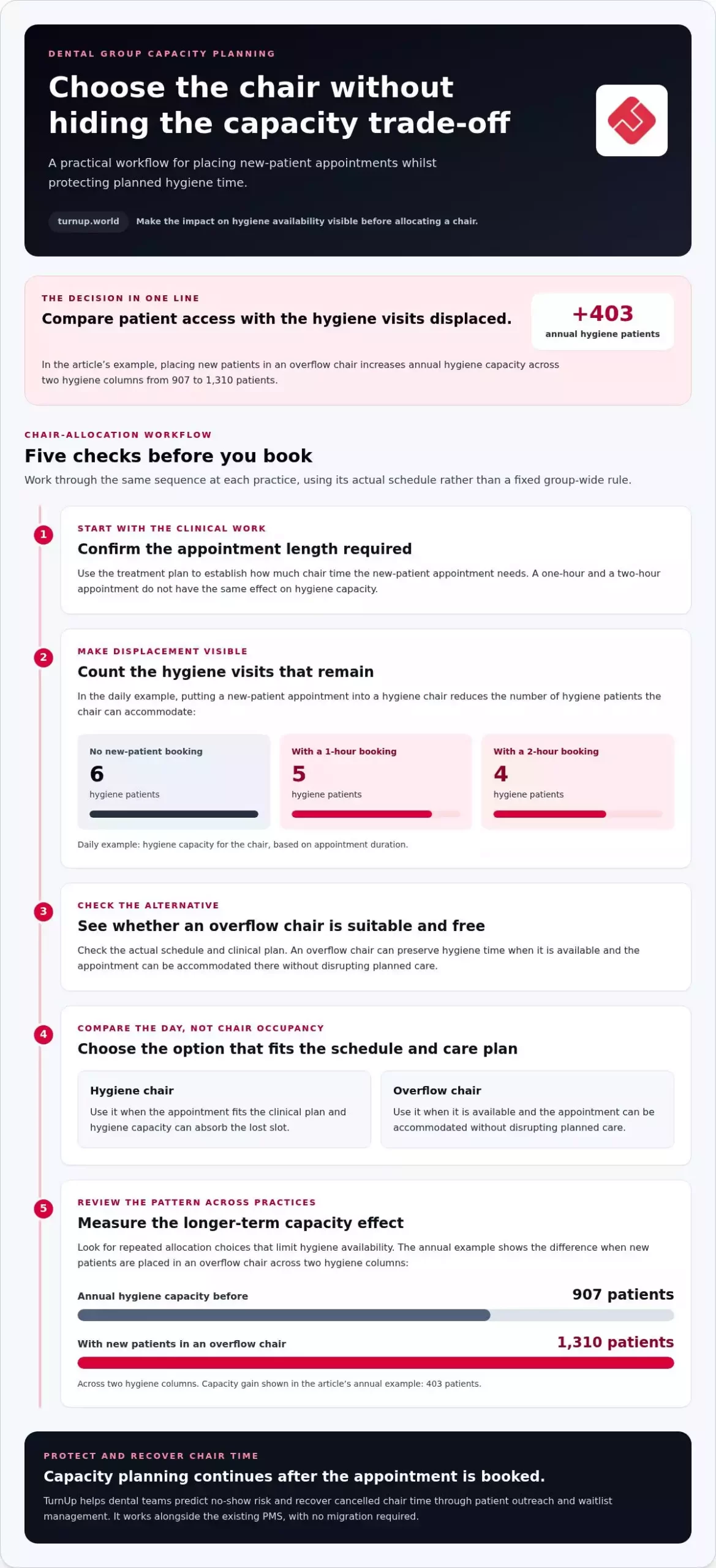
Using a hygiene chair for a new-patient appointment may displace planned hygiene visits. In one daily example, a one-hour new-patient appointment reduces hygiene capacity from six patients to five; a two-hour appointment reduces it to four. An overflow chair can preserve hygiene time when it’s available and suitable.
Compare the options against the actual schedule, not a fixed group-wide rule. Check the expected appointment length, hygiene sessions already booked and whether an overflow chair is free. Then weigh patient access against the hygiene visits displaced. This makes the trade-off visible across practices and helps teams identify opportunities to use chair time differently.
- Use a hygiene chair when the appointment fits the clinical plan and hygiene capacity can absorb the lost slot.
- Use an overflow chair when it’s available and the appointment can be accommodated there without disrupting planned care.
- Compare the effect on the day’s hygiene appointments, not just the number of chairs occupied.
- Review patterns across practice schedules to see where the same choice repeatedly limits hygiene availability.
The annual example shows why the decision matters beyond one day. Across two hygiene columns, placing new patients in an overflow chair increases annual hygiene capacity from 907 to 1,310 patients, a gain of 403 patients per year. This illustrates the potential capacity difference in that example, rather than a universal forecast for every dental group.
Keep a simple decision record for each practice: note the appointment type and duration, the chair selected, the effect on hygiene capacity and whether an overflow chair was used. Review the records alongside patient access and actual schedule use. If booking new patients regularly reduces hygiene capacity, consider using overflow chairs where suitable. If overflow availability is limited, protect hygiene sessions by matching appointments to the time and chair available. The aim is deliberate allocation, not filling every chair without considering what that removes from the day.
How do dental groups forecast patient demand and appointment capacity?
Forecasting connects expected treatment demand with chair time, workforce supply and skill mix. A model for England used three stages to project these factors over 20 years. For group leaders, the task is practical: estimate which appointments each practice can deliver with its available staff and rooms.
Start with demand by treatment type, then map it against clinician sessions and usable chair hours. Separate NHS and private activity so different appointment mixes remain visible. Include follow-up patterns too. If patients attend twice yearly on six-month turns, theoretical capacity for 136 visits monthly could facilitate 816 patients annually.
Then test the forecast against the operating day, not just the annual total. An eight-hour practice day with a one-hour lunch provides seven patient hours. In an eight-chair example, four chairs are allocated to hygiene. If 20% of the patient base is in periodontal care, the model requires at least one two-hour appointment daily on average for each hygiene column.
- Map demand: group appointments by treatment and patient pathway.
- Map supply: match required hours to staff, skill mix and chair availability.
- Stress-test: account for unfilled cancellations and no-shows. A 10% rate reduces the example hygiene column’s daily capacity by one visit.
- Compare scenarios: test whether proposed growth fits workforce and chair capacity before expanding.
Overestimating demand during expansion can create operational strain or cash-flow difficulties. Revisit assumptions when appointment mix, staffing or utilisation changes. A forecast should show which constraint limits delivery, not simply report a target number of appointments. This helps leaders direct capacity towards practices and services where patient need matches available teams.
For a clearer view of chair use and forecast gaps, explore dental capacity insights alongside your planning process.
TurnUp World: Dental capacity optimisation platform for dental practices and multi-site DSOs
TurnUp World helps dental practices and multi-site DSOs protect chair time and recover capacity lost to missed appointments and short-notice cancellations. Its platform combines no-show and failure-to-attend prediction with automated prevention, appointment confirmation, cancellation and rebooking through an AI Call Center, and waitlist management to refill cancelled slots.
Use it when teams need a clearer view of schedule capacity and a more consistent way to recover appointment time across practices. TurnUp works alongside your existing practice management system, so a PMS migration isn’t required. The focus is operational: keep chairs filled and make scheduling workflows more efficient. Contact TurnUp World to discuss your group’s capacity planning needs.
Make capacity planning part of the operating rhythm
A capacity plan is most useful when teams connect it to daily decisions. Build regular reviews around what has changed: patient demand, staffing, appointment mix and chair availability. Use those signals to decide whether to adjust the plan, rather than waiting for missed targets to accumulate.
For dental group capacity planning, the next step is to turn visibility into action across each practice. Give scheduling teams a clear way to identify emerging gaps and respond consistently, while keeping local clinical needs in view. This creates a more responsive process without relying on assumptions that no longer fit the diary.
TurnUp World supports dental groups looking to strengthen that operational workflow. Explore how TurnUp can support your capacity planning and take the next step towards more deliberate chair-time decisions.
Frequently Asked Questions
What does capacity planning mean for a dental group?
Dental group capacity planning means matching expected patient demand with available chairs, clinician time and support capacity across practices. A useful plan translates group objectives into site-level assumptions, then compares actual activity against them. For example, a practice may have enough dentist sessions but limited hygiene availability. Leaders can distinguish a staffing constraint from a scheduling imbalance before reallocating resources.
How can dental practices optimise chair time, appointment lengths and scheduling?
Match appointment templates to the treatment and team required, rather than applying one duration to every visit. A practice can separate routine hygiene appointments from longer, more complex treatment, then assign chair time accordingly. Review the diary for recurring gaps between appointments and avoid booking visits into chairs without the right staff or time. This makes the schedule more practical to deliver.
What software is used for dental group capacity planning in the UK?
Dental groups can use their practice management system for appointment records and capacity optimisation tools for operational visibility and missed-appointment workflows. TurnUp World works alongside the existing PMS, with no migration required. It predicts no-show risk and supports automated prevention, while its AI Call Center handles appointment confirmation, cancellation and rebooking. Automated waitlist management helps recover short-notice cancellations.
How can a dental group compare capacity across locations and allocate resources?
Compare practices using consistent definitions for available chair time, booked activity, completed appointments and unfilled slots. Then review the figures alongside each site’s treatment mix and staffing constraints. A higher appointment count alone doesn’t prove stronger utilisation if one location handles longer visits. Direct support towards the specific bottleneck, such as a shortage of suitable sessions, rather than reallocating resources based only on overall volume.
What steps should a UK dental group follow to create a capacity plan?
Build the plan around each practice’s current position and expected workload. Keep assumptions visible so managers can revise them as conditions change.
- Set objectives for access, activity and chair use.
- Map demand by treatment and patient pathway.
- Record available chairs, clinician sessions and support.
- Compare planned capacity with delivered activity.
- Adjust the site plan, then review the result.