
Manual scheduling is no longer a viable strategy for a modern dental group. Whilst your front desk team works tirelessly to manage cancellations, the reality is that human effort alone cannot keep pace with the 2026 operational landscape. Most practices remain trapped in a cycle of reactive fire-fighting, watching their chair utilisation fluctuate whilst patient waitlists grow. If you are still relying on staff to manually call through a list when a slot opens, your dental waitlist management software, or lack thereof, is costing you lost production.
You likely feel that your current processes are as efficient as they can be without hiring more people. It’s a common sentiment amongst practice managers who are overwhelmed by manual admin. This guide changes that perspective. You’ll discover exactly where your practice sits on the capacity maturity scale and learn the precise steps to transition to a predictive model. We’ll explore how to automate short-notice cancellation recovery and protect your production, ensuring your chairs stay filled without adding pressure to your team.
Key Takeaways
- Identify your practice’s position on the five-stage capacity maturity scale to pinpoint specific operational bottlenecks and untapped production.
- Understand why traditional manual processes fail and how intelligent dental waitlist management software recovers lost production time automatically.
- Gain a framework for real-time visibility into chair utilisation across multiple sites to ensure consistent performance and operational accountability.
- Discover the roadmap for moving to predictive scheduling using AI and automation without the need for a disruptive PMS migration.
Defining Capacity Maturity for Modern Dental Operations
Capacity maturity measures how effectively a dental group protects its most perishable asset: chair time. Many practices mistake a busy diary for an efficient one. However, being “fully booked” is meaningless if no-shows and short-notice cancellations create persistent gaps. Traditional operations often remain stuck in a reactive state, where the front desk team spends hours manually calling patients to fill holes. This fire-fighting approach is a hallmark of low operational maturity.
From Chaos to Control: The Operational Shift
Moving up the maturity scale requires a transition from manual effort to automated precision. Whilst basic appointment scheduling software digitises the diary, it rarely optimises it. A standard PMS acts as a passive record-keeper rather than a proactive engine. High-maturity groups use dedicated dental waitlist management software to predict no-show risks and automate the recovery of lost time. This shift reduces the administrative burden on staff and ensures that idle chairs are refilled with surgical accuracy.
The Role of Capacity in Practice Scalability
For DSOs, capacity maturity is a direct driver of valuation. Investors and acquisition teams look for predictable, scalable systems. A practice that relies on the “heroic effort” of a single receptionist to manage the waitlist is a risk. Conversely, a group with standardised, automated workflows for capacity recovery represents a stable investment. By 2026, the ability to maintain high chair utilisation across multiple sites without increasing headcount is the primary differentiator for growing UK dental groups.
The Five Stages of Dental Capacity Maturity
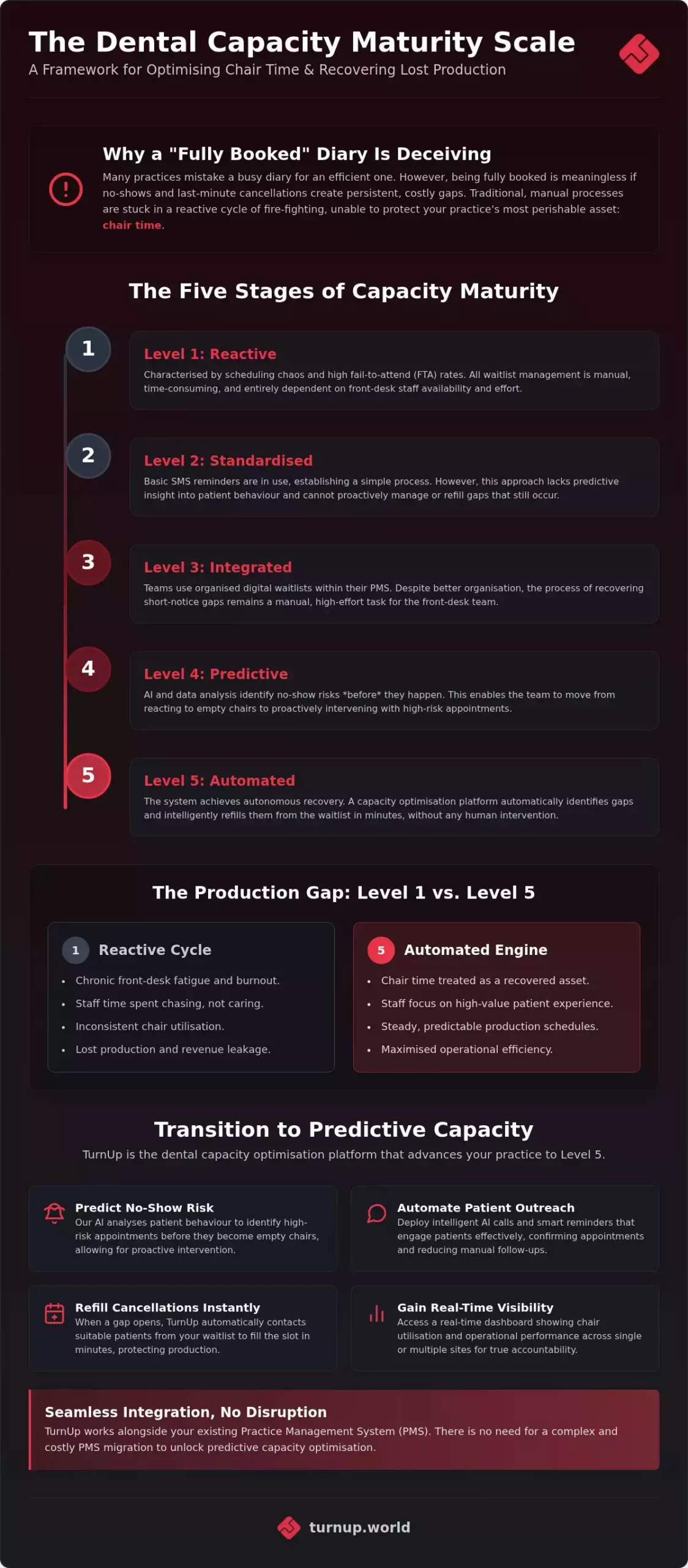
Operational excellence in 2026 is defined by how a group handles scheduling volatility. Most practices fall into one of five maturity stages, ranging from manual chaos to autonomous optimisation. Identifying your current stage is the first step toward protecting your production. The five levels are:
- Level 1 (Reactive): Characterised by scheduling chaos and high FTA rates. Waitlist management is entirely manual and staff-dependent.
- Level 2 (Standardised): Basic SMS reminders are active. The practice has a process, but it lacks predictive insight into patient behaviour.
- Level 3 (Integrated): Teams use digital waitlists, but the recovery of short-notice gaps remains a manual task for the front desk.
- Level 4 (Predictive): AI identifies no-show risks before they happen. Data allows for proactive intervention rather than just reacting to gaps.
- Level 5 (Automated): Autonomous recovery. The system leverages dental waitlist management software to refill gaps instantly without human prompts.
Level 1 vs Level 5: A Production Comparison
The gap between these stages is measured in recovered revenue. Level 1 practices suffer from chronic front desk fatigue. Staff spend their day chasing cancellations rather than focusing on patient experience. Level 5 DSOs eliminate this administrative friction. They treat chair time as a recovered asset, using dental waitlist management software to ensure production remains steady even when the diary shifts at the last minute.
Why Most DSOs Plateau at Level 2
Many dental groups stop at Level 2 because they rely on generic appointment reminder tools. These systems are passive. They notify a patient but do nothing to refill the chair if that patient cancels. True dental capacity management requires a more proactive approach. To move beyond this plateau, groups must adopt systems that work alongside their existing PMS to predict and refill gaps. You can assess your current maturity level to identify where your scheduling process is leaking revenue.
Capacity Maturity Checklist: Assessing Your DSO
To improve operational efficiency, you must first measure it accurately. High-growth DSOs use this checklist to identify where production is leaking across their network. If your current system relies on manual effort, you are likely operating at a lower maturity level than your competitors.
- Data Visibility: Do you have a real-time dashboard showing chair utilisation across all sites? Relying on end-of-month reports means you are reacting to old problems rather than preventing them.
- No-Show Prevention: Are you predicting no-show risk before it happens? Advanced dental waitlist management software identifies high-risk behaviours rather than just sending a generic SMS reminder.
- Waitlist Automation: Can you fill a cancellation in under ten minutes without a single phone call? Speed is the primary factor in successful chair-time recovery.
- Workflow Integration: Does your optimisation tool work within your existing PMS? Technical maturity means enhancing your current stack, not enduring a disruptive PMS migration.
Measuring Your Current Utilisation Rate
True capacity is often lower than it appears on paper. Use this formula: (Actual Production Hours / Total Available Chair Hours) x 100. Look closely at hygiene schedules for ghost gaps. These are small, unbooked blocks that seem insignificant but accumulate into hours of lost production across a multi-site group. Identifying these hidden openings is essential for moving toward a predictive model.
Evaluating Front Desk Efficiency
Audit your team’s daily activity. Calculate how many hours per week staff spend on manual rebooking and waitlist management. In reactive practices, this administrative load often exceeds 15 hours per week. This burden forces teams to choose between administrative recovery and patient care. Shifting to an automated system allows your front desk to focus on the patient in front of them whilst the software fills the gaps in the background.
Audit your DSO capacity to identify hidden production gaps today.
Transitioning to Predictive Capacity with TurnUp
Transitioning from Level 2 to Level 4 maturity doesn’t require a disruptive PMS migration. TurnUp World acts as an intelligent layer that works seamlessly alongside your current software. It transforms your operations by maximising dental practice operational efficiency through AI-driven insights. By implementing the Front Desk Copilot, you create a silent engine for chair-time recovery that operates in the background. This shift allows your team to move away from reactive fire-fighting and focus on high-value patient interactions.
The Power of No-Show Prediction
Traditional systems wait for a cancellation to occur before they act. TurnUp World’s AI identifies high-risk appointments by analysing historical patient behaviour and attendance patterns. It flags potential failures to attend (FTAs) before the gap even appears. This foresight enables automated outreach that protects production hours. When a vacancy is confirmed, the dental waitlist management software refills the slot in minutes. Training your team to trust these automated workflows is vital. Once they see the system recovering production without manual prompts, they can focus on clinical excellence rather than administrative recovery.
Scaling Maturity Across Multiple Sites
Consistency across a multi-site group is often the biggest barrier to growth. TurnUp World centralises scheduling operations, providing a single source of truth for chair utilisation across the entire DSO. The centralised dashboard allows operations leaders to see exactly which sites are struggling with no-shows or idle time. You can identify performance outliers and deploy support where it’s needed most. This visibility ensures that every practice in your group operates at peak capacity. It removes the reliance on individual site performance and creates a standardised, high-maturity scheduling culture across your entire network.
Automate Your Path to Level 5 Maturity
Moving from reactive fire-fighting to predictive chair-time recovery is the most significant operational upgrade a dental group can make in 2026. You now have a clear framework to assess your current maturity level and a roadmap to automate your scheduling operations. By shifting the administrative burden from your front desk to an intelligent system, you protect your production whilst improving the patient experience. Performance no longer depends on manual effort; it depends on the strength of your systems.
The transition to high-maturity operations doesn’t require a complex PMS migration. TurnUp is designed specifically for DSOs and multi-site groups; it works alongside your existing PMS as a silent, reliable engine for efficiency. Implementing advanced dental waitlist management software ensures that short-notice cancellations are refilled instantly and autonomously. This visibility across your entire network allows you to identify performance gaps and recover lost revenue with surgical precision. Book a demo to find your Capacity Maturity Level and start your journey toward a predictive, high-production future. Your team and your bottom line will thank you.
Frequently Asked Questions
What is a capacity maturity level in dentistry?
A capacity maturity level is a benchmark used to measure how effectively a dental group manages its scheduling operations and chair utilisation. It tracks the evolution from reactive, manual fire-fighting at Level 1 to predictive, autonomous optimisation at Level 5. Assessing your maturity helps identify operational leaks that cause idle chairs and lost production time across your multi-site DSO.
How long does it take to move from a manual to an automated scheduling level?
The timeline for moving from manual scheduling to an automated level typically takes a few weeks. Implementing dental waitlist management software involves integrating the platform with your current daily workflows. As the AI begins to analyse patient behaviour, the transition to autonomous chair-time recovery occurs rapidly, allowing your team to move away from administrative tasks without disrupting patient care.
Do I need to change my Practice Management System (PMS) to improve my maturity level?
You don’t need to switch your Practice Management System to improve your operational maturity. TurnUp works alongside your existing PMS as a silent, reliable engine for capacity optimisation. It adds the predictive foresight and automated recovery features that standard systems lack. This approach eliminates the need for a costly and disruptive PMS migration whilst providing the high-tech tools necessary for DSO growth.
What are the main benefits of reaching Level 5 capacity maturity?
Reaching Level 5 maturity ensures your chairs stay filled through autonomous, short-notice cancellation recovery. The main advantages are increased production, reduced front desk fatigue, and total visibility into chair utilisation across all sites. It turns scheduling into a data-driven engine that operates in the background. This level of operational efficiency protects your revenue and significantly enhances the overall valuation of your dental group.
How does predictive AI help with dental no-shows?
Predictive AI helps with no-shows by identifying high-risk appointments before they occur. It analyses historical data and patient attendance patterns to flag potential failures to attend. Unlike a generic reminder tool, the system can then trigger automated recovery through dental waitlist management software. This proactive approach ensures that potential gaps are filled from your waitlist in minutes, protecting your production from scheduling volatility.