A missed-appointment fee should never come as a surprise. A dental appointment cancellation policy template should set a clear notice period, explain when a fee applies and show how the practice calculates it. For private appointments, spell out the consequences of cancelling late or missing a visit before patients book.
Clear terms help patients and the team managing the diary. A consistent policy gives reception staff a straightforward way to explain booking changes and helps protect chair time that might otherwise go unused. It should also distinguish between cancellations based on appointment type, notice given and any deposit terms.
This guide explains how to set fees for missed or late-cancelled private appointments, manage cancellations and rescheduling, and communicate expectations to patients. It also covers what to include in your policy and how to manage short-notice gaps, so your team can apply the rules consistently and keep the schedule moving.
Key Takeaways
- Set out when a missed-visit or late-cancellation fee applies, how it is calculated and which appointment types it covers.
- Make booking changes easier to manage with clear instructions for cancelling, rescheduling and notifying the practice about lateness.
- Give patients and staff the same policy information, with practical wording that helps explain decisions consistently.
- Protect chair time by identifying no-show risk and creating a process to refill short-notice gaps from the waitlist.
1. Fees for missed or late-cancelled private appointments
For private care, a missed-appointment fee should follow the terms patients receive when booking. Policies use different approaches: one may charge by appointment length, while another may use a deposit or treatment cost. For example, a per-minute policy charging £1 for each minute would make a missed 20-minute appointment £20. These are examples, not a standard UK fee.
A cost-based approach can be clear, too. State whether a fee applies to late cancellations, non-attendance or both, and explain how you treat deposits. Send a reminder before the appointment so patients have time to act. Record when it was sent and how patients can notify the practice of a change.
Respond consistently when a patient disputes a missed appointment. Record the booking terms, reminder and cancellation contact, then invite the patient to appeal in writing to the Practice Manager. Review the timeline and apply the published policy consistently. A documented decision gives staff a clear basis for explaining the outcome.
NHS practices should separate missed-appointment fees from decisions about future care. Section 3 of the National Health (Dental Charges) Regulations 2005 prevents charging NHS patients for failing to attend. However, repeated missed or cancelled appointments can affect access under practice policies: examples include removing future NHS appointments after a first missed visit, or reviewing access after two missed appointments within a 12-month period. Explain the relevant policy to patients and record each contact and outcome.
For each missed appointment, record the appointment type, notice received, reminder history, fee or deposit decision, and any appeal. This creates a consistent record for private and NHS dental care without treating their consequences as interchangeable.
2. Booking and rescheduling appointments
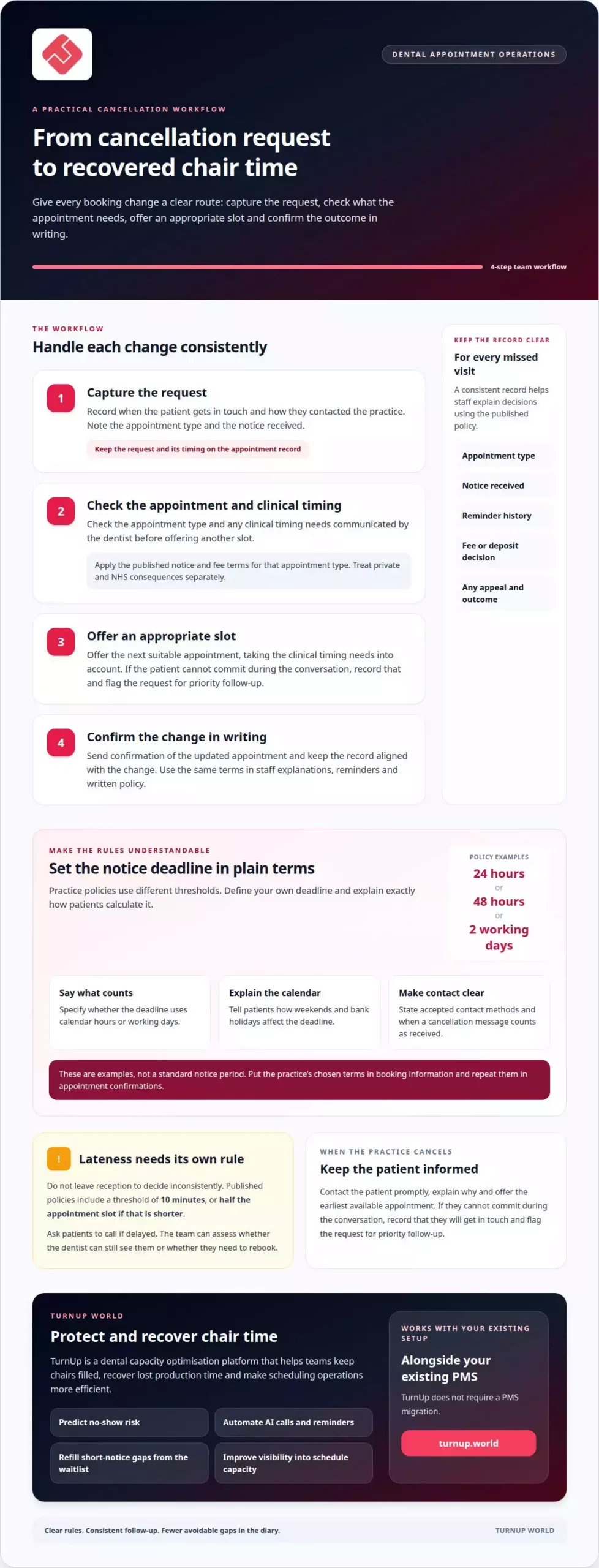
Make the notice period visible during booking, then repeat it in appointment confirmations. Practice policies use different thresholds: examples include 24 hours, 48 hours or two working days. These terms are not interchangeable. Define whether the practice counts calendar hours or working days, and explain how weekends and bank holidays affect the deadline. For instance, a two-working-day rule needs a clear calculation around a weekend so patients know when to contact the practice.
Give patients a clear way to cancel or rearrange, and record when the request arrives. If someone cannot attend, staff can offer the next suitable appointment and note any clinical timing needs communicated by the dentist. If the practice needs to cancel, contact the patient promptly, explain why and offer the earliest available appointment. If they cannot commit during the conversation, record that they will get in touch and flag the request for priority follow-up.
Late arrivals need a separate rule from cancellations. State how lateness affects attendance and whether the appointment can still proceed, rather than leaving reception to decide inconsistently. Published policies include a threshold of 10 minutes, or half the appointment slot if that is shorter. For example, a patient arriving late for a short routine visit may have used half the available time before that threshold. Tell patients to call if they expect to be delayed, so the team can assess whether the dentist can still see them or needs to rebook.
Use a simple workflow: capture the request, check the appointment type and clinical timing, offer an appropriate slot, then confirm the change in writing. An AI call centre for dental appointment confirmation, cancellation and rebooking can support this process and reduce manual follow-up. Practices looking to coordinate changes and recover schedule capacity can explore automated appointment rebooking.
3. Setting and communicating a cancellation policy
Choose a notice period and apply it consistently across the appointments it covers. UK practice policies use different approaches, including 48 hours or two working days, so explain your own deadline clearly. State whether it means calendar hours or working days, and how weekends or bank holidays affect the calculation. For example, patients need a specific deadline for cancelling a Monday appointment if the practice counts working days. Tell them which contact methods the practice accepts and when a message counts as received.
Explain how the practice considers exceptional circumstances, such as sudden illness or an emergency. Ask patients to contact the team as soon as possible and describe what information helps staff assess the request. Record the reason, time received and decision. This gives the team a clear basis for handling similar situations consistently without implying that every late cancellation removes a charge.
Share the policy before patients need to cancel. Include it in new-patient information and appointment communications, and display it prominently at the practice. Many clinics, such as Stoddard Dental Square, integrate clear guidance directly into their appointment booking process so patients understand expectations from the outset. Ask patients to acknowledge receipt and keep a record alongside the booking. Reminders should repeat the appointment details and explain how to give notice. They should not introduce different cancellation terms at the last minute.
Give reception staff a short script to keep explanations consistent. It should state the deadline, describe the consequence of late notice and explain how patients can appeal. For example, at TurnUp World, staff might say: “Your appointment requires 48 hours’ notice to cancel without a charge. Please contact us by telephone or email. If exceptional circumstances affect your attendance, tell us when you contact the practice.” Ensure your team uses your specific practice terms in place of these examples. Review the wording when booking procedures change, so telephone explanations, reminders and written policies remain aligned.
4. What should a dental appointment cancellation policy template include?
A useful template turns the practice’s rules into clear steps for patients and staff. Separate private and NHS arrangements, since charges and decisions about future care differ. Include the policy’s effective and review dates so the team can identify which version applied when an appointment was booked.
Set out the notice period and explain how patients can cancel or rearrange. For example, specify 48 hours or two working days, then define how weekends and bank holidays affect the deadline. Name accepted contact routes, such as telephone or email, and say when a message counts as received. Include instructions for patients who expect to arrive late.
- Appointments covered: identify private, plan, hygienist and other relevant appointments.
- Fee calculation: state when a charge applies and whether it depends on appointment length, treatment cost or another clear basis.
- Deposits: explain when a deposit is requested, how it is applied, and what happens after late cancellation.
- Exceptions and appeals: explain how patients can report illness or other circumstances, and how the Practice Manager reviews a decision.
- NHS arrangements: distinguish attendance consequences from private fees, and explain how repeated missed appointments are handled.
Make every term understandable without staff interpretation. If laboratory work is involved, one policy example uses a minimum deposit of 50% for private and plan appointments. This is particularly relevant for complex restorative and implant procedures, such as those demonstrated by Reston Family Dental Center, where extensive clinical time and bespoke laboratory fabrications require firm booking commitments. State when that condition applies and how the deposit is treated if the patient changes the booking. Give staff a consistent explanation and record the policy version provided to each patient.
Use the template in booking confirmations and new-patient information, then display it where patients can read it at the practice. Keep reminder messages aligned with the same terms. A clear process can also support capacity planning by making cancellations easier to record and act on. Improve visibility into appointment capacity with a more structured view of schedule changes.
TurnUp World: No-show/FTA prediction and automated prevention for dental appointments
TurnUp World helps dental teams act on no-show risk before chair time is lost. Its capacity optimisation platform predicts appointment risk, automates patient outreach through AI calls and reminders, and supports confirmation, cancellation and rebooking. When a patient cancels at short notice, automated waitlist management helps practices recover the opening. This connects attendance activity with the wider goal: keeping chairs filled and scheduling operations efficient.
TurnUp sits on top of an existing practice management system, so practices do not need a PMS migration to use the platform. No-Show Radar scans the schedule in real time and flags high-risk appointments. TurnUp supports individual practices and multi-site DSOs with appointment capacity insights and cancellation recovery. If missed visits and late changes are disrupting your schedule, book a demo to see how TurnUp can help.
Make your policy part of a stronger scheduling process
Treat a dental appointment cancellation policy template as a practical operating tool, not a document to file away. Use it to create a consistent experience for patients and a dependable framework for staff decisions. When reviewing your scheduling workflow, trace how cancellation information moves from booking to follow-up and identify where unclear hand-offs leave chair time exposed.
The next step is to connect policy with action. A clear rule sets expectations; an effective process helps the team respond when attendance changes. TurnUp supports dental practices and multi-site DSOs with capacity optimisation, helping teams anticipate no-show risk and manage appointment changes alongside their existing PMS.
To discuss how this could fit your scheduling operations, start a conversation with TurnUp World. A more deliberate approach can help your team turn clearer expectations into a more resilient diary.
Frequently Asked Questions
Can UK dental practices charge cancellation or missed appointment fees?
Cancellation fees may depend on the appointment terms, so patients should check the practice’s policy. Apply the relevant arrangement to the appointment type rather than using one rule for every booking. For example, distinguish a private hygienist visit from an NHS appointment before deciding whether a fee applies.
What are the rules on deposits and cancellation fees for private dental treatment in the UK?
For private treatment, explain the deposit amount, what it covers and how cancellation affects it before accepting payment. Deposits may be used to secure appointments involving laboratory work; one policy example requests a minimum 50% deposit for private and plan appointments of this type. Make clear whether the deposit is credited towards treatment or retained under the stated cancellation terms.
How should a dental practice explain cancellation fees and obtain patient agreement?
Give patients the terms before they commit to a booking, then retain a record of their acknowledgement. Include the policy in appointment communications and record the patient’s response alongside the booking. Staff should explain the relevant fee basis in plain language, invite questions before confirming, and note any agreed exception or clarification in the patient record.
What steps should patients follow to cancel or rearrange a dental appointment?
Patients should use the practice’s stated contact route and include their name and appointment date and time. They should say whether they want to cancel or rearrange, then ask the practice to confirm the change. If illness or an unexpected event prevents attendance, they should explain the circumstances when contacting the practice. If the practice cannot be reached, use its published alternative contact method.
What wording can a UK dental practice use for a fair cancellation policy template?
Use wording that clearly states the notice period, contact route and consequence: “Please give [notice period] to cancel or rearrange. Contact us by [method]. For private appointments, late cancellations or missed visits may incur [fee or deposit terms]. NHS appointment attendance is handled separately. If exceptional circumstances affect your attendance, contact us as soon as possible.” Replace each bracket with the practice’s actual terms before issuing the policy.