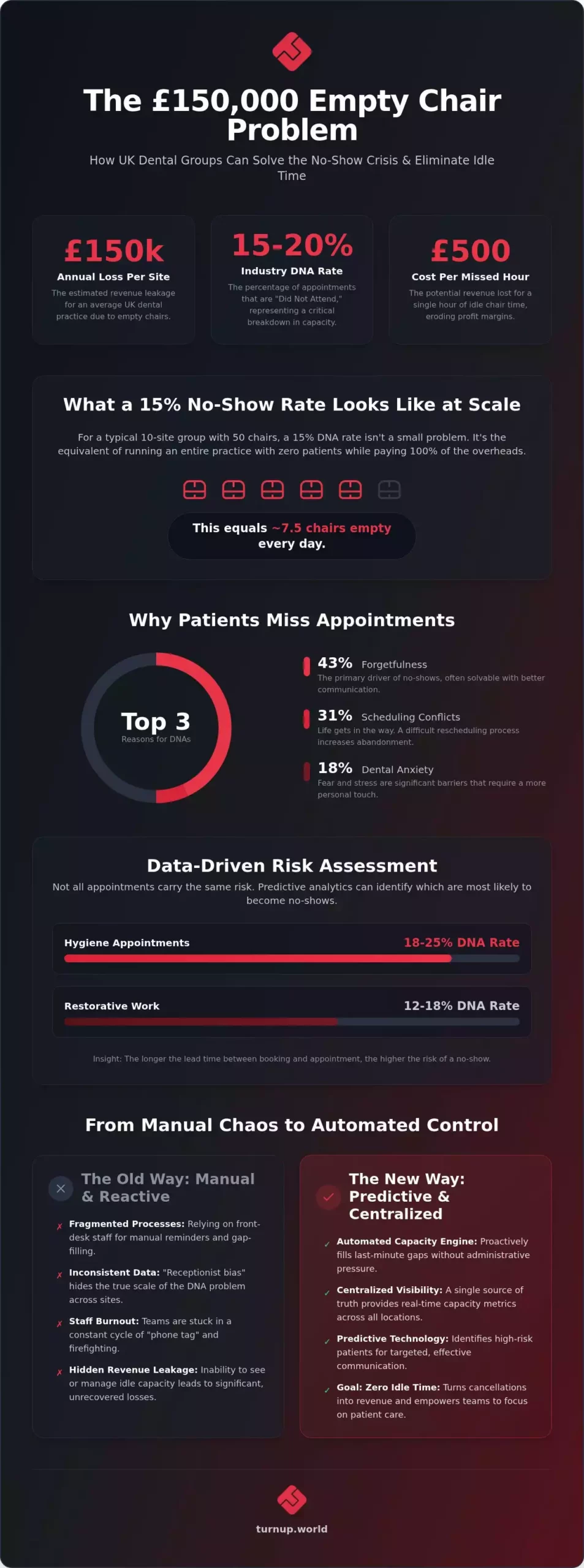
In 2026, the average UK dental group loses between £50,000 and £150,000 annually per site because of empty chairs. With industry DNA rates hovering between 15% and 20%, the central question for operations directors is no longer just about sending reminders. The real challenge is: how can a dental group reduce no-shows while scaling across multiple locations? Relying on fragmented, manual processes at the front desk is no longer a viable strategy for growth. It leads to inconsistent performance, staff burnout, and significant revenue leakage that stays hidden without centralised visibility.
You likely recognize that traditional SMS pings aren’t enough to protect your bottom line when a single missed hour can cost up to £500. This article shows you how to move beyond reactive fixes. Discover how multi-site dental groups can leverage predictive technology and centralised operations to eliminate idle chair time and solve the no-show crisis for good. We will examine the transition to automated capacity engines that provide a predictable schedule and higher utilisation rates. It’s time to turn cancellations into revenue and give your team the tools to focus on patient care rather than phone tag.
Key Takeaways
- Understand why a 15% DNA rate is a critical threat to DSO profitability and how it compounds across multiple sites.
- Explore how can a dental group reduce no-shows by replacing manual front-desk tasks with predictive technology and centralised visibility.
- Identify the psychological barriers to attendance and use frictionless digital communication to meet modern patient expectations.
- Implement a standardised scaling framework that balances centralised oversight with local clinic efficiency.
- Focus on the goal of zero idle chair time by using automated engines to fill last-minute gaps without increasing administrative pressure.
The DNA Crisis: Quantifying the Impact on DSO Profitability
The Did Not Attend (DNA) rate is the silent killer of Dental Service Organisation (DSO) profitability. While individual practices might view a missed appointment as a minor scheduling hiccup, the compound effect across ten or twenty sites is devastating. In 2026, UK dental groups are seeing average DNA rates between 15% and 20%. This isn’t just a clinical issue; it’s a fundamental breakdown in operational capacity. Total operational excellence requires a shift from clinical efficiency to capacity optimisation. It’s about ensuring every minute of available chair time is utilised profitably. If your group operates 50 chairs across 10 sites, a 15% DNA rate equates to 7.5 chairs standing empty every single day. That’s the equivalent of running an entire practice with zero patients while still paying 100% of the overheads.
When considering how can a dental group reduce no-shows, you must first look at the EBITDA impact. A 5% increase in DNA rates doesn’t just reduce top-line revenue by 5%. It erodes profit margins significantly because your fixed costs are static. You’re still paying for the clinician’s time, the dental nurse, the surgery rent, and the specialised equipment. Traditional appointment scheduling software often masks these losses by focusing on the event rather than the unrecovered cost of the idle chair. You can’t manage what you can’t accurately measure. Understanding how to improve DSO profitability through capacity optimization is essential before any meaningful reduction in idle chair time can be achieved.
The Hidden Costs of Idle Chair Time
Every empty chair represents a direct loss of approximately £200 to £500 per hour in potential revenue. Beyond the immediate financial leak, idle time creates a ripple effect throughout the group. High-value patients are pushed further down the waiting list, increasing the risk they’ll seek treatment elsewhere. Meanwhile, front-desk teams face mounting pressure to fill gaps manually. This constant firefighting leads to staff burnout and high turnover rates. It adds recruitment costs to an already strained balance sheet and prevents your team from focusing on patient experience.
Why Manual Tracking Fails at Scale
Decentralised groups often struggle with inconsistent data entry across different clinic locations. One site might record a late cancellation as a DNA, while another marks it as a “rescheduled” event to protect their internal KPIs. This ‘receptionist bias’ makes it impossible for group operations directors to see the true scale of the problem. Without centralised, real-time metrics, you’re managing by guesswork. To solve the no-show crisis, you need a single source of truth that removes human error from capacity reporting and provides visibility across the entire estate.
The Psychology of Patient Attendance in 2026
Patient behaviour has shifted. In 2026, forgetfulness remains the primary driver of DNAs, accounting for 43% of missed appointments. However, dental anxiety (18%) and scheduling conflicts (31%) are significant secondary factors that often go unaddressed. When patients encounter a complex booking process or feel a lack of urgency, their commitment to the appointment wanes. This is particularly evident in private dentistry, where ‘low-intent’ bookings-appointments made for routine check-ups or elective treatments-see higher abandonment rates than emergency or pain-driven visits.
Instead of relying on punitive fee-based deterrents, which often alienate patients and create friction in the relationship, focus on removing the barriers to attendance. A study on no-show reduction suggests that multi-channel communication is far more effective than rigid penalties. By understanding the psychological drivers behind attendance, you can implement strategies that build trust while protecting your group’s schedule. Proactive engagement proves more effective than reacting to an empty chair after the fact.
Identifying High-Risk Patient Profiles
Data is your most powerful tool for foresight. Predictive analytics now allow DSOs to flag patients who are statistically more likely to miss an appointment based on their historical behaviour and treatment type. For example, hygiene appointments typically see DNA rates of 18-25%, while restorative work drops to 12-18%. Lead time is another critical variable; the longer the gap between the booking date and the appointment, the higher the risk of a no-show. By identifying these patterns, you can answer the core operational question: how can a dental group reduce no-shows through targeted intervention? Tailoring your communication-such as using a more personal tone for anxious patients or increasing frequency for hygiene visits-maximises the impact of your outreach.
Reducing Friction in the Patient Journey
In a world of instant gratification, friction is the enemy of attendance. If a patient has to navigate a complex portal or remember a password just to confirm their visit, they’re likely to ignore the task. One-click confirmation links and 2-way SMS or WhatsApp channels are essential for modern dental groups. These tools allow for immediate, low-effort interaction that fits into the patient’s daily life. A patient-centric reminder schedule should respect their time, providing enough notice to reschedule without becoming intrusive. When you streamline these touchpoints, you reduce administrative pressure and improve chair utilisation. If you’re looking to eliminate manual follow-ups, you might explore how a front desk copilot automates patient flow.
Reminders vs. Predictive Capacity Management
Basic automated reminders have become a standard feature in most Practice Management Systems (PMS). However, they are fundamentally reactive. A reminder asks a patient to show up; it doesn’t solve the problem when they don’t. If a patient ignores a text message sent 24 hours before their appointment, your clinic is still left with a revenue-killing gap. When evaluating how can a dental group reduce no-shows, the distinction between a simple notification and active capacity management is critical.
Capacity management represents a shift in focus from clinical efficiency vs operational efficiency in dentistry. While your clinicians focus on high-quality care, the operational engine must focus on maintaining 100% chair utilisation. Relying on basic reminders is like checking the weather after the storm has already hit. Predictive technology allows you to see the storm coming and adjust your schedule in real-time. By shifting from reactive reminders to predictive capacity management, you solve the fundamental question of how can a dental group reduce no-shows at scale.
The Evolution of Dental Scheduling Technology
The industry has moved through three distinct phases of scheduling sophistication:
- Phase 1: Manual paper diaries and phone calls. This was labour-intensive, prone to human error, and impossible to track centrally.
- Phase 2: Digital PMS with basic automated SMS. This improved reach but remained passive and disconnected from real-time capacity needs.
- Phase 3: AI-driven capacity optimisation and dynamic rebooking. This is the current gold standard, where technology acts as a silent engine to backfill cancellations automatically.
Leveraging AI for Proactive Prevention
Predictive rebooking is the automated process of identifying high-risk appointment gaps before they occur and securing alternative patients to maintain 100% chair utilisation.
Modern algorithms can now ‘flag’ a likely no-show up to 48 hours in advance by analysing historical attendance patterns and appointment types. Instead of waiting for a DNA to happen, the system proactively engages with the patient or prepares a replacement. This includes automating the ‘standby’ list for high-demand slots, such as hygiene appointments, which often see the highest cancellation rates. The TurnUp Front Desk Copilot handles this heavy lifting, allowing your team to focus on the patients who are actually in the building rather than chasing those who aren’t. When selecting the right platform for your group, reviewing the best DSO operational efficiency software UK has to offer in 2026 can help you identify the features that matter most for capacity optimisation.
Centralising Operations for Multi-Site Excellence
Scaling a Dental Service Organisation requires a fundamental shift from individual practice management to a unified group strategy. While local clinics often prefer autonomy, fragmented processes make it impossible to answer a critical question: how can a dental group reduce no-shows effectively across twenty sites? Without standardisation, one clinic’s success remains isolated while another’s failure drains the group’s EBITDA. True operational excellence stems from the Standardising procedures across dental clinics framework, which ensures every site follows a proven, data-driven protocol.
Centralising the command centre of your operations doesn’t mean removing the human touch from the front desk. It means providing a single source of truth for performance benchmarking. By comparing DNA rates across the estate, you can identify underperforming clinics and deploy targeted support. This centralised visibility allows you to move away from reactive firefighting and toward a proactive, group-wide attendance strategy. You gain the power to spot trends before they become revenue leaks.
Implementing a Group-Wide DNA Policy
Consistency is the foundation of patient trust and operational data. You must standardise the grace period and rebooking rules across all locations. If one site allows a 15-minute delay while another cancels after five, your group-level analytics become skewed and unreliable. Rolling out new technology requires clear communication to ensure local staff don’t feel replaced. Instead, show them how uniform data collection empowers the whole group to perform better. When every receptionist records no-shows using the same criteria, your predictive algorithms become exponentially more accurate.
Empowering the Front Desk Team
Receptionist burnout is a significant risk in high-volume DSOs. Manual outbound calls to confirm appointments or fill gaps are repetitive and often futile. By automating these tasks, you shift the front desk role from admin to patient coordinator. This allows your team to focus on the high-value interactions that happen inside the clinic. Technology can now handle last minute dental appointment filling automatically; this ensures that no chair stays empty because of a human delay in the workflow. If you want to see how automation can protect your team and your margins, book a demonstration of the Front Desk Copilot. Understanding the full scope of common dental front desk problems is essential before deploying any new technology, as it ensures your solution addresses the root causes of schedule gaps rather than just the symptoms.
The TurnUp Strategy: Turning Cancellations into Revenue
Zero no-shows is a myth. Patients will always face genuine emergencies, traffic delays, or sudden illness. Aiming for a 0% DNA rate is a battle against human nature. However, zero idle chair time is an achievable operational goal. When considering how can a dental group reduce no-shows, the focus must shift from stopping the cancellation to instantly backfilling the gap. The TurnUp World Front Desk Copilot acts as a silent, automated engine that monitors your schedule for these openings and secures a replacement before your team even notices the vacancy.
Imagine a high-value restorative appointment for 9:00 AM is cancelled at 8:45 AM. In a traditional setting, that chair remains empty, costing the group up to £500 in lost hourly revenue. A manual waitlist is too slow to react in fifteen minutes. The TurnUp World strategy uses automation to identify and contact the ideal patient from your database, securing a booking and confirming the arrival without a single outbound phone call. This level of responsiveness transforms a potential loss into recovered EBITDA across your entire estate.
The financial impact of this efficiency is substantial. For a ten-site dental group, reducing the DNA rate by just 2% can recover over £130,000 in annual revenue. This isn’t speculative; it’s the direct result of maximising existing capacity. By automating the heavy lifting of schedule maintenance, you protect your margins while allowing your staff to focus on the patients currently in the chair. For a comprehensive breakdown of the strategies that drive these results, the 2026 DSO profitability and capacity optimization guide provides a detailed roadmap for unlocking hidden revenue across your estate.
Dynamic Rebooking: The Last-Minute Solution
Manual waitlists fail DSOs because they rely on human speed and availability. If your receptionist is checking in a patient, they cannot simultaneously call five people to fill a sudden gap. TurnUp World identifies the best patients to fill specific slots based on treatment type, proximity, and historical reliability. The system handles the communication through frictionless channels like SMS, ensuring a seamless patient experience. Short-notice rebooking becomes a value-add for patients who want faster access to care, rather than a desperate administrative scramble. A modern dental appointment waitlist app transforms this process from a reactive paper list into a proactive, automated revenue engine that fills gaps in minutes without burdening your front desk team.
Future-Proofing Your DSO Tech Stack
Modern capacity platforms must integrate deeply with your existing Practice Management Systems. Whether your group utilises Exact, R4, or Dentally, the data must flow bi-directionally to maintain a single source of truth. In 2026, data-driven authority is the hallmark of successful dental management. You cannot scale effectively on intuition alone. The next step for any growth-oriented group is a rigorous audit of current chair utilisation rates. By identifying where the leaks are happening, you can deploy targeted automation to seal them. Future-proofing your estate means moving beyond reminders and embracing a fully automated capacity engine.
Master Your Group Capacity for 2026
Operational excellence in a multi-site DSO requires a shift from chasing missed appointments to predicting them. We have explored how the transition from basic reminders to automated capacity engines protects your EBITDA and reduces staff burnout. By centralising your DNA protocols and leveraging predictive AI, you move beyond the limitations of traditional practice management software. The question of how can a dental group reduce no-shows is finally answered through technology that acts as a silent, reliable engine for chair utilisation.
Stop allowing empty chairs to drain your group’s profitability. You can reduce no-shows by up to 3% with predictive AI while eliminating the need for manual rebooking calls. Optimise your group capacity with the TurnUp Front Desk Copilot, a platform designed specifically for the unique scaling challenges of multi-site DSOs. It’s time to replace administrative uncertainty with a predictable, high-performance schedule. Take control of your capacity and lead your group into a more efficient, automated future.
Frequently Asked Questions
What is the average no-show rate for a UK dental group?
The average DNA rate for UK dental groups in 2026 sits between 15% and 20%. This figure varies based on appointment type, with hygiene visits typically seeing higher abandonment than restorative procedures. High-performing groups use centralised visibility to track these rates in real-time, allowing them to intervene before revenue leakage impacts the group’s total EBITDA. This visibility is the first step in identifying which sites require immediate operational support.
How can AI help prevent dental no-shows?
AI prevents no-shows by using predictive analytics to identify high-risk appointments before they occur. By analysing historical attendance data and patient behaviour, the system flags likely DNAs 48 hours in advance. This foresight allows for proactive intervention, such as tailored outreach or preparing a backfill. It shifts the strategy from reactive notifications to intelligent capacity management, ensuring your clinicians remain productive throughout the day.
Should dental groups charge a fee for missed appointments?
Charging fees is a common deterrent, but it often creates friction in the patient relationship and is legally restricted for NHS patients. While private clinics can charge between £25 and £100, these fees rarely recover the full cost of an empty chair. A more effective strategy focuses on removing barriers to attendance through frictionless digital communication and automated rebooking. Positive engagement typically yields better long-term retention than punitive measures.
What is the difference between a waitlist and a dynamic rebooking tool?
A traditional waitlist is a static list requiring manual phone calls, whereas a dynamic rebooking tool is an automated engine. Static lists are too slow for last-minute gaps and rely entirely on receptionist availability. Dynamic tools instantly identify and contact the best-fit patient from your database, filling the chair in minutes without any human intervention. This speed is essential for maintaining 100% chair utilisation across a multi-site estate.
How do I reduce no-shows without annoying my patients with too many texts?
Focus on the quality and timing of communication rather than the volume. Use 2-way SMS or WhatsApp channels that allow patients to confirm or reschedule with a single click. By respecting the patient’s time and providing frictionless options, you answer the core question of how can a dental group reduce no-shows without damaging the patient experience. Targeted, intelligent messaging is always more effective than generic, repetitive blasts.
Can automated scheduling really reduce dental receptionist burnout?
Yes, automation eliminates the repetitive and often frustrating task of outbound chase calls. When a front desk copilot handles the heavy lifting of capacity optimisation, your team can focus on high-value patient coordination. This shift reduces administrative pressure and allows staff to concentrate on providing an excellent in-clinic experience. It significantly lowers turnover rates by removing the most stressful elements of the front-desk role.
How do I standardise attendance policies across 50+ different dental sites?
Standardisation requires a centralised scaling framework that dictates uniform rules for grace periods and rebooking. You must implement a group-wide technology stack that ensures every clinic records data identically. This consistency is vital when considering how can a dental group reduce no-shows at scale. It allows operations directors to benchmark performance across the entire estate and deploy support to sites where DNA rates exceed the group average.
What happens if a patient cancels at the very last minute?
Last-minute cancellations trigger an automated backfill process to ensure zero idle chair time. A front desk copilot identifies patients seeking urgent care or those on a priority standby list and offers them the slot immediately. This rapid response recovers lost revenue in real-time. It ensures that even a cancellation fifteen minutes before the start time doesn’t result in a wasted hour or a loss of clinical momentum.