If your DSO is seeing a no-show rate between 11% and 20%, you aren’t just losing time; you’re hemorrhaging revenue. Every empty slot represents roughly £155 in lost opportunity that your clinical team can’t recover. You know the frustration of a 10:00 AM cancellation that leaves a high-value chair cold for an hour. Traditional manual outreach is a failing strategy. Your reception staff shouldn’t spend their day frantically making phone calls or scrolling through static waitlists while the patient experience suffers.
It’s time to stop reacting to gaps and start preventing them. This guide shows you how to eliminate revenue leakage by automating your last minute dental appointment filling process. We’ll explore how predictive AI and real-time capacity optimization transform your front desk into a high-efficiency engine. You’ll learn how the most profitable UK dental groups are leveraging automated copilots to maintain 100% chair utilization, reduce administrative burnout, and ensure consistent growth across every location in your portfolio. The future of dental operations isn’t manual; it’s autonomous.
A no-show rate of 20% isn’t just an administrative headache; it’s a direct threat to your DSO’s bottom line. You understand that every empty chair in a UK practice represents a lost opportunity of at least £155 per hour. This article provides a comprehensive roadmap to eliminate that revenue leakage by automating your last minute dental appointment filling protocols. We examine the inherent operational friction of manual outreach and provide a 5-step strategy to transition your team toward automated broadcasting. You will learn how to leverage predictive AI to identify high-probability patients for specific gaps and how to standardise these capacity solutions across your entire group portfolio. We also detail how the TurnUp World Front Desk Copilot functions as a silent, reliable engine to maintain 100% chair occupancy. Discover how to reduce administrative burden on your reception staff and maximise revenue per chair through intelligent, high-tech capacity optimisation that stays ahead of the schedule.
The High Cost of Empty Chairs in Modern Dentistry
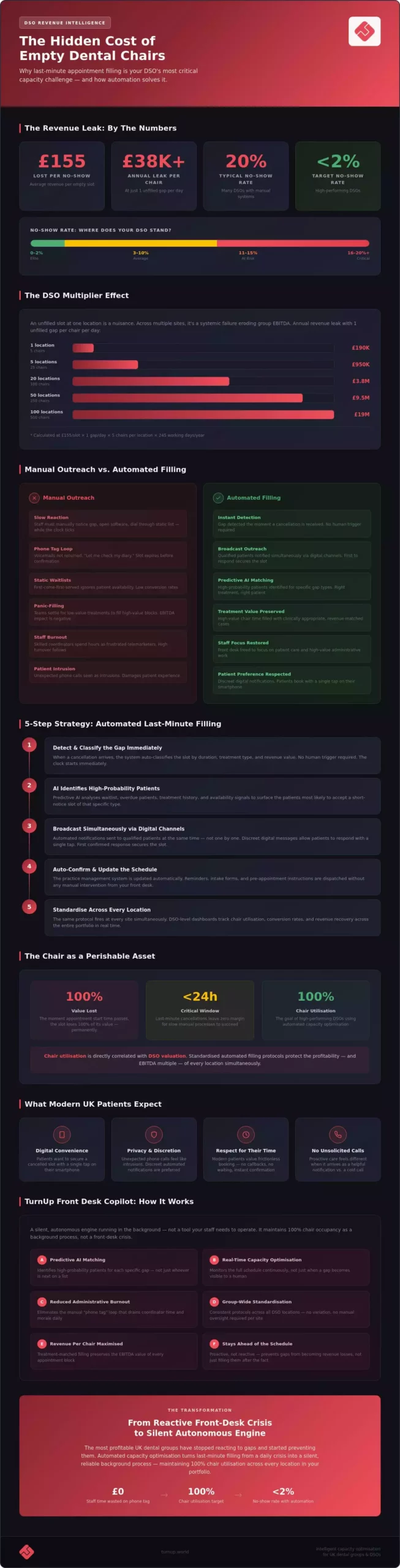
An empty dental chair is more than a scheduling gap. It’s a perishable asset that loses 100% of its value the moment the clock ticks past the appointment start time. Within a busy practice, last minute dental appointment filling isn’t just a receptionist’s chore; it’s a critical capacity management task. When a patient cancels with less than 24 hours’ notice, the financial impact is immediate. Research indicates the average revenue lost per no-show is approximately £155. If your practice averages just one unfilled gap per day, you’re looking at an annual revenue leak of over £38,000 per chair. This isn’t just a minor inconvenience. It’s a systemic drain on your bottom line.
The “last-minute” window is the most volatile segment of your schedule because it leaves zero margin for error. Traditional methods are reactive. They rely on a staff member noticing the gap, opening the practice management software, and manually dialling through a list. This approach is slow, inconsistent, and often fails because it doesn’t account for the speed of modern life. Proactive capacity optimisation replaces this friction with automated precision, ensuring that last minute dental appointment filling becomes a silent, background process rather than a front-desk crisis.
Why Traditional Waitlists Fail
The “first-come, first-served” model is a fallacy. It assumes the person who has been waiting the longest is the one most likely to drop everything for a short-notice opening. In reality, conversion rates for manual waitlists are dismal. Your front desk team ends up playing “phone tag,” leaving voicemails that are never returned. This creates a hidden cost. Every hour your staff spends on unsuccessful outreach is an hour not spent on patient care or higher-value administrative tasks. Manual waitlists are static, but modern schedules are fluid. By the time a receptionist reaches the fifth person on a list, the slot is often already too close to start, making it impossible to fill.
Impact on DSO Profitability
For Dental Service Organisations (DSOs), these inefficiencies don’t just add up; they multiply. An unfilled slot at one location is a nuisance. Across 20, 50, or 100 locations, it’s a systemic failure that erodes group EBITDA. There’s a direct, measurable correlation between chair utilisation and the overall valuation of a dental group. High-performing DSOs aim for no-show rates under 2%, yet many struggle with rates as high as 20% due to antiquated, manual systems. When you standardise automated filling protocols, you protect the profitability of every location simultaneously. Capacity optimisation is the silent engine of dental revenue.
The Phone Tag Trap: Why Manual Outreach Is Obsolete
When a patient cancels, the traditional front desk enters a high-stress loop. The coordinator stops their current task to navigate a “calling tree.” This is the manual era of last minute dental appointment filling. It’s fundamentally inefficient. While AI-driven communication tools like Nexdial have transformed efficiency in other sectors by automating outbound calls, many dental practices still rely on a receptionist identifying a gap and manually dialling through a static list. They reach a voicemail. They dial the second. “Let me check my diary and call you back,” the patient says. The chair stays cold while the clock ticks. This friction creates operational uncertainty that manual systems cannot resolve. By the time a patient finally confirms, the appointment window has often already passed.
This cycle leads to “panic-filling.” To avoid the sight of an empty chair, teams often settle for low-value, short-duration treatments to plug high-value blocks. Filling a gap intended for a complex restorative case with a routine check-up might look like a full calendar, but the EBITDA impact is negative. It’s a compromise your DSO shouldn’t have to make. Beyond the financial loss, there’s a psychological toll. Your patient coordinators are skilled professionals. Forcing them to spend hours each day as frustrated telemarketers leads to rapid burnout and high staff turnover. Transitioning to a specialised capacity optimisation platform eliminates these manual bottlenecks and restores focus to patient care.
The Patient Experience Gap
Modern UK patients value their time and privacy. An unexpected phone call from their dentist is often viewed as an intrusion rather than a service. Contrast this with a discreet, automated notification. Patients prefer digital convenience. They want to secure a cancelled slot with a single tap on their smartphone. Manual texting lacks this seamlessness. It also carries the risk of “notification fatigue” if staff members send individual messages without a coordinated strategy. Professional, automated communication maintains your brand authority and ensures every interaction feels intentional and high-tech.
Data Inaccuracy in Manual Systems
Manual systems rely on human memory and static lists. Traditional practice management software often contains outdated contact details or “ghost” patients who haven’t visited in years. If your waitlist consists of sticky notes or an uncurated spreadsheet, your data is already obsolete. A high-volume DSO requires real-time synchronisation. Manual waitlists are rarely updated as patient circumstances change, leading to wasted effort on outreach that was never going to convert. Effective last minute dental appointment filling requires a live, data-driven approach that knows exactly who is ready to book right now.
A 5-Step Strategy for Automated Last-Minute Filling
Automation isn’t just about sending reminders. It’s a fundamental shift from manual outreach to intelligent broadcasting. By integrating directly with your existing Practice Management Software (PMS), you can transform last minute dental appointment filling into a high-speed, background operation. This 5-step strategy ensures your chairs stay occupied without adding a single task to your front desk’s plate. It replaces the uncertainty of “phone tag” with the precision of data-driven capacity management.
Step 1: Real-Time Gap Detection
The moment a cancellation is logged in your PMS, the clock starts. Manual systems often leave these gaps unnoticed for hours while the team manages in-office patients. An automated solution uses 2-way synchronisation to detect these openings in milliseconds. This eliminates the latency between a patient dropping out and your practice starting the recovery process. Speed is the primary factor in filling short-notice vacancies. If the system doesn’t see the gap instantly, the opportunity to fill it diminishes with every passing minute.
Step 2: Intelligent Patient Selection
Blasting your entire database is a tactical error that leads to high opt-out rates and brand erosion. Effective last minute dental appointment filling requires surgical precision. Use predictive logic to filter patients by treatment type, geographical proximity, and historical reliability. The system identifies those most likely to accept a 2-hour notice based on their previous behaviour. It targets high-probability matches, ensuring your outreach is relevant rather than intrusive. This intelligent selection protects your patient relationships while maximising the chance of a successful booking.
Step 3: Frictionless Booking
Friction is the enemy of conversion. If a patient receives a notification but has to call your office to confirm the slot, you’ve already lost the majority of your leads. Provide a direct “Click to Claim” link in every message. This allows the patient to secure the chair instantly, 24/7, without speaking to a human. Reducing booking clicks by 50% can increase fill rates by 3x. When the process is as simple as a single tap, patients are far more likely to commit to an unplanned visit.
To complete the strategy, Step 4 involves setting parameters for “smart filling.” You define the clinical priority. The system can be configured to prioritise high-value restorative cases or specific emergency needs over routine check-ups. Finally, Step 5 establishes a continuous feedback loop. By analysing which patients accept short-notice gaps, the AI refines its selection engine to improve future accuracy. This creates a self-optimising system that gets more efficient with every filled slot.
Scaling Efficiency: Last-Minute Solutions for DSOs
Fragmented operations are the primary driver of revenue leakage in large dental groups. While a single practice might survive on manual effort, a DSO requires systemic precision. Standardising your last minute dental appointment filling protocols across 20 or 50 locations ensures that every chair produces maximum value. Centralising this process through a specialised platform removes the variability of local staff performance. It transforms a reactive front-desk task into a group-wide strategic asset. To see how systemic automation can protect your group’s EBITDA, explore our capacity optimisation solutions.
DSOs possess a unique advantage: geographic density. If a high-value restorative slot opens in a specific practice location, the system shouldn’t just look at that clinic’s waitlist. It can identify high-probability patients from nearby sister locations who are willing to travel for faster treatment. This cross-site capacity sharing ensures that no chair stays cold simply because one local list is exhausted. You can monitor this group-wide utilisation through a single, unified dashboard, providing real-time visibility into the health of your entire portfolio.
Standardising Operations Across the UK
Consistency is the hallmark of a professional brand. Automated workflows ensure that every patient receives the same high-standard communication, regardless of which clinic they visit. This standardisation also accelerates onboarding. New front-desk staff don’t need weeks of training on complex manual waitlist management; they simply monitor the silent engine of automation. DSO-level data then highlights underperforming chairs, allowing leadership to intervene with data-backed precision. This approach reduces the administrative burden on local teams while ensuring the group’s clinical standards are met across the board. For DSOs looking to build this consistency at a deeper level, standardising procedures across dental clinics provides the architectural framework needed to eliminate the operational friction that kills profitability at scale.
Managing High-Volume Patient Databases
Managing tens of thousands of patient records is impossible for humans to do without error. Automation handles this volume with surgical accuracy. You can segment your group database for targeted campaigns, reaching the right patient at the right time. From a compliance perspective, automated logs provide a transparent audit trail of every communication sent. This ensures your group meets the highest standards of data security and patient privacy regulations. By leveraging automated last minute dental appointment filling, you remove the risk of human error in data handling while maintaining a rigorous, compliant communication strategy.
TurnUp Front Desk Copilot: The Future of Dental Capacity
Operational excellence in a modern DSO requires more than just a full calendar. It requires a resilient system that protects that calendar from the inevitable volatility of patient cancellations. TurnUp Front Desk Copilot is the specialized capacity optimization platform designed to eliminate the uncertainty of last minute dental appointment filling. Unlike generic administrative tools, TurnUp acts as a silent, reliable engine that works in the background. It monitors your schedule with surgical precision, identifying gaps and filling them before they can impact your bottom line. It’s the difference between a reactive practice and a proactive business.
The tangible ROI of an automated capacity strategy is undeniable. If a single unfilled 60-minute slot costs a UK practice £155, a DSO with 20 locations losing just one slot per day per site faces an annual revenue leak exceeding £760,000. TurnUp recovers this lost opportunity by ensuring your chairs remain productive. By automating the outreach process, the platform identifies high-probability patients and secures bookings in minutes. This isn’t just about filling space; it’s about maximizing the EBITDA of your entire portfolio through intelligent, high-tech capacity management.
Beyond Simple Reminders
Basic reminder systems are reactive. They notify a patient of an upcoming appointment but offer no solution when that patient cancels. TurnUp is a “Copilot” because it possesses foresight. It uses predictive scheduling to anticipate no-show risks before they occur, allowing your team to stay ahead of the curve. This proactive energy reduces the pressure on your reception staff. By automating the most stressful and repetitive part of their job, you significantly reduce administrative burnout. Your team can focus on the patients in the building while the AI handles the complexities of the digital waitlist.
Seamless Integration with Your UK Practice
Implementation shouldn’t mean disruption. TurnUp sits directly on top of your existing practice management software, synchronizing data in real-time without requiring a complete workflow overhaul. The “set and forget” nature of the filling engine means that once your parameters are established, the system operates autonomously. It maintains your clinical priorities and brand standards with every message sent. It’s time to transition from manual uncertainty to automated precision. Optimize your practice capacity with TurnUp Front Desk Copilot and ensure every chair in your DSO performs at its peak.
Master Your DSO Capacity Strategy
Relying on manual waitlists and phone calls is a high-risk strategy that guarantees revenue leakage. As we have established, the cost of a single empty chair averages £155 per hour. For a growing DSO, these losses compound across every location, eroding group EBITDA and straining your front-desk teams. Transitioning to an autonomous system for last minute dental appointment filling is no longer a luxury. It’s a requirement for operational survival in a competitive market.
TurnUp Front Desk Copilot provides the silent, reliable engine your group needs to maintain 100% chair utilisation. By leveraging AI-driven predictive scheduling, you can anticipate gaps before they occur and fill them with surgical precision. This platform is specifically built for the UK DSO market, offering a scalable solution that can help top performers achieve no-show rates below 1%. Stop reacting to cancellations and start optimising your capacity with data-driven foresight. It’s time to empower your staff and protect your revenue with the future of dental automation.
Book a demo of the TurnUp Front Desk Copilot today and take control of your practice growth.
Frequently Asked Questions
How does last-minute dental appointment filling software work?
The software uses a live, 2-way sync with your practice management software to detect cancellations the second they occur. It then automatically identifies high-probability patients from your database based on their treatment history and proximity. Instead of making individual phone calls, the system broadcasts the availability to a targeted group, allowing them to claim the slot instantly through a secure link.
Can I fill a dental cancellation in less than 30 minutes?
Yes, speed is the primary advantage of automation. While a receptionist might take 20 minutes to reach three people via phone, an automated broadcast reaches dozens of eligible patients simultaneously. This high-speed outreach significantly increases the chance of securing a replacement for even the tightest scheduling windows, ensuring your chairs don’t stay cold.
Will automated appointment filling annoy my dental patients?
Does TurnUp integrate with my existing dental practice management software?
TurnUp is designed to sit directly on top of your existing PMS without disrupting established clinical workflows. It maintains real-time synchronisation with major platforms to ensure your calendar is always accurate. This “set and forget” integration means your team doesn’t have to learn a new scheduling system; they simply benefit from the automated capacity engine.
How much revenue does a dental practice lose from empty chairs?
In the UK, a single 60-minute empty slot represents a revenue loss of approximately £155. For a typical practice, an average no-show rate of 15% can lead to tens of thousands of pounds in annual leakage. Last minute dental appointment filling is the most effective way to recover this lost opportunity and protect your practice’s EBITDA.
What is the best way to reduce no-shows in a dental group?
The most effective strategy involves moving from reactive reminders to predictive AI. By using a copilot that identifies high-risk patients before they miss their slot, you can intervene early. Combining this with automated filling protocols allows DSOs to maintain occupancy rates above 98%, which is the benchmark for top-performing dental groups.
Can I use automated filling for high-value treatments only?
You have full control over the clinical and financial parameters of the filling engine. The system can be configured to prioritise high-value restorative cases or specific emergency needs over routine check-ups. This ensures that your most profitable chairs are always occupied by the cases that drive the highest revenue for your DSO.
Is TurnUp suitable for large DSOs with multiple locations?
TurnUp is specifically engineered for DSO scalability and group-level management. It allows leadership to standardise capacity protocols across an entire portfolio, ensuring consistency in every clinic. Group leaders can monitor chair utilisation and revenue recovery across all locations through a single, centralised dashboard, providing total visibility into operational efficiency.