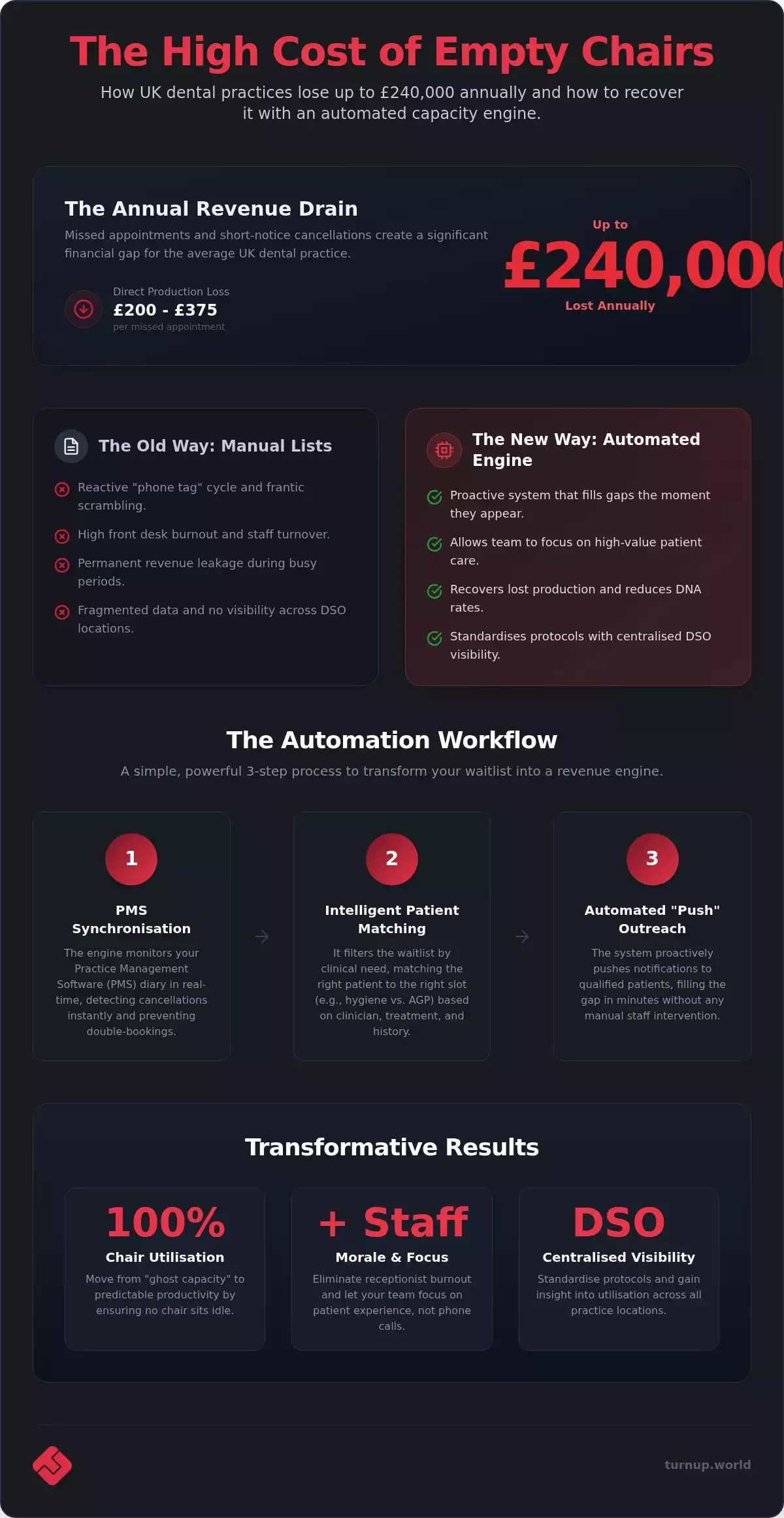
The average UK dental practice loses up to £240,000 every year because of missed appointments and short-notice cancellations. It is a staggering figure that represents more than just idle chair time; it is a direct drain on your team’s morale. You know the routine. A patient cancels at 10:00 am, and your front desk staff spends the next hour frantically scrolling through a paper list, making desperate phone calls. This manual approach is reactive and often fails to fill the gap. Adopting a modern dental appointment waitlist app changes this dynamic by replacing manual labour with surgical precision.
You already understand that every empty slot is a lost opportunity for care. We will show you how to transform your waitlist from a passive document into a proactive, automated revenue engine. It is possible to achieve 100% chair utilisation without burning out your receptionists or losing visibility across multiple DSO locations. This article explores the transition from manual calling to an automated capacity workflow that recovers lost production and restores operational calm. Stop reacting to gaps and start predicting your practice’s productivity.
Key Takeaways
- Stop losing up to £240,000 annually by replacing static paper lists with a proactive capacity engine that fills gaps instantly.
- Eliminate front desk burnout by automating the “phone tag” cycle, allowing your team to focus on patient care rather than manual rebooking.
- Learn why a clinical-first dental appointment waitlist app outperforms generic retail tools by matching patients to specific hygiene or AGP slots.
- Standardise rebooking protocols across all DSO locations to achieve centralised visibility and 100% chair utilisation.
- Deploy the TurnUp Front Desk Copilot as a silent engine to reduce DNA (Did Not Attend) rates and recover lost production.
The High Cost of Static Dental Cancellation Lists
A manual waitlist is where revenue goes to die. It is a passive document in an active, fast-moving business. When a patient cancels, the front desk enters a high-stress “phone tag” cycle. They dial numbers, leave voicemails, and wait for callbacks that rarely arrive in time. This reactive scramble is the opposite of efficiency. In 2026, the average UK practice loses between £105,000 and £240,000 annually to no-shows and short-notice gaps. Each missed appointment represents a direct production loss of £200 to £375. These are not just numbers; they are the financial foundation of your practice eroding in real time.
The psychological toll on clinical teams is equally damaging. Clinicians face the frustration of an empty surgery while knowing patients are waiting weeks for essential treatment. It creates a disjointed rhythm that kills practice momentum. Modern appointment scheduling software has evolved, yet many groups still rely on paper or basic spreadsheets. Relying on a traditional dental appointment waitlist app that lacks automation is simply leaving your capacity to chance. It creates a culture of “ghost capacity” where slots exist but remain unreachable when they are needed most.
Receptionist Burnout and the Manual Burden
Calling ten patients to fill a single 30-minute hygiene slot is a poor use of skilled labour. This administrative friction is a primary driver of staff turnover in dental groups. Your team should be managing patient experiences, not “dialling for dollars.” When rebooking is manual, it is often ignored during busy periods, leading to permanent revenue leakage. Shifting to an automated dental appointment waitlist app removes this burden. It allows the front desk to act as strategic coordinators. They move away from the frustration of manual outreach and towards high-value patient management.
The DSO Profitability Leak
Multi-site organisations face unique challenges with fragmented data. Cancellation lists across 20 or more locations make benchmarking success nearly impossible. Without central visibility, you can’t see the true extent of the vacancy problem. “Ghost capacity” remains hidden because local practices lack the time to report every unfilled gap. An integrated platform provides the data needed to identify which sites are struggling with utilisation. It transforms local practice autonomy into group-wide efficiency. This ensures no chair sits idle across the entire estate, protecting the bottom line of the entire organisation.
Transitioning to an Automated Capacity Engine
A waitlist is a liability; an automated capacity engine is an asset. Most practices view a waitlist as a static storage bin for patient names. This is a fundamental error. To protect your revenue, you must shift from a “list” mindset to a “capacity optimization” mindset. A generic dental appointment waitlist app might store contact details, but it doesn’t solve the vacancy problem. True capacity optimization uses predictive AI to spot high-risk appointments. It anticipates a no-show before the patient even misses the slot by analysing historical data and confirmation patterns.
The core difference lies in the mechanics of outreach. Traditional systems rely on “pull” mechanics. A staff member must remember to check the list and manually dial numbers. This is slow and prone to human error. Automated engines use “push” mechanics. They actively monitor your diary and push notifications to qualified patients the millisecond a gap is detected. It’s a proactive approach that ensures your chairs stay full without requiring constant supervision. You can optimise your practice capacity by letting technology handle the heavy lifting of rebooking.
Step 1: PMS Synchronisation
Your Practice Management Software (PMS) is the source of truth for your business. The engine must monitor this diary in real-time to be effective. If a patient cancels via an automated text or a phone call, the system sees it immediately. Cloud synchronisation ensures that once a slot is filled, it disappears from the offer list across all platforms. This eliminates the risk of double-bookings and ensures your staff always see an accurate schedule. Data integrity is the foundation of a reliable automated workflow.
Step 2: Intelligent Patient Matching
Efficiency requires more than just filling a chair; it requires filling it with the right clinical context. Not all patients are suitable for every opening. The system filters the list by clinician, treatment type, and patient history. By using last minute dental appointment filling logic, you can prioritise high-value procedures like crowns or implants over simple check-ups. This ensures your most profitable surgeries remain active and your clinical resources are used effectively.
Step 3: Frictionless Rebooking
Patient convenience is the final hurdle in the rebooking process. Portals, logins, and complex passwords create abandonment. Modern workflows use “one-click” booking links sent directly via SMS or WhatsApp. The patient simply selects the slot that works for them, and the PMS updates instantly. It’s a frictionless loop that requires zero manual intervention. By removing the barriers to booking, you increase the speed of recovery for every cancelled appointment.
Waitlist App vs. Dental Capacity Platform
Choosing a generic retail tool for a dental surgery is like using a calculator to perform surgery. It is the wrong tool for a high-stakes environment. A standard dental appointment waitlist app might manage a simple queue, but it lacks the clinical intelligence required to manage a modern surgery. Dental capacity platforms are built to distinguish between a 15-minute hygiene check and a 60-minute AGP (Aerosol Generating Procedure) that requires specific ventilation protocols. Generic apps fail because they treat every patient as an identical unit of time. They ignore the complexity of the dental diary.
Data security is another critical differentiator. UK dental practices handle sensitive health data that falls under strict GDPR regulations. A dedicated capacity platform ensures all patient communications are encrypted and compliant with healthcare standards. This is not just about privacy; it is about protecting your professional liability. When scaling to 50 or 100 sites, a “simple” app becomes a security risk. You need a robust system that offers centralised control and enterprise-grade security across your entire estate.
Clinical IQ: Beyond the Name and Number
Efficiency requires surgical precision. A capacity platform uses “Clinical IQ” to match patient needs with specific surgery setups and clinician skills. It doesn’t just find a patient; it finds the right patient for that specific room. For example, it can filter for patients who don’t require specific specialist equipment that might be out of service. It also handles lab-dependent appointments with ease. The system can be configured to only offer short-notice slots to crown or bridge patients once the lab work has been marked as “received” in your records. This prevents the nightmare of a patient arriving for a treatment that cannot proceed.
DSO-Grade Reporting and Visibility
For a multi-site organisation, visibility is the primary challenge. You cannot manage what you cannot see. Centralised dashboards allow group directors to monitor capacity across every location in real time. You can benchmark rebooking speeds and identify which practices are struggling to fill gaps. By implementing DSO operational efficiency software UK, you move from anecdotal evidence to data-driven decision-making. This visibility ensures that “ghost capacity” is eliminated, and every site contributes to the group’s overall growth and profitability.
Standardising Rebooking Across Multi-Site DSOs
Scaling a dental group is a logistical challenge. The tension between local practice autonomy and group-wide efficiency often leads to significant revenue leakage. If each of your 30 practices manages its waitlist differently, you have 30 different levels of productivity. Standardising rebooking protocols ensures that every location operates at peak capacity. A centralised dental appointment waitlist app provides the infrastructure needed to enforce these standards. It moves the organisation from a collection of individual clinics to a unified, high-performing engine.
Success in a multi-site environment depends on measurable data. You must track DNA rates, chair utilisation, and rebooking speed with surgical precision across all locations. If one site fills gaps in minutes while another takes hours, you have identified a training opportunity. Automation removes the variability of human effort. It guarantees that every cancelled slot is offered to the right patient instantly. You can optimise your DSO capacity to eliminate idle chair time across your entire estate.
The Scaling Framework
Consistency is the bedrock of profitability. By standardising procedures across dental clinics, you protect your bottom line during rapid expansion. A unified rebooking protocol ensures a consistent patient experience regardless of the site visited. It also simplifies the integration of newly acquired surgeries. New staff don’t need to learn a bespoke manual system; they simply plug into the existing automated workflow. This reduces the administrative learning curve and ensures new acquisitions contribute to group revenue from day one.
Overcoming Internal Resistance
Front desk teams sometimes fear that automation leads to replacement. Management must address this fear by positioning technology as a support tool. TurnUp acts as a Copilot that handles the repetitive, low-value task of manual calling. This frees your team for high-value patient interactions and complex treatment coordination. You can motivate staff by gamifying rebooking success. Use group-wide leaderboards to reward practices with the lowest DNA rates. When staff see the dental appointment waitlist app as a tool that reduces their burnout, adoption becomes seamless.
Maximising Chair Utilisation with TurnUp Front Desk Copilot
The TurnUp Front Desk Copilot represents the final step in the evolution of practice management. It is not merely a dental appointment waitlist app; it is a sophisticated capacity engine designed for the complexities of modern dentistry. By combining NoShow prevention with LastMinute rebooking, it creates a closed-loop system that protects your revenue. When the system identifies a high-risk appointment, it doesn’t just wait for the failure to occur. It prepares the recovery strategy in advance. This proactive energy transforms the reception workflow from a defensive scramble into a controlled, high-velocity operation.
The real-world impact of this technology is quantifiable. UK practices that deploy the Front Desk Copilot often see their DNA rates drop to under 5%. In an industry where a single missed appointment represents a production loss of up to £375, the return on investment is immediate. Filling just one additional hygiene gap per day can generate thousands of pounds in recovered revenue each month. This isn’t about replacing your team. It is about empowering them with a tool that eliminates the most draining part of their job.
The TurnUp Advantage
Success starts with a fundamental shift in strategy. Understanding how can a dental group reduce no-shows requires more than just sending basic text reminders. It requires predictive analytics that forecast cancellation risks based on patient history and behavioural patterns. TurnUp provides this foresight, allowing you to stay ahead of the curve. The platform offers seamless integration with major UK Dental PMS systems, ensuring that your data remains synchronised and your diary stays accurate. It acts as a silent, reliable engine that runs 24/7, even when your practices are closed.
Next Steps for Your DSO
The first step toward 100% chair utilisation is a thorough audit of your current cancellation process. Identify where the leaks are happening and how much “ghost capacity” is currently costing your group. Transitioning from a static list to a high-velocity rebooking engine is a strategic move that future-proofs your business against economic uncertainty. You can move beyond the limitations of a basic dental appointment waitlist app and take full control of your clinical capacity. Book a bespoke capacity optimization demo to see how the Front Desk Copilot can transform your DSO’s profitability and team morale.
Eliminate Idle Chair Time and Secure Your Revenue
The shift from manual lists to automated capacity is no longer optional for high-growth DSOs. You’ve seen how static documents drain productivity and how clinical intelligence prevents the “phone tag” trap. By standardising rebooking protocols, you transform fragmented sites into a unified revenue engine. A modern dental appointment waitlist app provides the foundation; true profitability comes from a proactive capacity engine that identifies gaps before they occur.
TurnUp World offers specialised NoShow prevention for DSOs and a Front Desk Copilot designed for surgical precision. With UK-wide national support, you can deploy these tools across your entire estate to ensure 100% chair utilisation. It’s time to stop reacting to cancellations and start predicting your practice’s success. Optimise your dental group’s capacity with TurnUp World and empower your team with the silence of a reliable, automated workflow. Your clinical future is automated, efficient, and fully booked.
Frequently Asked Questions
What is the difference between a dental waitlist and a short-notice cancellation list?
A waitlist is a general log of patients needing future treatment, whereas a short-notice cancellation list is a high-velocity recovery tool for gaps within 48 hours. The former is a long-term scheduling aid. The latter is a direct revenue protection mechanism. Using an automated dental appointment waitlist app allows your practice to move beyond static logs and actively target patients who can arrive at the surgery on short notice.
How does automated rebooking software integrate with my current PMS?
The Front Desk Copilot integrates directly with major UK Practice Management Systems through secure API connections or cloud synchronisation. This ensures the engine monitors your diary in real-time without manual data entry. When a slot opens in your PMS, the automation triggers outreach instantly. Once a patient claims the slot, the system updates your main schedule automatically. This eliminates double-bookings and maintains total data integrity across your DSO estate.
Is a dental appointment waitlist app GDPR compliant for UK practices?
Yes, the platform is fully GDPR compliant and designed specifically for the UK healthcare regulatory environment. All patient data is encrypted both in transit and at rest using enterprise-grade security protocols. We ensure that patient communication remains private and secure, protecting your professional liability. Unlike generic retail tools, this dental appointment waitlist app treats clinical data with the required sensitivity and follows strict Information Governance standards.
Can patients opt-out of automated short-notice appointment alerts?
Patients have full control over their communication preferences and can opt-out of automated alerts at any time. Every SMS or WhatsApp notification includes a clear, simple mechanism for unsubscribing. Respecting patient choice is a core component of maintaining a positive patient journey. The system tracks these preferences automatically. This ensures your front desk staff never inadvertently contact a patient who has requested to be removed from the short-notice list.
How much revenue can a DSO save by automating their cancellation list?
DSOs can recover between £105,000 and £240,000 in lost annual production per practice by automating their cancellation lists. For a group with 20 locations, this represents a multi-million-pound revenue protection strategy. By reducing DNA rates from the industry average of 15% to under 5%, the software pays for itself by filling just one or two hygiene gaps per month. It transforms idle chair time into predictable, recovered production. To evaluate which solution delivers the best results for your group, review our best software to prevent no-shows comparison guide for 2026.
Does the software differentiate between NHS and Private dental appointments?
The software distinguishes between NHS and Private appointments to ensure clinical and financial targets are met. You can configure the engine to prioritise Private treatments for high-value surgery slots or target NHS patients to meet contract delivery requirements. This clinical IQ allows your DSO to manage complex mixed-mode diaries with surgical precision. It ensures that the right patient is matched to the right appointment type automatically.
How long does it take to implement TurnUp Front Desk Copilot across multiple sites?
Implementation across multiple sites typically takes between two to four weeks, depending on the scale of your DSO. The process is designed for minimal operational disruption. We handle the technical integration and provide remote training for your front desk teams. Because the Front Desk Copilot acts as a silent engine, your staff can begin seeing results in chair utilisation almost immediately after the initial synchronisation is complete.
Can we prioritise certain patients, like those mid-treatment, on the automated list?
Yes, the system allows you to prioritise specific patient cohorts, such as those mid-treatment or those requiring urgent follow-ups. You can set intelligent rules that filter the waitlist based on clinical priority or treatment value. This ensures that a cancelled slot is offered to a patient needing a crown fit or implant check before it is offered for a routine examination. It maximises both clinical outcomes and surgery revenue.