If automated dental appointment reminders actually solved the no-show problem, your chairs would stay full. They don’t. Most practice leaders believe that a scheduled SMS is the final safeguard for their production time. It’s a logical assumption, but it ignores a critical reality: reminders only remind the reliable. They don’t change the behaviour of high-risk patients who are already likely to fail to attend. Passive notifications are a baseline, not a strategy for growth.
We understand the frustration of watching gaps appear in the diary despite having automation in place. It leads to front-desk burnout and inconsistent utilisation across your sites. This article explains why standard reminder workflows fail to prevent no-shows and how you can transition to a proactive capacity optimisation strategy. You’ll learn how to identify no-show risks before they happen and use intelligent automation to recover lost time. We’ll outline a framework for protecting your schedule without the need for a PMS migration, ensuring your team can focus on patients rather than manual cancellation recovery.
Key Takeaways
- Recognise why standard automated dental appointment reminders act as a baseline communication tool rather than a comprehensive strategy for protecting production time.
- Transition from reactive scheduling to predictive capacity management by identifying potential no-shows up to 48 hours before the chair goes cold.
- Evaluate the performance gap between passive SMS notifications and personal AI calls for securing high-value clinical appointments.
- Master a four-step automated recovery workflow to detect, match, and refill short-notice cancellations from your waitlist without manual intervention.
The Reminder Myth: Why Sending Notifications Isn’t the Same as Protecting Production
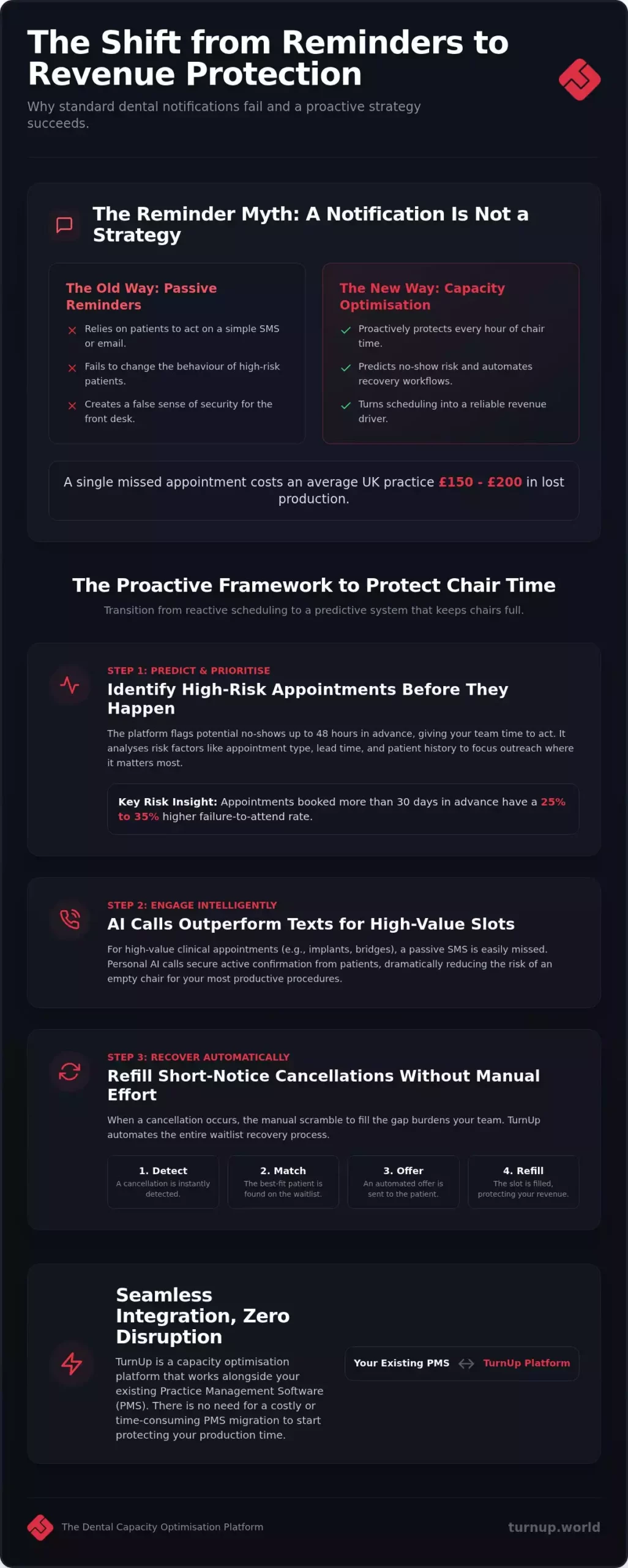
Many practices treat appointment scheduling software as a set and forget solution. They assume that sending a text message is equivalent to securing a chair. It isn’t. Standard automated dental appointment reminders are a baseline communication tool, not a robust no-show prevention strategy. There is a vast financial difference between a patient receiving a notification and a patient actually attending. One is a digital interaction; the other is captured revenue. A single missed appointment costs an average UK practice between £150 and £200 in lost production, and understanding the true cost of an empty dental chair per hour reveals just how quickly these losses compound across your schedule. Passive reminders don’t stop that loss.
The Difference Between a Notification and a Capacity Strategy
Notifications inform patients of a date and time. Strategies ensure that time remains productive. Relying on SMS alone creates a false sense of security for front-desk teams. They see the sent status and assume the slot is safe. Capacity optimisation is a proactive approach to keeping every dental chair filled by predicting risks and recovering lost time. It works alongside your existing software, so it doesn’t require a PMS migration. You can learn more about maximising dental practice operational efficiency through capacity optimisation to understand this shift from communication to protection.
Why Traditional Reminders Only Capture Low-Hanging Fruit
Traditional reminders typically reach the reliable patients who’ve turned up anyway. They make the process easier for the patient but don’t change high-risk behaviour. The silent no-show remains the biggest threat to your daily revenue. These are the unconfirmed slots that stay empty because the reminder was ignored. Standard workflows fail to address the underlying causes of idle chair time because they’re reactive. TurnUp changes this by predicting which automated dental appointment reminders will be ignored before the patient fails to show.
Predictive Intelligence: Identifying High-Risk Appointments Before the Chair Goes Cold
Standard automated dental appointment reminders react to patient input. If a patient fails to reply, your team only discovers the problem when the chair stays empty. TurnUp Front Desk Copilot shifts your operations from reactive scheduling to predictive capacity management. By using data-driven insights, the platform flags potential no-shows 48 hours in advance. This foresight gives DSO executives and practice leaders group-level visibility into appointment risk across multiple locations. You can see where gaps are likely to appear before they impact your daily production.
The Anatomy of a High-Risk Appointment
Not every slot on your diary carries the same level of risk. A routine check-up booked last week is statistically safer than a complex treatment scheduled months ago. Factors such as appointment type, lead time, and historical patient behaviour dictate the probability of a failed to attend (FTA) event. Research shows that appointments scheduled more than 30 days in advance have a significantly higher no-show rate, often between 25% and 35%. A 3-unit bridge represents a high-value clinical slot that requires a different confirmation workflow than a simple scale and polish. Identifying these nuances allows you to protect your most valuable chair time.
Prioritising Front-Desk Effort Through Risk Scoring
Skilled reception teams shouldn’t spend their day calling every patient on the list. It’s an inefficient use of resources that leads to burnout. TurnUp provides a risk score for every appointment, allowing your team to focus their outreach on the slots most likely to go cold. This targeted approach means automation handles the reliable patients whilst your staff intervenes where it matters most. By optimising your scheduling capacity through risk scoring, you reduce the administrative burden and ensure your team spends more time on in-practice patient care. It’s about working smarter, not harder, to keep your chairs filled.
The SMS Trap: Why AI Calls Outperform Texting for High-Value Clinical Slots
Standard automated dental appointment reminders rely almost exclusively on SMS. Whilst convenient, a text message is easily swiped away or buried amongst personal notifications. For high-value clinical slots, such as implants or complex restorative work, this passive approach is inherently risky. A text lacks the urgency and psychological weight needed to secure a patient’s commitment. If the patient doesn’t reply, the chair remains at risk until the very last minute. To strengthen these touchpoints, many practices utilise platforms like Answer Strong to automate phone calls and texts, ensuring a more persistent and reliable confirmation process.
Verbal vs Digital: The Psychology of Appointment Commitment
Patients are statistically more likely to attend when they have “spoken” to the practice. A verbal interaction creates a social contract that digital notifications cannot replicate. AI calls bridge the gap between manual reception outreach and cold automation. By using TurnUp’s AI Call Centre, you provide a personal touchpoint that feels urgent and professional. The system handles confirmations, cancellations, and rebooking without human intervention, ensuring your high-stakes slots are protected by more than just a character count. For practices needing comprehensive support across all incoming enquiries, you can check out Aglaé By ClicFone.
Manual confirmation calls are a primary driver of front-desk burnout. Staff spend hours playing “phone tag,” leaving voicemails that are rarely returned. TurnUp eliminates this administrative burden by letting AI handle the initial outreach. Your team only steps in when a complex clinical conversation is required. This keeps your brand voice consistent whilst automating thousands of patient interactions across your group. To see how this works in practice, you can explore our AI call centre solutions to reclaim your team’s time. Moving beyond simple automated dental appointment reminders allows your staff to focus on the patients physically present in the clinic.
The Manual Waitlist Burden: How to Recover Lost Chair Time Without Effort
Standard automated dental appointment reminders often conclude their workflow the moment a patient cancels. If a patient replies “No” to a text, the notification system logs the response and stops. This leaves a gap in your diary that requires immediate manual intervention to fill. TurnUp Front Desk Copilot eliminates this administrative burden by automating the recovery process. Our four-step workflow (Detect, Match, Invite, and Fill) ensures that lost production time is reclaimed in minutes, not hours.
Instant Waitlist Matching for Short-Notice Gaps
Matching a cancelled high-value treatment with the right patient from a manual waitlist is a poor use of clinical capacity. It often leads to “panic-filling” with low-value check-ups just to keep the chair warm. When you consider the cost of an empty dental chair per hour against your fixed overheads, the urgency of intelligent waitlist matching becomes clear. TurnUp matches gaps based on treatment type and clinical value. When a slot opens, the platform identifies suitable patients and sends targeted invitations automatically. This speed is essential; filling a cancellation in minutes prevents the chain reaction of lost revenue that occurs when the front desk is too busy to make recovery calls.
Seamless PMS Integration: No Migration Required
You don’t need to replace your current software to gain advanced capacity tools. TurnUp acts as an intelligence layer that sits atop your existing practice management system. There is no PMS migration required. This allows multi-site groups and DSOs to deploy sophisticated automated dental appointment reminders and recovery workflows whilst maintaining their established clinical records. By adding foresight to your current setup, you protect your production without the operational upheaval of a software transition. This proactive approach ensures your scheduling operations remain efficient, scalable, and focused on maximised chair utilisation.
Secure Your Production with Predictive Capacity Optimisation
Relying on automated dental appointment reminders is a reactive approach that leaves your production vulnerable to high-risk patient behaviour. True operational efficiency requires moving beyond simple notifications toward a data-driven capacity strategy. By identifying no-show risks 48 hours in advance and using AI calls to secure verbal commitment, you protect your most valuable clinical slots. When cancellations do occur, automated waitlist matching ensures your chairs stay filled without adding to front-desk burnout.
TurnUp provides the intelligence layer your practice needs to eliminate operational uncertainty. Our platform is specialised for multi-site DSOs, offering group-level visibility into schedule capacity. Because there’s no PMS migration required, you can start recovering lost production time immediately. It’s time to stop reacting to empty chairs and start predicting your success.
Optimise your chair utilisation with TurnUp Front Desk Copilot and take control of your schedule today. Your team deserves a workflow that works as hard as they do.
Frequently Asked Questions
Do automated dental appointment reminders actually reduce no-shows?
Yes, they provide a baseline reduction by helping reliable patients remember their slots, but they don’t solve the core problem of high-risk behaviour. Research indicates that dental no-show rates typically sit between 10% and 20% even with automation. Whilst standard automated dental appointment reminders are a necessary communication tool, they are passive. They don’t predict which patients will ignore them, meaning gaps still appear in your diary without proactive intervention.
Can I use AI calls for patient confirmations without sounding robotic?
Yes, modern AI call centres use sophisticated natural language processing to deliver professional and human-like verbal interactions. These calls feel personal and urgent to patients, which creates a stronger sense of commitment than a text message. By automating the confirmation and rebooking process through TurnUp, you maintain your brand voice whilst reducing the administrative burden on your front-desk team. It ensures high-value slots are confirmed through meaningful interaction.
How does capacity optimisation software integrate with my existing dental PMS?
TurnUp acts as an intelligence layer that sits alongside your existing practice management system rather than replacing it. There is no PMS migration required to gain these advanced capacity tools. The software syncs with your current diary to predict no-show risks and automate recovery workflows. This seamless integration allows multi-site DSOs to improve visibility and chair utilisation without the operational disruption of a full software transition.
What is the difference between a standard reminder and a predictive confirmation?
Standard automated dental appointment reminders are sent to every patient regardless of their history or appointment type. In contrast, predictive confirmations use AI to identify high-risk appointments up to 48 hours in advance. This allows your team to prioritise outreach for slots most likely to go cold. It moves your operations from reactive scheduling to proactive capacity management, ensuring your most valuable clinical time is protected by data-driven foresight.
Is it possible to automate the recovery of last-minute dental cancellations?
Yes, automated waitlist management can refill short-notice gaps in minutes. When a cancellation is detected, the platform matches the slot with a suitable patient from your waitlist based on treatment type and clinical value. It then sends an automated invitation to fill the gap. This four-step recovery workflow (Detect, Match, Invite, and Fill) ensures your chairs stay productive without requiring manual phone calls from your reception team.