A typical dental practice loses between £105,000 and £240,000 every year simply because patients fail to attend or cancel at the last minute. When you factor in fixed overheads and lost clinical production, the cost of an empty dental chair per hour is often significantly higher than most principals realise. It’s a common frustration; profit margins are eroding despite high patient demand, leaving front desk teams overwhelmed by manual call lists and inaccurate utilisation reports. You know the chairs should be full, but the data doesn’t always show the true story.
This article provides the precise formula you need to quantify these losses and present a clear business case to your stakeholders. You’ll discover how to establish Revenue Per Hour (RPH) benchmarks and implement a strategy that moves your operations from reactive fire-fighting to proactive capacity optimisation. We’ll explore how TurnUp World works alongside your existing PMS to protect your most expensive asset, recovering lost production time through intelligent automation rather than generic reminders.
Key Takeaways
- Quantify the true financial impact of idle time by using a structured formula to calculate the cost of an empty dental chair per hour based on fixed overheads and lost clinical production.
- Understand the DSO multiplier effect; small gains in chair utilisation across multiple sites scale into significant revenue recovery for dental groups.
- Transition from reactive scheduling to proactive capacity optimisation by using predictive AI to identify high-risk appointments and automate short-notice cancellation recovery.
- Protect your clinical capacity without the friction of a PMS migration; modern optimisation platforms integrate directly with your current systems to refill gaps automatically.
The Anatomy of an Empty Dental Chair in 2026
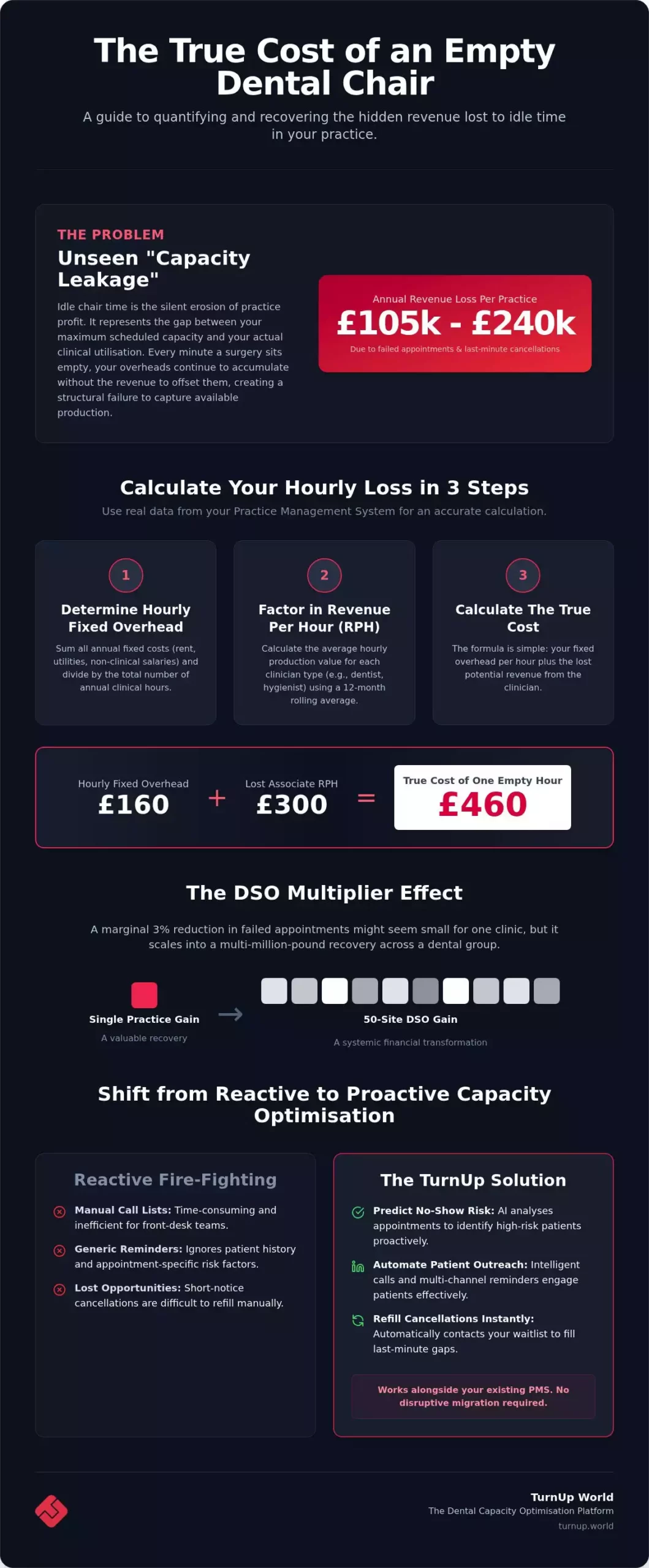
Idle chair time is the silent erosion of practice profit. It represents the gap between your maximum scheduled capacity and your actual clinical utilisation. In 2026, many practices operate under the illusion of being busy, yet they suffer from Capacity Leakage. This is the primary enemy of practice profitability. It isn’t just a scheduling error; it’s a structural failure to capture available production. Every minute a surgery sits empty, your overheads continue to accumulate without the revenue to offset them.
Beyond the balance sheet, empty chairs damage team morale. Clinicians and nurses lose their rhythm and focus. High-performing staff often leave practices where the schedule is erratic, preferring the stability of a well-optimised operation. Maintaining a full diary isn’t just about the money; it’s about staff retention and operational flow.
Fixed vs Variable Costs: The Hidden Penalty
When a patient fails to attend (FTA), your variable costs like dental materials or anaesthetic are technically saved. However, these savings are negligible. Your fixed costs, including rent, business rates, utilities, and non-clinical salaries, create a constant burn rate. You must understand the economic principle of opportunity cost to truly value this time. The Sunk Cost of the Surgery is the hourly overhead required to keep the doors open regardless of patient presence. This directly impacts the cost of an empty dental chair per hour because those overheads are now unrecovered and must be subsidised by other appointments.
The Patient Attrition Factor
Gaps in the diary don’t just lose money today; they compromise tomorrow. When chairs sit idle, other patients wait longer for appointments. This creates a bottleneck that drives patients towards competitors. A poorly managed diary often results in unbooked follow-ups and lost restorative work that would have been diagnosed during that missed slot. It’s a compounding loss that destabilises the practice’s long-term growth and patient loyalty.
Calculating Your Hourly Loss: A 3-Step Formula
Relying on monthly averages obscures the immediate financial damage caused by a gap in the diary. To improve dental practice operational efficiency, you must transition to hourly metrics. This granular visibility allows you to see the true cost of an empty dental chair per hour as it happens. Use real data from your Practice Management System (PMS) rather than industry generalisations to ensure your calculations reflect your specific clinical reality.
Step 1: Determine Your Hourly Fixed Overhead
Your fixed overhead includes every expense that persists regardless of patient volume. Sum your annual rent, business rates, utilities, and non-clinical staff salaries. Divide this total by the number of hours your surgeries are clinically active each year. When assessing your average dental practice overhead, remember to include facility maintenance and software subscriptions to find your baseline burn rate. This figure represents the fundamental component of the cost of an empty dental chair per hour before a single clinician begins treatment.
Step 2: Factor in Revenue Per Hour (RPH)
Calculate the RPH for each clinician type separately. Associates, hygienists, and specialists have vastly different production values. Use a 12-month rolling average to smooth out seasonal fluctuations and account for varying treatment complexities. This ensures that your valuation of lost time is accurate, whether the missed slot was a routine scale and polish or a complex restorative case.
Step 3: The Final Calculation
The formula is straightforward: (Hourly Fixed Overhead + Lost RPH) = True Cost of an Empty Chair.
Consider a 2026 UK benchmark. If your surgery has an hourly fixed overhead of £160 and your Associate’s average RPH is £300, a single FTA represents a loss of £460 for that hour. This calculation exposes the high stakes of idle time. To stop this leakage, you need more than simple reminders; you need a system that identifies risk and refills gaps automatically. You can optimise your capacity today by integrating the intelligence layer from TurnUp World into your existing workflow without the need for a PMS migration.
The DSO Multiplier: Scaling Capacity Leakage Across Groups
For a single practice, an empty chair is a financial leak. For a 50-site DSO, it’s a systemic crisis. A 3% reduction in failed appointments at one clinic might seem marginal. Scaled across an entire group, that same 3% represents a multi-million pound recovery of lost production. Centralised scheduling teams often lack the real-time visibility needed to manage group-wide chair utilisation effectively. Without a unified view, the cost of an empty dental chair per hour remains an unquantified drain on the group balance sheet that compounds every day.
Capacity Leakage as a KPI
Capacity Leakage is the percentage of available clinical hours lost to schedule gaps and FTAs. It’s the definitive metric for operational health. Standardising RPH across all sites allows for objective performance reviews and identifies which workflows need intervention. This approach enables operations leaders to move away from anecdotal evidence and towards data-driven decision-making. TurnUp World delivers this visibility through DSO-level dashboards. It integrates with each local PMS to provide a single source of truth for group-wide capacity without the friction of a data migration, allowing for immediate performance comparisons across different regions.
The EBITDA Impact of Recovered Time
Recovering just 30 minutes of chair time per day per surgery provides a direct boost to annual EBITDA. This strategy is far more efficient than increasing marketing spend for new patient acquisition. You’re extracting more value from the capacity you already have. By focusing on recovered time, you improve the valuation of the entire organisation whilst protecting the clinical chair as your most expensive asset. Optimise your group capacity in real-time with TurnUp World to stop production leakage and improve operational efficiency across your entire estate.
Beyond Reminders: Proactive Strategies to Protect Chair Time
By 2026, the industry has realised that automated dental appointment reminders are no longer sufficient to secure a diary. Whilst reminders nudge reliable patients, they do little to influence the behaviour of high-risk individuals who contribute to the 15% to 20% average no-show rate. Relying on passive notifications leaves you vulnerable to the high cost of an empty dental chair per hour. You need a proactive intelligence layer that predicts scheduling failure before it occurs.
Predictive AI identifies high-risk appointments by analysing historical patient behaviour. Instead of treating every booking with the same generic sequence, the system flags those most likely to result in an FTA. AI call centres then step in to handle confirmations and rebookings through natural conversation. This eliminates front-desk burnout and ensures that your team focuses on in-practice care rather than chasing manual call lists. It is the necessary transition from reactive scheduling to automated capacity protection.
Automating the Recovery Workflow
When a cancellation is confirmed, the manual process of calling a waitlist is often too slow to be effective. TurnUp World automates this recovery by instantly matching the gap with the most suitable patient on your digital waitlist. It prioritises high-value matching, ensuring that restorative or complex cases take precedence for last-minute openings. This precision recovery protects your RPH and ensures that no clinical minute is wasted. It turns a potential loss into a recovered production opportunity within seconds, keeping the cost of an empty dental chair per hour to an absolute minimum.
Implementation Without PMS Migration
Operational leaders often fear the disruption of switching software. Modern capacity optimisation tools solve this by working as an intelligence layer over your existing systems. TurnUp World integrates directly with your current PMS, requiring no data migration or staff retraining on new clinical software. For multi-site organisations, this allows for rapid deployment across the entire estate. You can start protecting your clinical chairs and recovering lost production time within days. It is the most efficient way to scale operational excellence without technical friction.
Master Your Clinical Capacity
Calculating the cost of an empty dental chair per hour is the first step toward true operational control. By quantifying the burn rate of your fixed overheads and the lost production from missed appointments, you move from guesswork to data-driven leadership. You have seen how these figures scale across a DSO, where even small improvements in chair utilisation deliver significant EBITDA growth. The solution isn’t more reminders; it’s a proactive intelligence layer that predicts risk and automates recovery.
TurnUp World provides the foresight needed to protect your most expensive asset. Our predictive AI identifies high-risk FTAs before they happen, whilst automated waitlist matching fills gaps in minutes. Because it’s a PMS-agnostic integration, you can achieve a rapid rollout across your entire group without the friction of a data migration. It’s time to stop reacting to cancellations and start anticipating them. Book a TurnUp World demo to see how much capacity your group could recover and take command of your schedule today. You have the tools to turn idle time into productive growth.
Frequently Asked Questions
What is the average cost of an empty dental chair per hour in the UK?
The average cost of an empty dental chair per hour is the sum of unrecovered fixed overheads and lost clinical production. For a typical UK associate surgery, this figure often exceeds £400 when you factor in rent, non-clinical staff, and utilities. Because these costs remain constant whether the chair is occupied or not, every missed slot represents a pure loss that directly erodes the practice’s monthly profit margins.
How does an empty chair impact the EBITDA of a dental group?
Empty chairs have a disproportionate impact on EBITDA because dental practices have high fixed-cost structures. Every hour of lost production time removes high-margin revenue that would otherwise flow directly to the bottom line. For a multi-site DSO, these losses compound across dozens of locations. Recovering just a small percentage of this lost capacity can significantly increase the group’s overall valuation and operational efficiency without increasing marketing spend. This enhanced profitability is a key metric used by Healthcare Biz Brokers, Inc. when determining the true market value of a dental group during a sale or acquisition.
Why are traditional SMS reminders failing to prevent empty chairs?
Traditional SMS reminders are passive tools that fail to address the underlying reasons for patient no-shows. They don’t identify high-risk behaviour or provide a mechanism to refill the gap instantly. Whilst a reminder might nudge a reliable patient, it cannot predict an FTA or automate the recovery workflow. Modern capacity optimisation requires an intelligence layer that identifies risk and manages waitlists through active, automated outreach rather than simple notifications.
What is the difference between a no-show and capacity leakage?
A no-show is a specific instance where a patient fails to attend a scheduled appointment. Capacity leakage is a broader operational KPI that measures the total percentage of clinical hours lost to all gaps, including FTAs and unbooked slots. Whilst no-shows are a primary cause, capacity leakage accounts for the entire structural failure to utilise available surgery time, providing a more accurate reflection of a dental group’s true performance.
How can AI help fill last-minute dental appointment cancellations?
AI helps by predicting which appointments are at high risk of failing before the patient actually cancels. This foresight allows the system to initiate automated outreach through AI call centres to confirm or rebook. When a gap does occur, AI-driven waitlist matching identifies the most suitable patient to fill the slot based on treatment value and clinical requirements, refilling the chair in minutes without manual intervention from the front desk.