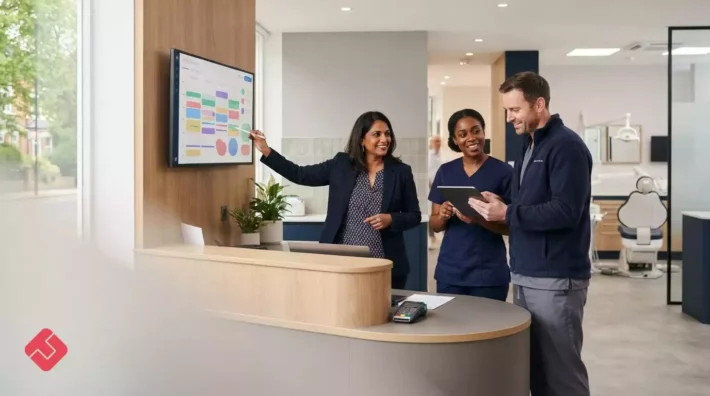
With front desk turnover in dental practices now exceeding 40% annually, the cost of manual admin is no longer just a line item. It’s a structural risk to your DSO. Recruiting and training a single new employee can cost up to £8,000; yet most groups still rely on overwhelmed staff to manually chase short-notice cancellations. You know the frustration of watching a high-value chair sit empty because a staff member was too busy with repetitive paperwork to fill the gap. It’s an inefficient cycle that drains revenue and burns out your best people.
We agree that your front-of-house team should be focused on patient experience, not fighting a losing battle against the calendar. This guide reveals how automating dental front desk workflows with predictive technology can transform your operations from a manual bottleneck into a high-performance capacity engine. You’ll learn how to standardised workflows across every site in your group while maximising chair utilisation through automated gap-filling. We will examine the 2026 DSO blueprint for reducing administrative overhead and ensuring your clinical hours are never wasted.
Key Takeaways
- Reframe the front desk as a capacity engine to proactively stop the revenue leaks caused by manual task management.
- Implement a five-step operational audit for automating dental front desk workflows to reclaim clinical hours lost to administrative friction.
- Replace reactive gap-filling with predictive NoShow prevention that flags high-risk appointments before they impact your daily schedule.
- Establish a standardised single source of truth for capacity across your DSO to ensure consistent operational performance at every location.
- Deploy the TurnUp World Front Desk Copilot to automate last-minute cancellations and empower your staff with surgical precision.
Beyond the Busywork: Why Automating Dental Front Desk Workflows is a Capacity Challenge
Traditional dental management views the front desk as an administrative cost centre. This is a strategic error. In the high-stakes environment of a 2026 UK DSO, your front-of-house team must be redefined as a “Capacity Engine.” While your clinicians focus on clinical outcomes, the desk controls the most valuable asset you have: time. When you neglect automating dental front desk workflows, you aren’t just making staff work harder. You’re allowing revenue to leak through every unfilled gap in the diary.
The 2026 reality is stark. With front desk turnover exceeding 40% and recruitment costs climbing, manual scheduling has become a liability. A manual workflow relies on human memory and reactive effort to fill chairs. This creates a “Hidden Leak” where clinical time is lost because staff were too busy answering basic enquiries to chase a cancellation. To scale successfully, groups must distinguish between clinical efficiency in the surgery and operational efficiency at the desk. One provides the care; the other ensures there is a patient in the chair to receive it.
The True Cost of Manual Task Management
Manual admin is an expensive distraction. When a receptionist earning a competitive UK wage spends hours on low-value data entry, the ROI of that role plummets. More importantly, the mental load of “task-switching” between phone calls, patient check-ins, and insurance verification leads to critical scheduling errors. Research suggests front desks field up to 60 messages a day. Without automation, the probability of a high-value appointment slipping through the cracks increases exponentially. You can read more about balancing these demands in our guide on clinical efficiency vs operational efficiency in dentistry.
Most groups rely on standard dental practice management software to record data. However, these systems often act as passive repositories rather than active tools. They tell you a patient cancelled; they don’t fill the slot for you. This distinction is where many DSOs fail to see the true cost of their manual processes. It’s the difference between having a map and having a driver.
Capacity Optimisation vs. Simple Task Automation
True progress requires moving beyond simple task automation. Sending a generic SMS reminder is a task. Capacity optimisation is the proactive management of provider time to ensure maximum utilisation. It’s the difference between working faster and working smarter. Traditional streamlining focuses on doing the same manual tasks in less time. In contrast, automating dental front desk workflows through a “Front Desk Copilot” model eliminates the need for those tasks entirely. This technology acts as a bridge. It turns administrative noise into predictable revenue by identifying and filling gaps before they even occur.
The 5-Step Workflow Audit: Identifying Operational Leaks
Before you begin automating dental front desk workflows, you must identify where your current system is bleeding revenue. Most DSOs operate with invisible inefficiencies. These “operational leaks” often hide behind a veneer of staff being “busy.” However, being busy isn’t the same as being productive. A truly efficient practice measures output in chair utilisation, not the number of phone calls answered.
Start by mapping the patient journey from the first digital enquiry to the final post-operative follow-up. Every manual touchpoint is a potential point of failure. If your staff spends 15 minutes manually validating insurance or making three phone calls to confirm a single check-up, you’ve already lost the battle for capacity. Quantify your “Dead Time.” These are the clinical minutes lost when a receptionist is tethered to a desk phone instead of managing the patient experience. In 2026, 58% of practices have already moved toward automation. If you haven’t, you’re competing with groups that have reclaimed hours of staff time every week.
Mapping and Quantifying the Administrative Load
Perform a “Time-Motion Study” over a standard 48-hour period. Record every repetitive task your front-of-house (FOH) team performs. You’ll likely find three primary “Time Thieves”: insurance verification, manual appointment reminders, and the frantic attempt to fill last-minute gaps. These tasks are repetitive and prone to human error. Use the dental practice efficiency audit to benchmark your current results against industry standards. It’s the first step toward reclaiming your team’s focus and reducing staff burnout.
Tech Evaluation and Friction Removal
Implementing robust dental office management tips requires a tech stack that works for you, not against you. Calculate the ROI of change. If your DSO has 10 sites and each site loses just two hours of chair time a week to manual admin, that’s nearly £100,000 in lost annual revenue across the group. Identifying these leaks is the only way to justify the shift to a capacity-first operations model.
Transitioning from Reactive Scheduling to Predictive Capacity Management
Most DSOs operate in a state of constant reaction. A cancellation occurs, and the front desk team immediately shifts into crisis mode. They scramble to consult a manual “short-notice list” or a dog-eared notebook, hoping to find a patient who can arrive in thirty minutes. This reactive cycle is the primary cause of idle chair time. It relies on luck rather than logic. By automating dental front desk workflows, you transition from “chasing” gaps to predicting them, ensuring your clinical diary remains stable regardless of patient volatility.
Predictive capacity management uses data to identify risks before they manifest as empty chairs. Instead of waiting for a no-show, the system analyses patient history and adherence patterns. It flags high-risk appointments and initiates automated outreach to confirm or re-allocate the slot. This shift removes the burden of “cold calling” from your staff, allowing them to focus on the patients currently in the building. It turns a chaotic administrative hurdle into a silent, reliable revenue engine.
The Failure of Manual Cancellation Lists
Manual lists are inherently flawed because they are always 24 hours behind the clinical reality. By the time a receptionist has a moment to pick up the phone, the opportunity to fill a morning gap has often passed. There is also a significant psychological burden on staff when they are forced to plead with patients to fill slots. It’s a low-value activity that leads to frustration and burnout. Automated gap filling recovers this lost revenue without human intervention, identifying eligible patients and offering them the slot via their preferred digital channel instantly.
Implementing Predictive No-Show Prevention
Modern automating management tasks involves using data-driven triggers. If a patient has a history of late cancellations, the system doesn’t just send a standard reminder; it requires a higher level of engagement to secure the slot. If that engagement isn’t met, the “Front Desk Copilot” can proactively offer that time to a patient on the waiting list. This ensures you are never left with a “dead” hour in the surgery.
The goal of this technology is simple but transformative. Predictive capacity is the ability to fill a chair before it empties. By automating dental front desk workflows in this way, you protect your clinicians’ time and your group’s bottom line. You move away from the uncertainty of manual scheduling and toward a future where capacity is guaranteed through intelligent foresight.

Standardising Front-of-House Workflows for DSOs and Multi-Site Groups
Scaling a DSO is an exercise in replication. If your operational success depends on the unique talents of a specific individual at one site, your group cannot scale effectively. You need a “Single Source of Truth” for capacity that exists independently of local staff habits. By automating dental front desk workflows, you move away from fragmented, site-specific processes and toward a unified operational engine. This ensures that whether a patient visits any of your clinics, the efficiency of the booking experience remains identical.
The debate between centralising a front desk or automating it locally is often a false choice. Centralisation frequently adds a layer of management cost without solving the underlying administrative friction. In contrast, deploying intelligent automation at the local level allows for group-wide standardisation without the overhead of a massive call centre. It provides the head office with real-time visibility into underperforming sites. If one clinic has a higher rate of short-notice cancellations, centralised reporting identifies the bottleneck immediately, allowing for surgical adjustments to capacity.
The DSO Scaling Framework
To grow without increasing administrative chaos, you must implement standardising procedures across dental clinics. This framework reduces training time for new hires, which is critical in an industry where staff turnover is high. Using an automated “Copilot” ensures that even if a receptionist leaves, the standard of patient communication and gap-filling remains constant. The system holds the “institutional knowledge,” meaning your operations don’t reset every time you hire someone new. This consistency is the foundation of brand trust.
Eliminating ‘Local Hero’ Dependency
Many practices rely on a “super-receptionist” who knows every patient and every scheduling quirk. While valuable, this “Local Hero” model prevents a DSO from scaling. If that person is ill or leaves, the clinic’s capacity collapses. Automating dental front desk workflows moves that expertise into the software. It ensures every site follows the same high-efficiency protocol, regardless of who is behind the desk. When you acquire a new practice, you can integrate it into your group’s efficiency rhythm within 30 days by simply deploying your automated workflow stack.
Standardisation isn’t about removing the human touch; it’s about removing the human error that limits your growth. If you’re ready to harmonise your group’s operations and eliminate idle chair time, explore how our capacity optimisation platform empowers DSOs.
Scaling with the TurnUp Front Desk Copilot: Your Operational Engine
The 2026 dental landscape demands more than just digital record-keeping. It requires foresight. While a standard PMS acts as a passive filing cabinet, the TurnUp Front Desk Copilot functions as a high-performance engine for your DSO. By automating dental front desk workflows through predictive logic, groups can finally break the cycle of reactive scheduling. This isn’t just about software; it’s about reclaiming the clinical capacity that manual processes routinely waste.
The platform focuses on two critical pain points: NoShow prevention and LastMinute gap filling. These aren’t just features. They’re differentiators that allow a DSO to maintain high-margin chair utilisation across multiple sites with surgical precision. The “Set and Forget” nature of the platform means your front-of-house team no longer spends their day in a state of administrative triage. They’re empowered to focus on the patient in front of them while the Copilot manages the calendar in the background. It’s a silent, reliable partner that eliminates operational uncertainty.
How the Copilot Automates the ‘Impossible’ Tasks
Consider the hygiene gap. Traditionally, filling a short-notice cancellation takes ten minutes of staff time and several disruptive phone calls. TurnUp does this in under 60 seconds without a single outgoing call. It operates as a “Silent Engine” within your existing ecosystem, working in the background of your practice management software. The LastMinute solution identifies the most likely patient to accept the slot and secures the booking instantly. This immediate revenue recovery transforms a potential loss into a clinical win without adding to your staff’s workload.
Healthcare capacity optimisation is no longer a luxury for large-scale dentistry groups; it’s a requirement for profitability. The ROI is immediate. By reducing the “Hidden Leak” of idle chair time, the platform pays for itself through recovered clinical hours. It provides the data-driven authority you need to manage a growing group with confidence.
Next Steps: From Burnout to Balance
Transitioning to an automated, predictive front desk is the only viable path to DSO sustainability. Staff burnout is often the direct result of being forced to perform repetitive, low-value tasks. When you invest in automating dental front desk workflows, you restore balance to your team’s workday. You move from a culture of crisis management to one of operational excellence.
Choosing a partner that understands the specific capacity challenges of UK DSOs is essential. You need a tool that integrates seamlessly and delivers results without constant hand-holding. It’s time to stop fighting your schedule and start optimising it. To see how your group can eliminate manual bottlenecks, Book a TurnUp Capacity Audit today.
Secure Your DSO’s Future with Predictive Capacity
The transition from manual admin to automated efficiency is no longer optional for UK DSOs. By automating dental front desk workflows, you eliminate the “hidden leak” of empty chairs and staff burnout. We’ve explored how a workflow audit identifies operational friction and how predictive technology fills gaps before they impact your revenue. It’s about moving from a state of constant reaction to a future of predictable, standardised performance across every site in your group.
The TurnUp Front Desk Copilot is the operational engine designed for this new reality. It delivers specialised NoShow prevention for dental groups and automated LastMinute appointment filling. These tools are built specifically for DSO capacity management. It’s time to move beyond the limitations of your PMS and embrace a system that actively recovers clinical time. Scale your DSO efficiency with the TurnUp Front Desk Copilot. Transforming your front desk into a high-performance engine is the most direct path to sustainable growth in 2026.
Frequently Asked Questions
How do I reduce dental receptionist burnout?
Eliminate the burden of repetitive administrative tasks by shifting them to an automated system. Staff burnout often stems from high-volume, low-value work like manual appointment confirmations and data entry. By implementing these solutions, you allow team members to focus on the patient experience. This transition reduces the mental load of constant task-switching and provides a more sustainable, professional work environment for your team.
Can automation really prevent dental no-shows?
Yes, by using predictive triggers instead of generic reminders. Modern automation identifies high-risk patients based on historical adherence data and requires active confirmation for high-value slots. If a patient fails to respond, the system proactively flags the risk or re-allocates the time. This ensures your clinical diary remains stable without requiring constant manual intervention or stressful last-minute phone calls from the front desk.
What is the best way to fill last-minute dental appointment gaps?
Deploy an automated gap-filling solution that communicates with your patient database in real-time. Manually calling patients from a cancellation list is too slow for 2026 operations. An automated system identifies eligible patients and offers the slot via digital channels instantly. This method recovers revenue within minutes and eliminates the need for staff to cold call patients, ensuring your chairs stay full without administrative friction.
Is a Front Desk Copilot different from a standard Practice Management System?
A Front Desk Copilot is an active capacity engine, whereas a standard PMS is a passive database. While your PMS stores records, the Copilot proactively manages time. It integrates with your existing software to perform complex tasks like automating dental front desk workflows and filling short-notice gaps. It acts as an intelligent layer that turns your existing data into predictable clinical capacity.
How do DSOs standardise front desk tasks across multiple sites?
Standardisation is achieved by deploying a unified technological stack rather than relying on local habits. Automation ensures that every site follows the same high-efficiency protocol for patient intake and scheduling. This creates a Single Source of Truth for group capacity. It allows head office to monitor performance and maintain brand consistency across all locations through centralised reporting and automated task management.
Will patients find automated scheduling impersonal?
No, most patients in 2026 prefer the speed and convenience of digital-first communication. Automation allows for highly personalised messaging based on patient history and specific treatment needs. By removing administrative friction, your staff actually have more time for meaningful, face-to-face interactions. Efficiency at the desk enhances the patient experience by ensuring their journey is seamless and their time is respected.
What are the most common dental scheduling errors to avoid?
Avoid relying on manual cancellation lists and failing to account for dead time between appointments. Many practices make the mistake of tasking receptionists with complex scheduling while they are handling patient check-ins. This leads to critical errors and unfilled gaps. Automating dental front desk workflows removes human error from the equation, ensuring your clinical diary is always optimised for maximum utilisation and revenue.
How much revenue is lost to idle chair time in a typical practice?
UK dental groups often lose thousands of pounds per site each month to unfilled gaps and no-shows. If a single high-value chair remains empty for just two hours a week, the annual revenue loss is substantial. When multiplied across a DSO with ten or more locations, this hidden leak can easily exceed £100,000. Automation is the only scalable way to recover this clinical time and protect your margins.