
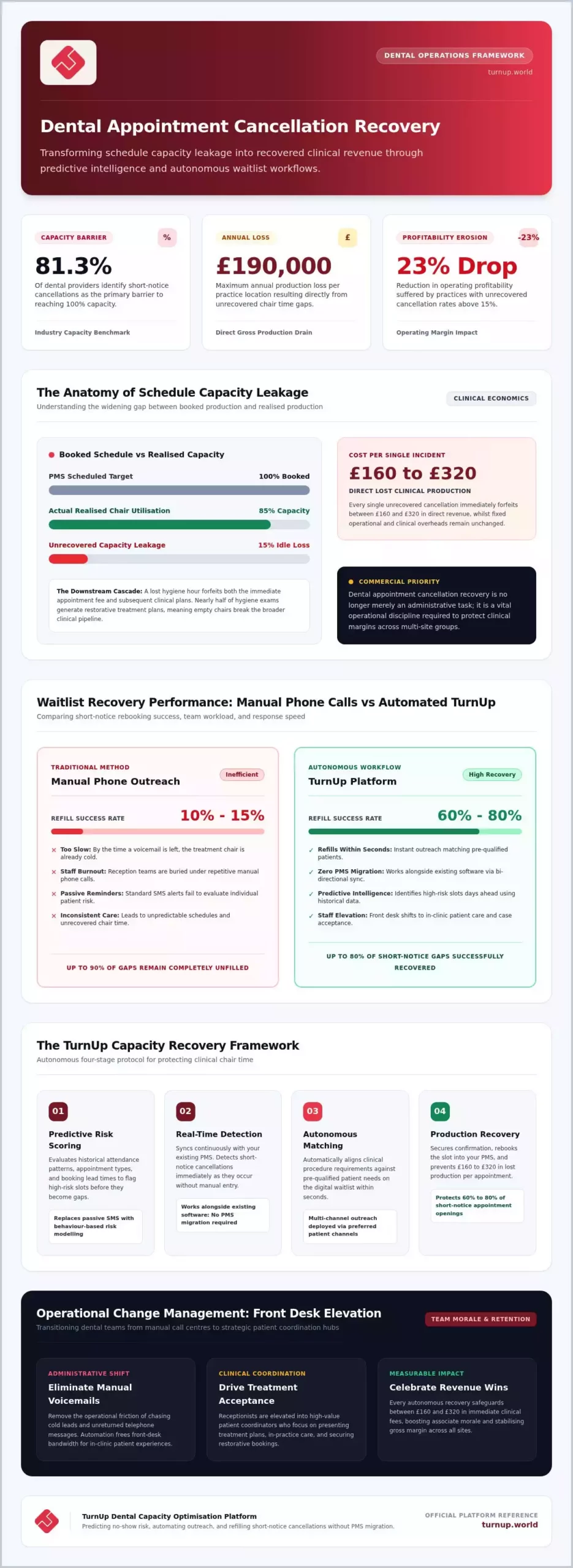
81.3% of dental providers identify short-notice cancellations as the primary barrier to reaching 100% capacity. For many practices, these gaps result in an annual production loss of up to £190,000 per location. You likely recognise the friction of a front desk team buried under manual rebooking calls whilst chairs sit empty. This guide demonstrates how to master dental appointment cancellation recovery by shifting from reactive manual lists to automated capacity optimisation.
It’s a cycle of operational stress. It drains your bottom line and burns out your best administrative staff. Discover how to transform lost production time into recovered revenue through TurnUp. As a platform engineered for predictive risk scoring and automated outreach, it works alongside your existing software and requires no PMS migration. We’ll outline a 2026 operational framework to protect your chair time, reduce no-show rates, and provide total visibility across your dental group. By the end of this guide, you’ll have a clear, data-driven strategy to eliminate operational uncertainty and keep your chairs filled.
Key Takeaways
- Quantify the financial impact of idle chair time to understand how unrecovered gaps directly erode clinical profitability and associate morale.
- Shift from reactive SMS reminders to a predictive model that uses historical data to identify high-risk appointments before they become empty slots.
- Manage the transition to automated workflows to reduce front-desk burnout by delegating manual rebooking tasks to intelligent systems.
- Deploy a strategic dental appointment cancellation recovery workflow that integrates with your existing PMS to refill short-notice gaps in real time.
The Economic Impact of Dental Appointment Cancellations
In 2026, the gap between gross production and realised production is widening. Whilst your PMS might show a full book, the reality is often a schedule running at 85% capacity. This 15% leakage represents a significant financial drain. Industry data indicates a single unrecovered cancellation costs between £160 and £320 in direct lost clinical production. For a multi-site group, this aggregates to an annual loss of up to £190,000 per location. Effectively managing dental appointment cancellation recovery is no longer an administrative task; it is a core commercial requirement.
Calculating Lost Production Across Multi-Site DSOs
Capacity leakage often hides in hygiene and specialist schedules. A lost hygiene hour doesn’t just forfeit the immediate fee; it breaks the clinical pipeline. Since nearly half of hygiene exams generate restorative treatment plans, one empty chair creates a downstream production cascade. Practices with unrecovered cancellation rates above 15% suffer a 23% reduction in operating profitability. Operations leaders must prioritise standardised chair utilisation reporting to identify these vulnerabilities. Successfully implementing these new standards requires applying change management principles to ensure clinical teams align with efficiency benchmarks.
The Problem with Manual Waitlist Management
Traditional phone-based recovery is failing. Manual outreach successfully refills only 10% to 15% of short-notice gaps. It’s too slow. By the time a receptionist leaves a voicemail, the chair is already cold. This creates high administrative burnout and an inconsistent patient experience. Manual systems are the weakest link in dental appointment cancellation recovery efforts. TurnUp solves this by acting as a capacity optimisation platform that refills gaps within seconds. It integrates directly with your existing software, so there’s no need for a risky PMS migration. Automation ensures a 60% to 80% refill rate, protecting revenue without overworking your front desk.
Shifting from Reactive to Predictive Recovery Models
Standard SMS reminders are passive. They notify a patient of an appointment but fail to account for behavioural patterns or lead-time risks. Modern dental appointment cancellation recovery relies on foresight rather than reaction. By utilising predictive models for dental appointment no-shows, practices can identify high-risk slots days in advance. These algorithms evaluate history, appointment type, and lead time to flag vulnerabilities before they become empty chairs. This allows for proactive intervention rather than last-minute panic.
Automated Waitlist and Short-Notice Recovery
When a cancellation occurs, speed is the only metric that matters. Manual phone calls are too slow to fill a gap with only two hours’ notice. TurnUp automates this process by instantly matching the open slot with pre-qualified patients on a digital waitlist. This autonomous system handles the outreach, confirmation, and rebooking without human intervention.
- Matches clinical procedure requirements to patient needs automatically.
- Triggers outreach within seconds of a cancellation notice.
- Reduces “failed to attend” (FTA) events by engaging patients on their preferred channels.
This high-momentum approach ensures your schedule remains resilient even during peak cancellation periods. It transforms the role of the front desk from a reactive call centre to a proactive coordination hub. To further support this transition, you can learn more about mobile tools that help staff digitise documents and reduce administrative friction.
Operations leaders often fear that new technology requires a disruptive PMS migration. It doesn’t. TurnUp functions as a capacity optimisation engine that works alongside your current software. It syncs bi-directionally to provide data-driven insights into chair utilisation across all sites. This seamless flow allows your front desk to focus on patient coordination whilst the AI handles the heavy lifting of scheduling logistics. To see how this fits into your current workflow, you can explore our capacity optimisation platform today. The goal is a unified clinical team supported by silent, reliable automation.
Change Management for Dental Practices: Adopting New Workflows
Adopting automated systems requires a mindset shift. Staff resistance often stems from a fear of obsolescence. Address this by redefining the dental receptionist as a high-value patient coordinator. Instead of chasing voicemails, they focus on in-clinic engagement and case acceptance. Use data to celebrate team wins. When the system recovers a £320 gap, the team sees the immediate benefit to clinical production and morale.
According to ADA Health Policy Institute economic data, cancellations remain the primary obstacle to full schedule fullness. Solving this requires clear KPIs. Monitor your Waitlist Refill Conversion Rate and target a recovery rate of over 65% to ensure your dental appointment cancellation recovery strategy is effective.
A Framework for Operational Transition
Success follows a structured path. First, audit current capacity to identify where leakage occurs. Most practices find gaps in hygiene or long-lead-time restorative slots. Second, train the team on the Front Desk Copilot. This tool acts as a silent assistant, handling dental appointment cancellation recovery whilst the team manages the patient lounge. Finally, monitor chair utilisation via DSO dashboards to ensure long-term maturity.
Standardising Procedures Across Multiple Clinics
For multi-site groups, inconsistency is the enemy of efficiency. You must create a unified recovery protocol. Consult our guide on standardising procedures across dental practices to align your locations. Consistent patient communication ensures that the recovery process remains professional and seamless across the group. To begin optimising your group-wide operations, integrate TurnUp into your workflow today. This transition empowers your staff to focus on patients while the platform protects your production.
Protecting Capacity with the TurnUp Front Desk Copilot
TurnUp acts as the silent engine behind your scheduling operations. It moves beyond the limitations of manual outreach by predicting no-show risk with surgical precision. By analysing historical patterns and lead times, the platform allows for proactive intervention. This protects your production without adding to the team’s administrative burden. It’s a sophisticated tool that empowers you to take control of your business.
Beyond Reminders: A True Capacity Optimisation Platform
Generic scheduling software often fails because it treats every appointment as a static event. High-performing DSOs require a specialised dental capacity management system to maintain schedule fullness. TurnUp refills short-notice gaps by autonomously matching waitlisted patients to open slots in real-time. This improves the patient experience by providing faster access to care whilst ensuring your clinicians remain productive. It’s a proactive approach to dental appointment cancellation recovery that eliminates the uncertainty of empty chairs.
Measuring Success and ROI
DSO leaders gain total visibility into group-wide capacity through centralised dashboards. You can track chair utilisation and the success of your dental appointment cancellation recovery efforts across all locations. These dashboards provide a top-down view of scheduling capacity, allowing you to identify which sites need support before a revenue dip occurs. This data-driven oversight allows for precise operational adjustments without requiring a PMS migration.
- Reduces FTA rates through intelligent, automated outreach and predictive risk scoring.
- Increases the percentage of recovered chair time from the manual average of 15% to over 60%.
- Eliminates the burnout associated with constant manual rebooking calls.
The impact of the Front Desk Copilot is immediate. By quantifying the value of every recovered hour, operations leaders can prove the direct ROI of automation. It is the most efficient method to protect your production with TurnUp and secure the financial health of your practice.
Mastering Clinical Capacity in 2026
Manual scheduling belongs to the past. The transition from reactive reminders to predictive capacity optimisation is the only way to protect your realised production in 2026. You’ve identified the high cost of idle chair time and the operational friction of manual rebooking. By implementing a sophisticated strategy for dental appointment cancellation recovery, you transform lost hours into recovered revenue without increasing staff workload.
TurnUp is designed for multi-site DSO operations and features specialised NoShow prevention technology. It works alongside all major UK PMS systems, requiring no migration or technical overhaul. This platform acts as a silent, reliable engine that eliminates scheduling gaps whilst providing you with total visibility across your entire group. It empowers your patient coordinators to focus on care rather than logistics.
Take control of your clinical capacity and provide your team with the tools they need to succeed. Your journey toward an automated, high-momentum practice starts now. It’s time to secure your schedule and eliminate operational uncertainty for good.
Optimise your dental group capacity today
Frequently Asked Questions
What is the difference between a dental reminder and cancellation recovery?
Standard reminders are passive notifications sent via SMS or email to confirm an existing booking. In contrast, dental appointment cancellation recovery is an active capacity optimisation strategy. It focuses on identifying high-risk slots and autonomously refilling gaps as they occur. Whilst reminders merely broadcast information, recovery engines actively protect production by matching clinical openings with waitlisted patients in real-time. This ensures that a vacated chair is refilled within minutes.
How does predictive AI help prevent dental no-shows?
Predictive AI evaluates historical attendance patterns, lead times, and procedure types to assign a risk score to every appointment. If a patient is flagged as high-risk, the system triggers targeted outreach through AI calls or interactive messaging. This foresight allows practices to confirm or reschedule vulnerable slots days in advance. By addressing potential gaps before they manifest, dental groups can maintain a more resilient and predictable clinical schedule.
Can we implement cancellation recovery software without changing our PMS?
You do not need to replace your Practice Management System (PMS) to implement TurnUp. Our platform is designed to function as a capacity optimisation layer that integrates bi-directionally with your existing software. This avoids the high risk and disruption associated with data migrations. You retain your current clinical workflows whilst gaining enterprise-level tools for dental appointment cancellation recovery, predictive risk scoring, and group-wide capacity reporting.
How long does it take to see results from automated capacity optimisation?
Most dental groups observe a measurable improvement in chair utilisation within the first week of implementation. Automated systems begin refilling short-notice gaps immediately, often achieving refill rates between 60% and 80% compared to the 15% seen with manual methods. Operations leaders can track these gains through real-time dashboards. This provides instant visibility into recovered production and reduced no-show rates across all practice locations from day one.
Will our front desk staff be replaced by AI call centres?
AI call centres and automated tools, such as Rep AI, are designed to support your team, not replace them. We position TurnUp as a Front Desk Copilot that handles the repetitive, high-volume tasks of rebooking and waitlist management. This eliminates administrative burnout and allows your receptionists to transition into patient coordinators. They can focus on providing high-quality in-clinic experiences and improving case acceptance whilst the AI manages the logistics of the schedule.