Confirmation is not a courtesy; it’s the first step in active capacity management. Finding the best way to confirm dental appointments is no longer about polite reminders. It’s about protecting your practice revenue from the 15-20% no-show rates currently plaguing the industry in 2026. You’ve likely seen the damage first-hand: gaps in the schedule that appear too late to fill and a front desk team exhausted by repetitive, manual calling.
We agree that your receptionists should focus on patient care, not admin-heavy phone tag. This article provides a definitive checklist to master automated, predictive methods that eliminate uncertainty and protect your bottom line. You’ll learn how to implement a standardised workflow that reduces DNA rates by at least 3-5% while keeping your chairs full. We’ll preview the shift from passive reminders to high-tech capacity optimisation, ensuring your practice operates as a silent, reliable engine of efficiency. It’s time to stop reacting to empty slots and start controlling your schedule with surgical precision.
Key Takeaways
- Shift from manual phone tag to asynchronous messaging to align with modern patient preferences and eliminate receptionist burnout.
- Implement a layered multi-channel framework—SMS, Email, and WhatsApp—as the best way to confirm dental appointments and maximise confirmation rates.
- Compare manual, automated, and predictive AI workflows to move beyond basic reminders toward surgical capacity management.
- Use the 2026 Front Office Checklist to audit DNA rates and establish a standardised confirmation sequence across your entire organisation.
- Connect confirmation failures to automated rebooking tools to fill last-minute gaps and protect practice revenue without manual intervention.
Why Traditional Dental Appointment Confirmations Are Failing in 2026
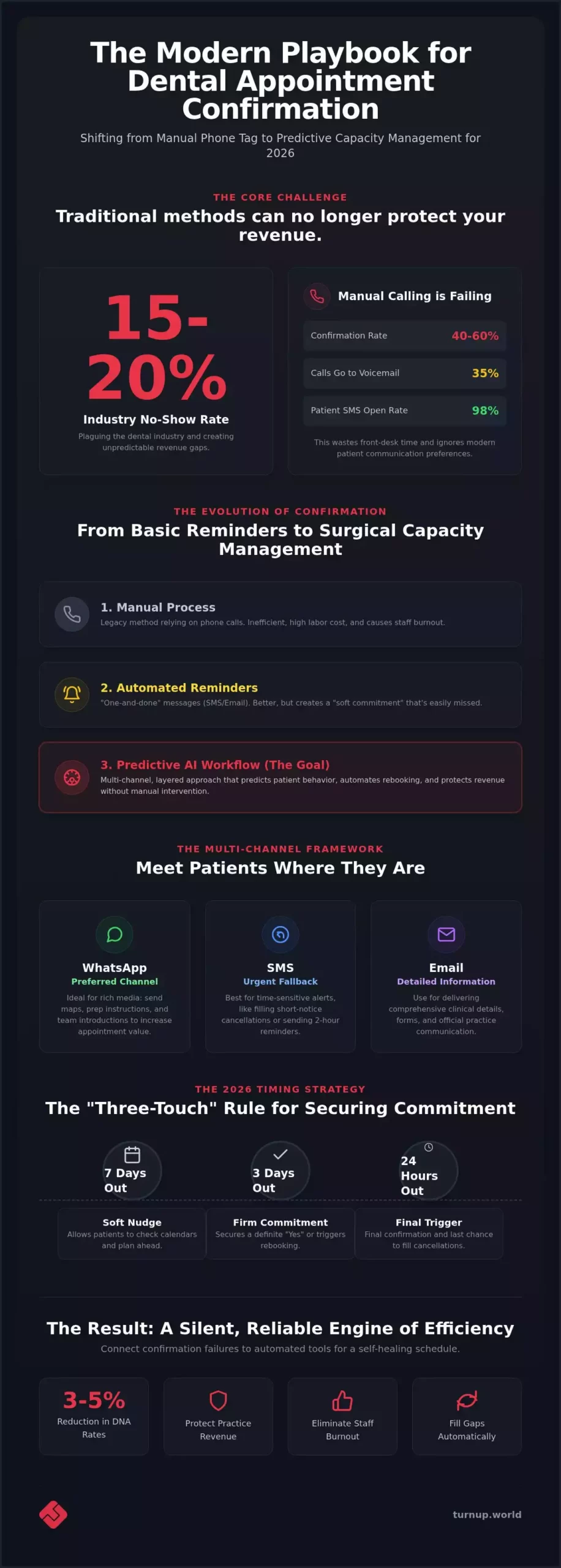
Traditional manual calling is a legacy process failing in a digital-first economy. While some industry bodies still advocate for the “personal touch” of a phone call, the data tells a different story. Manual calls currently achieve a 40-60% confirmation rate, leaving nearly half your schedule in limbo. The labour cost is staggering. Your team spends hours on outbound dialling only to hit voicemails 35% of the time. This is not the appointment scheduling software strategy required for high-growth practices. It’s a drain on resources that yields diminishing returns.
Patient behaviour has shifted toward asynchronous communication. “Ghosting” isn’t a lack of respect; it’s a refusal to engage with intrusive phone calls. In 2026, patients ignore unknown callers but show a 98% open rate for SMS. A single no-show ripples through the practice, wasting clinical prep time and tanking staff morale. Relying on the best way to confirm dental appointments means moving away from rigid, legacy PMS systems. These basic tools often lack the predictive intelligence needed to handle the complex, multi-site schedules of a modern DSO.
The Failure of the “One-and-Done” Reminder
Sending a single text 24 hours before a procedure is a high-risk strategy. It creates a “soft commitment” that patients easily overlook during a busy day. Patients require a multi-touch sequence to move from a tentative booking to a confirmed slot. We define the “Confirmation Gap” as the critical window between a reminder being sent and a response being received. When this gap remains open, your revenue is at risk. A single automated nudge is no longer sufficient to secure a high-value clinical chair.
Receptionist Burnout and the Human Element
Repetitive admin tasks drive staff churn in dental front offices. Chasing patients for confirmations is demoralising and inefficient. The opportunity cost is high. Instead of dialling numbers, your team should focus on patient experience and treatment coordination. Automation ensures brand consistency across all locations, removing the “receptionist bias” that leads to inconsistent schedule management. By standardising the workflow, you transform the front desk from a call centre into a patient-centric hub. This shift protects your team’s mental health while ensuring your chairs stay full through proactive, silent optimisation. Practices that invest in streamlining dental front desk workflows report measurable reductions in both staff churn and idle chair time.
The Multi-Channel Confirmation Framework for DSOs
Relying on a single communication channel is a single point of failure. Modern DSOs require a layered framework that meets patients where they are. SMS provides speed, email delivers clinical detail, and WhatsApp fosters real-time engagement. This multi-layered approach is the best way to confirm dental appointments while maintaining a professional brand image across 10 or more sites. Centralising these replies into a single dashboard allows your headquarters to monitor performance without micromanaging individual practices.
Security must remain the priority. Multi-site messaging demands strict GDPR compliance to protect patient data across the organisation. Adhering to dental appointment confirmation best practices keeps your group legally compliant and operationally sound. It’s about building a silent, reliable engine that eliminates uncertainty before the patient even arrives at the clinic.
Channel Optimisation: SMS vs. WhatsApp
WhatsApp is now the preferred channel for UK dental patients in 2026. It offers a richer experience compared to traditional text. You can send digital maps, prep instructions, or even video introductions to the clinical team. This increases the perceived value of the appointment and reduces patient anxiety. SMS remains the “urgent” fallback. It’s the best way to confirm dental appointments when time is of the essence, such as filling a short-notice cancellation slot or sending an immediate 2-hour alert.
The 2026 Timing Strategy
A “Three-Touch” rule creates a logical progression of commitment. We recommend a 7-day, 3-day, and 24-hour sequence. The 7-day message acts as a soft nudge to check calendars. The 3-day message secures the firm commitment. The 24-hour alert is the final trigger. If a patient responds with a “Maybe” or a reschedule request, the system must pivot to an automated rebooking workflow. Understanding how can a dental group reduce no-shows involves this level of surgical timing and channel layering.
Many dental groups achieve this level of precision by integrating a capacity optimisation platform into their daily operations, ensuring that the front desk remains focused on patient care rather than admin-heavy outreach.
Comparing Confirmation Methods: Manual vs. Automated vs. Predictive AI
Manual dialling is a legacy bottleneck. It relies on receptionist bias, where staff often prioritise “easy” patients over those with a history of failing to attend. This leads to an inconsistent schedule and high labour costs. While basic automation improved this by sending bulk messages, it remains a blunt instrument. It lacks the nuance to handle a patient who asks to reschedule or requires specific prep instructions. For a growing DSO, manual outreach is rarely the best way to confirm dental appointments; it’s a drain on human capital.
Predictive AI represents the 2026 standard for capacity management. It moves the needle from simple reminders to active schedule protection. By analysing historical data, AI identifies which patients are statistically likely to fail. This allows your team to move from a reactive stance to a proactive one. The financial impact is clear. An average no-show costs a practice approximately $100 per slot. With DNA rates reaching up to 20% in some regions, the cost of idle chair time far outweighs the investment in intelligent software.
The Rise of Predictive No-Show Prevention
AI models analyse historical patient behaviour to flag high-risk appointments automatically. These predictive models allow DSOs to over-prepare for potential gaps by identifying high-risk appointments and readying the “Short Notice” waitlist before a cancellation even occurs. We no longer ask “did they confirm?” but rather “will they actually show up?”. This shift in perspective allows your front desk to focus on high-value patient interactions rather than chasing low-probability confirmations.
Integrating with Your Dental PMS
Bi-directional sync is mandatory for operational efficiency. Manual data entry is a failure point that leads to scheduling conflicts and staff frustration. While legacy systems are often too rigid to handle complex DSO workflows, the TurnUp Front Desk Copilot acts as an intelligent overlay. It extracts data from your PMS and manages the heavy lifting of confirmation and rebooking without human intervention. This ensures that your schedule is the best way to confirm dental appointments and keep your clinical chairs productive. Most practices see a positive ROI within 30 to 90 days by reclaiming hours lost to manual admin and unfilled gaps.
The Ultimate Dental Appointment Confirmation Checklist
Implementing the best way to confirm dental appointments requires a shift from passive reminders to an active, standardised framework. You cannot manage what you do not measure. This checklist provides a surgical approach to reclaiming your schedule across every location in your group. It moves your team away from manual guesswork and toward a silent, reliable engine of capacity optimisation. Follow these steps to secure your revenue:
- Audit DNA rates by site and provider to identify performance gaps.
- Establish a multi-channel sequence using SMS, Email, and WhatsApp.
- Define “Confirmation Status” triggers in your dental software.
- Set up automated “Fail-Safe” workflows for unconfirmed slots.
- Train staff on the “Exception Handling” protocol for high-value treatments.
Step 1: Data Audit and Benchmarking
Calculate your true chair-time loss per hour. A missed appointment isn’t just a gap; it’s lost revenue that can’t be recovered. Audit your DNA rates across all locations to identify “problem sites” within your DSO network. Look for patterns. Some sites may struggle with specific patient demographics or local transport issues that impact attendance. Set realistic targets for a 3-5% reduction in no-shows within the first 90 days. This baseline allows you to measure the financial impact of your automated workflows accurately. Identifying these gaps early is the first step toward total capacity optimisation.
Step 2: Workflow Automation Setup
Draft templates that encourage a definitive “Yes” or “Reschedule” response. Ambiguity is the enemy of a full schedule. Define “Confirmation Status” triggers in your dental software to automate the next step without human intervention. If a high-value appointment remains unconfirmed 48 hours before the procedure, the system should trigger a “Fail-Safe” workflow. This might include a final WhatsApp nudge or an automated predictive call. Setting an “Auto-Cancel” threshold ensures that unconfirmed slots for complex procedures are released in time to be filled by the waitlist. Solving common dental front desk problems starts with this level of precise automation.
Train your team on “Exception Handling” for high-value treatments. While automation handles 80% of the communication volume, complex clinical cases still require a human touch. Establish a protocol for when a receptionist should step in to secure a commitment manually. This ensures brand consistency across your organisation while protecting your most profitable clinical hours. It’s the best way to confirm dental appointments while keeping your front desk focused on patient care rather than admin-heavy outreach. A broader strategy for streamlining dental front desk workflows across multiple sites ensures these protocols are applied consistently, regardless of location or team size.
Ready to eliminate operational uncertainty? Explore how TurnUp Front Desk Copilot automates your confirmation workflow and protects your practice revenue.
Beyond the Reminder: Turning Confirmations into Capacity Optimisation
Confirmations should not end with a “No.” In 2026, the best way to confirm dental appointments involves a logic-based pivot that protects your clinical hours. If a patient cancels via an automated text, the system shouldn’t just record the loss. It should immediately activate the next phase of revenue protection. This is the difference between a passive reminder and a proactive capacity optimisation platform. It transforms a potential vacancy into a filled chair without a single outbound call.
The TurnUp Front Desk Copilot bridges the gap between a cancellation and a new booking by acting as a silent, reliable engine. It monitors your schedule in real time, identifying confirmation failures before they become expensive gaps. This shift toward a “Self-Healing Schedule” is the future of enterprise dentistry. It moves the responsibility of schedule management from the exhausted receptionist to an intelligent, automated system that never misses a beat.
Filling Last-Minute Gaps Automatically
A “No” response is an immediate opportunity to fill a chair with a higher-priority patient. Traditional methods require a receptionist to manually check a paper waitlist or scroll through PMS notes. Modern automation triggers an immediate blast to your short-notice list the moment a cancellation is confirmed. This surgical approach reduces the time-to-fill from hours to mere minutes. Mastering last minute dental appointment filling is essential for protecting DSO margins in a competitive market. It ensures that your clinical team remains productive, even when life gets in the way for your patients.
Standardising Success Across the Group
Centralised reporting allows DSOs to benchmark performance across every site in the organisation. You can use this data to reward high-performing front desk teams and identify locations where DNA rates are slipping. As you acquire new practices, you can scale this confirmation strategy instantly, removing the variability of human performance. The best way to confirm dental appointments is the method that requires the least human effort. It’s about building a system that is intelligent, observant, and slightly disruptive to the status quo.
In conclusion, the goal of a modern confirmation workflow is total operational certainty. By connecting your confirmation failures directly to your waitlist, you create a seamless loop of productivity. You stop reacting to empty slots and start controlling your business with data-driven authority. The future of dental practice management is not more staff; it’s more automation.
Secure Your Practice Revenue Through Intelligent Automation
Standardising your front office workflow is the only way to eliminate the uncertainty of empty clinical chairs. By moving beyond manual phone tag and adopting a predictive, multi-channel framework, you transform your reception from a cost centre into a silent engine of efficiency. The best way to confirm dental appointments is through a system that doesn’t just remind patients but actively protects your capacity.
We’ve explored how layering SMS and WhatsApp reduces DNA rates while automated rebooking turns every cancellation into an immediate opportunity. These methods ensure your team remains focused on high-value patient care rather than repetitive admin. Transitioning to a self-healing schedule allows your organisation to scale without increasing headcount or operational friction. It’s about proactive energy and staying ahead of schedule gaps before they impact your bottom line.
Optimise your dental group capacity with TurnUp Front Desk Copilot. Our platform provides specialised NoShow prevention and AI-driven capacity optimisation to fill last-minute gaps automatically. Taking control of your schedule starts with the right tools. Your practice is ready for a more automated, profitable future.
Frequently Asked Questions
What is the best way to confirm dental appointments for a multi-site group?
The best way to confirm dental appointments for a multi-site group is through a centralised, automated platform that layers SMS, Email, and WhatsApp. Centralising communication allows your headquarters to monitor DNA rates across all practices from a single dashboard. This eliminates the variability of manual reception work. Using a tool like TurnUp Front Desk Copilot ensures brand consistency and operational efficiency across 10 or more locations without increasing your administrative headcount.
How far in advance should a dental practice confirm an appointment?
We recommend a “Three-Touch” rule for optimal results. Send the first nudge 7 days before the appointment to check calendars. A second follow-up 3 days out secures the firm commitment, and a final 24-hour alert acts as a critical trigger. This sequence moves patients from a soft commitment to a confirmed slot. It also provides enough time to activate your automated rebooking workflows if a patient asks to reschedule or fails to respond.
Is it better to call or text dental patients for reminders?
Texting is significantly more effective than manual calling in 2026. SMS messages have a 98% open rate, whereas 35% of incoming and outbound calls are missed or ignored. Asynchronous messaging allows patients to confirm or reschedule at their convenience without the intrusion of a phone call. While calls may feel personal, they are impossible to scale and often lead to receptionist burnout. Automation ensures every patient receives a prompt, professional nudge every time.
How do you handle patients who never confirm their dental appointments?
Unconfirmed appointments represent high-risk revenue. You should implement automated “Fail-Safe” workflows for patients who ignore multiple prompts. If a high-value slot remains unconfirmed 48 hours before the procedure, the system should trigger a final predictive nudge. If no response is received, the system can automatically release that slot to your “Short Notice” waitlist. This proactive approach ensures your clinical chairs remain productive even when patients fail to engage with your reminders.
Can AI really predict which patients will be no-shows?
AI-driven systems identify high-risk appointments by analysing historical patient behaviour and attendance patterns. These predictive models move beyond the simple question of “did they confirm?” to “will they actually show up?”. By flagging high-risk slots before they happen, your team can over-prepare by readying waitlist patients. This level of foresight is a core feature of capacity optimisation platforms, allowing you to protect practice revenue with surgical precision.
What should be included in a dental appointment confirmation message template?
A high-converting template must include a clear call-to-action that encourages a definitive response. Include the appointment date, time, and clinician name. For modern engagement, incorporate rich media like digital maps or specific pre-appointment instructions. Providing value, such as prep videos or parking details, increases the perceived importance of the slot. Always include a clear opt-out option to remain compliant with messaging regulations while ensuring the patient has a seamless experience.
How does automated confirmation reduce dental front desk burnout?
Automated confirmation systems eliminate the repetitive, admin-heavy tasks that drive staff churn. Instead of spending hours on outbound phone tag, your team can focus on high-value patient care and treatment coordination. Removing the burden of manual dialling reduces operational uncertainty and allows the front desk to function as a patient-centric hub. It’s about building a silent, reliable engine that handles the heavy lifting of schedule management without human intervention.
Is WhatsApp GDPR-compliant for dental appointment confirmations in the UK?
WhatsApp is GDPR-compliant for UK dental practices when used through the official Business API. This ensures that data is encrypted and managed within a secure framework. You must have a signed Business Associate Agreement (BAA) and clear patient consent to use electronic communication. In 2026, WhatsApp is a preferred channel because it allows for richer engagement while maintaining the strict security standards required for protecting sensitive patient information across multiple sites.