
What if your empty chairs aren’t a marketing failure, but a structural breakdown at the reception desk? Most practice owners blame external factors for schedule gaps, yet the real friction lies in invisible operational inefficiencies. You’ve felt the sting of a high-value clinical slot vanishing due to a last-minute cancellation. You’ve likely struggled with high staff turnover and the resulting inconsistency in patient care. These common dental front desk problems create a cycle of reactive firefighting that prevents true scaling.
It’s time to stop treating symptoms and start fixing the system. This 2026 efficiency checklist identifies the specific friction points that drain your revenue and provides actionable strategies to resolve them. We’ll show you how to eliminate no-show revenue leaks and maximize chair utilization through precise capacity management. This guide previews the transition from manual scheduling to automated systems that standardize the patient experience across every site in your group. You’re about to transform your front office into a high-performance engine that operates with surgical precision.
Key Takeaways
- Understand why front-office efficiency acts as the primary throttle for your clinical capacity and revenue growth.
- Identify and neutralize common dental front desk problems like the “No-Show” epidemic and the inefficiency of manual phone-based waitlists.
- Learn why your existing Practice Management System is a passive database rather than an active capacity optimization engine.
- Implement the 2026 efficiency checklist to fill short-notice gaps in under 10 minutes without making a single phone call.
- Discover how the TurnUp Front Desk Copilot integrates with your current workflows to standardize performance across multiple practice sites.
Why Front Desk Efficiency is the Throttle of Your Dental Practice
Efficiency in a dental setting isn’t just about answering phones quickly or being polite. It’s the precise synchronization of clinical capacity with patient demand. Your front desk functions as the throttle of the entire operation. When the reception team struggles with common dental front desk problems, they inadvertently limit the speed of your practice’s growth. Even if your clinicians are world-class, an inefficient front office creates a ceiling on your revenue. If the throttle is stuck, the engine cannot perform.
Many managers mistake “busy” for “productive.” High-volume manual administration often masks deep-seated operational friction. Your staff might spend six hours on phone calls just to fill a single surgical gap. That isn’t efficiency; it’s a resource drain. Modern practice management focuses on capacity optimization as the primary antidote to this friction. It moves the focus from “doing tasks” to “maximizing output.” You must stop viewing the reception as a cost center and start seeing it as a revenue driver.
The Hidden Cost of Inefficient Scheduling
Every minute a dental chair sits empty represents a permanent loss of revenue. Unlike physical stock, clinical time cannot be recovered once it’s lost. If an associate’s hourly rate is high, a single daily no-show can devastate your monthly EBITDA. The damage isn’t just financial. Scheduling bottlenecks cause a ripple effect across the entire team. Clinicians grow frustrated with irregular schedules and “dead time” in their day, which often leads to burnout and high staff turnover at the clinical level.
Administrative friction also erodes patient trust. If the booking process feels chaotic or inconsistent, the patient’s perceived value of the clinical care drops. This directly impacts Patient Lifetime Value (LTV). A patient who experiences scheduling hurdles is significantly less likely to accept a complex treatment plan. They lack confidence in the practice’s ability to manage their long-term care journey. Friction at the front desk equals friction in the treatment room.
From Reactive Reception to Proactive Capacity Management
Traditional reception models are reactive. They wait for the phone to ring or a patient to walk through the door. Proactive capacity management uses data and foresight to identify gaps before they occur. It replaces manual guesswork with automated, standardized workflows. This transition is essential for groups standardising procedures across dental clinics. It ensures that whether a patient visits site A or site B, the operational efficiency remains identical.
By moving away from “human-only” workflows, you create a system that doesn’t rely on the memory or energy levels of a single staff member. Modern technology eliminates the common dental front desk problems that arise from human error. It ensures your chairs stay full without increasing the administrative burden on your team. You aren’t just filling slots; you’re protecting your profit margins through surgical precision.
Common Dental Front Desk Problems: Identifying the Bottlenecks
Identifying bottlenecks isn’t about auditing staff performance; it’s about auditing your system. Many common dental front desk problems stem from a reliance on outdated communication methods that fail to meet 2026 patient expectations. Patients today demand instant, digital, and frictionless interactions. If your workflow depends on a receptionist’s memory or a manual spreadsheet, your practice is operating with a structural deficit. These manual processes don’t just slow things down. They actively leak revenue.
Information silos often represent the most significant hidden hurdle. When the front desk lacks real-time visibility into clinical capacity or billing status, the patient journey stalls. Administrative delays in insurance verification or payment processing create “desk clogs” that frustrate patients and clinical staff alike. Resolving these common dental front desk problems requires moving beyond surface-level fixes. You need a system that bridges the gap between clinical availability and administrative action with surgical precision.
The Failure of Traditional No-Show Prevention
A 24-hour reminder is no longer a prevention strategy. It’s a notification of impending revenue loss. By the time a patient cancels 24 hours before their slot, your team has almost zero chance of filling that gap through manual outreach. Patients fail to attend (DNA) because the friction of rescheduling is often perceived as higher than the cost of missing the appointment. Systemic change is the only solution. You must analyze how can a dental group reduce no-shows by using automation to lower the barrier for rebooking and attendance.
The role of technology in the modern dental practice has evolved. It’s no longer just about digital X-rays or record-keeping. It’s about active capacity management. Traditional systems allow gaps to form and stay open. Modern systems identify those gaps instantly and offer them to the patients most likely to fill them. Selecting the right dental no-show prevention software is now a critical strategic decision that directly determines how quickly your practice can recover lost capacity. This proactive approach eliminates the uncertainty that plagues manual scheduling models.
Last-Minute Cancellation Chaos
A single cancellation at 2:00 PM creates a “black hole” in your daily profitability. Most reception teams respond by “dialing for dollars.” They pull a paper list and begin making cold calls to patients who might want an earlier slot. This is a high-stress, low-yield activity. It pulls your team away from the patients currently in the building and creates a chaotic atmosphere. This manual approach is the opposite of efficiency.
Manual “short-call” lists are the primary reason for front-office burnout. They force staff into a reactive loop of firefighting rather than allowing them to focus on high-value patient interactions. Dental front desk staff churn reduction begins precisely here — by replacing the stress of manual gap-filling with automated systems that handle outreach instantly. If you want to stop the cycle of manual outreach and start filling gaps automatically, TurnUp World provides the tools to automate this recovery process. You can fill empty chairs in minutes without a single phone call.
Manual vs. Automated Systems: The Great Operational Divide
Human-only front desks are fundamentally limited by biology. Even the most dedicated receptionist can’t monitor a schedule, answer three phone lines, and analyze patient attendance patterns simultaneously. This traditional approach is where common dental front desk problems take root. Relying solely on manual effort creates a reactive environment where staff are always one step behind the schedule. High-performing DSOs are moving away from this model, opting instead for a tech-enabled front office that uses automation to handle the cognitive load of capacity management.
A standard Practice Management System (PMS) is a passive database. It’s a digital filing cabinet designed to store records, not an optimization engine designed to drive revenue. It tells you who is booked, but it doesn’t tell you how to fix a gap in real-time. The shift toward a TurnUp Front Desk Copilot represents a new era of proactive management. By using data to predict which patients are high-risk for no-shows, these platforms allow practices to intervene before the chair goes cold. It’s the difference between recording a loss and preventing one.
The Limitations of Your Current PMS
Many practices believe they’ve automated their workflow because they send out SMS reminders. This is a mistake. Automated reminders are a baseline communication tool, not a solution to common dental front desk problems. They notify a patient of an appointment, but they lack the “intelligence” to facilitate an immediate rebooking if that patient cancels. If a slot opens up, the PMS simply leaves it blank, waiting for a human to notice and act.
Manual data entry also compromises your reporting. When receptionists are rushed, chair utilization figures are often estimated or incorrectly logged. This leads to “ghost capacity” where the system thinks the practice is full, but the clinicians are actually idle. You can’t scale a business based on inaccurate data. Without an intelligent layer above the PMS, you’re flying blind.
The Rise of Capacity Optimisation Platforms
A capacity optimization platform functions as a “Copilot” for your reception team. It doesn’t replace the human touch; it empowers it. The system handles the heavy lifting of last minute dental appointment filling by identifying eligible patients and offering them the slot via their preferred digital channel. This happens in seconds, without a single phone call from your staff. It eliminates the “dialing for dollars” cycle that leads to receptionist burnout.
The impact on staff retention is significant. When you remove the stress of manual gap-filling, your team can focus on high-value patient interactions and treatment coordination. Reducing administrative friction directly correlates with lower churn rates at the front desk. Automation provides the calm reassurance of a full schedule, allowing your practice to operate as a high-performance engine rather than a chaotic fire station.
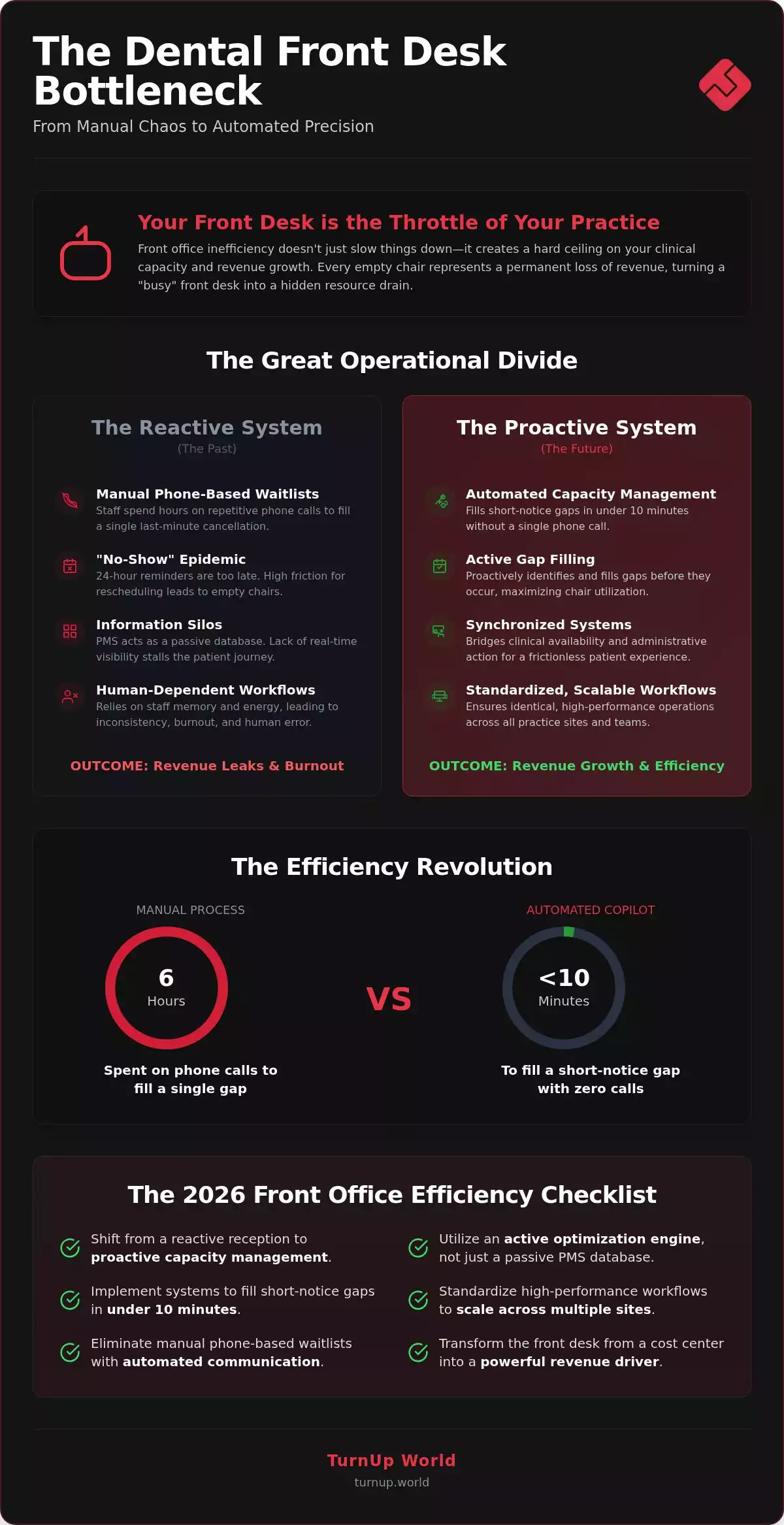
The 2026 Dental Front Office Efficiency Checklist
Efficiency isn’t a vague sentiment. It’s a quantifiable output. To solve common dental front desk problems, you must move from anecdotal evidence to hard data. This 2026 efficiency checklist provides a framework for auditing your reception operations with surgical precision. If your current systems can’t meet these benchmarks, you’re leaving revenue on the table. Use these points to identify where your practice is leaking capacity.
- Audit your DNA rate: Are you measuring the actual lost revenue from no-shows, or just the number of missed slots? Accurate reporting across all sites is the first step toward recovery.
- Automate the “Short-Notice” list: Can your system fill a surgical gap in under 10 minutes without a single phone call? If not, your manual processes are throttling your growth.
- Standardise patient intake: Ensure E-forms and insurance verifications are 100% complete at least 48 hours before the appointment. Administrative friction on the day of treatment is a primary cause of schedule delays.
- Implement real-time capacity tracking: Your front desk must see “true” chair availability, not just what’s written in the PMS. This prevents the “ghost capacity” that leaves clinicians idle.
- Deploy a TurnUp Front Desk Copilot: Empower your staff with AI that prioritises their daily tasks based on revenue impact and attendance risk.
Stop guessing and start optimizing your schedule. Implement the TurnUp Front Desk Copilot to secure your practice capacity and eliminate manual outreach.
Daily Operational Checks
The rhythm of a high-performance practice is set in the first thirty minutes of the day. Morning huddles shouldn’t just be a review of the schedule. They’re a strategic session to identify “high-risk” appointments that show a statistical probability of non-attendance. By flagging these early, your team can prepare contingency plans. A mid-day audit then identifies immediate gaps for the following 48 hours, allowing the automation engine to work ahead of the curve.
Post-operative automation is the final piece of the daily puzzle. You must ensure follow-up appointments are booked before the patient leaves the building. If this process is manual, it’s often forgotten during busy periods. Automated prompts ensure that no patient falls through the cracks, protecting the long-term treatment plan and the practice’s recurring revenue. Consistency here is what separates a growing practice from one that’s merely treading water.
Strategic DSO Multi-Site Audit
Scaling a DSO introduces a unique set of common dental front desk problems. You must decide between centralising the call centre or maintaining local practice autonomy. Regardless of the structure, benchmarking performance is mandatory. You need to compare chair utilisation rates across different locations to expose hidden inefficiencies. If one site consistently outperforms another, it’s usually due to better system adoption rather than better staff. Overcoming dental practice scheduling bottlenecks at every location requires standardized, automated protocols that remove the dependency on individual performance.
Maintaining the balance between clinical efficiency vs operational efficiency in dentistry is the ultimate goal for group managers. Clinical excellence brings patients in, but operational efficiency keeps the chairs full. Without standardised protocols, your group’s growth is throttled by its weakest site. A centralised data view allows you to see which sites are struggling with capacity management and deploy targeted solutions before the revenue loss becomes critical. For DSO leaders looking to take this further, understanding how to improve DSO profitability through capacity optimization is the essential next step in turning operational data into measurable EBITDA gains.
Future-Proofing Your Practice with TurnUp Front Desk Copilot
TurnUp World is the industry leader in dental capacity optimization. We don’t just record appointments; we ensure they happen. While some industry professionals report that manual work is a necessary evil, we’ve proven that intelligent automation is the only way to solve common dental front desk problems at scale. Our platform serves as the silent engine that powers high-performing practices by eliminating the uncertainty of the daily schedule.
The financial impact of idle chairs is often underestimated. Reducing your practice’s idle chair time by just 3% to 5% creates a massive shift in annual profitability. For a DSO, this incremental gain across multiple sites results in a significant boost to the group’s overall valuation. We provide the surgical precision needed to identify and recover that lost capacity before it impacts your bottom line. It’s time to stop treating empty chairs as an inevitability and start treating them as a solvable system failure.
How the TurnUp Front Desk Copilot Works
Our platform isn’t a replacement for your Practice Management System; it’s a high-performance engine that sits on top of it. It uses predictive scheduling to identify potential gaps days before they occur. Instead of waiting for a cancellation to happen, the system analyzes attendance risks and prepares the recovery protocol in advance. It’s foresight turned into a business tool.
When a gap does open, the TurnUp Front Desk Copilot handles the outreach automatically. It identifies the most suitable patients and contacts them via their preferred digital channels. The slot is often filled in minutes, while your staff remains focused on the patient currently standing in front of them. This seamless integration ensures your technology stack finally works for you, not against you. You gain a tech-enabled front desk that operates with 24/7 efficiency, and you can explore AI Business Automation and Web Development to further optimize your practice’s lead management and digital presence.
The most significant cause of staff churn is administrative burnout. By automating the high-stress tasks of “gap-filling” and “no-show chasing,” you create a calm, professional front-office environment. Your team stops being telemarketers and starts being true patient coordinators. This shift in focus resolves many common dental front desk problems related to staff morale and inconsistent patient experiences. For DSOs committed to long-term stability, implementing a structured dental front desk staff churn reduction strategy is the critical next step in protecting both your team and your patient experience.
Transitioning to a proactive capacity model is the most effective way to future-proof your business. You’ll gain a competitive edge by maximizing every minute of clinical time available. To understand the full scope of these strategies, read The Definitive Guide to Dental Capacity Optimization. It’s time to let automation handle the operational friction so your team can handle the patient care.
Secure Your Practice Capacity for 2026
Operational friction at the reception desk isn’t just an administrative hurdle; it’s a direct threat to your practice’s bottom line. By identifying and resolving common dental front desk problems through systematic change, you transition from a reactive firefighting model to a proactive revenue engine. You’ve learned that standardizing multi-site audits and embracing automation are no longer optional for those seeking to scale. These structural improvements ensure that your clinical talent is never throttled by administrative bottlenecks.
The TurnUp Front Desk Copilot provides the surgical precision required for modern healthcare capacity optimisation. With specialized NoShow prevention for DSOs and automated LastMinute appointment filling, you can eliminate idle chair time without increasing the burden on your staff. It’s time to let technology handle the heavy lifting of schedule recovery while your team focuses on delivering exceptional patient care. Your practice deserves a schedule that remains full, predictable, and profitable.
Optimise your dental practice capacity with TurnUp Front Desk Copilot and take control of your clinical output today. You have the tools to turn your front office into your greatest growth asset.
Frequently Asked Questions
What are the most common dental front desk problems in multi-site practices?
Inconsistent patient experiences and fragmented scheduling data are the primary issues. Multi-site groups often struggle with high staff turnover and manual waitlists that vary by location. These common dental front desk problems lead to “ghost capacity,” where one clinic appears full while another has idle chairs. Centralizing data through automation ensures performance remains uniform across the entire group, regardless of local staffing changes or individual experience levels.
How can I reduce dental receptionist burnout through technology?
You reduce burnout by removing the high-stress burden of manual “firefighting” from their daily tasks. Technology handles the repetitive, low-value work like chasing no-shows or dialling patients to fill cancellations. This allows receptionists to focus on high-value patient interactions and treatment coordination. When you replace manual outreach with automated systems, you create a calm front-office environment. This shift improves staff retention by empowering them with better tools rather than more tasks.
Does TurnUp Front Desk Copilot replace my existing Practice Management System?
No, it functions as an intelligent optimization layer that sits on top of your existing Practice Management System (PMS). While your PMS acts as a passive database for patient records, the TurnUp Front Desk Copilot is an active capacity engine. It integrates seamlessly with your current workflows to identify gaps and automate recovery. You don’t need to replace your software; you simply add the intelligence required to maximize your clinical output group-wide.
How do automated last-minute appointment tools actually work?
These tools monitor your schedule in real-time to detect cancellations the moment they occur. Once a gap is identified, the system automatically matches the slot with eligible patients from your database based on treatment type and urgency. It sends a digital offer via the patient’s preferred channel, and the first patient to accept is booked instantly. This process happens in seconds, filling empty chairs without a single phone call from your reception team.
What is the best way to handle a short-notice dental cancellation?
The most efficient method is to trigger an automated rebooking sequence immediately. Manual outreach is often too slow to fill a gap within a two-hour window. By using a digital waitlist, you can blast the availability to a targeted group of patients who have requested earlier slots. This proactive approach ensures that common dental front desk problems, like lost afternoon revenue, are mitigated through speed and data-driven targeting rather than manual effort.
Can capacity optimisation software really improve DSO profitability?
Yes, it directly impacts EBITDA by increasing chair utilization and reducing idle clinical time. Even a 3% to 5% improvement in filled slots across a multi-site group results in significant annual revenue gains. Capacity optimization software eliminates the hidden costs of manual administration and high staff churn. By maximizing the output of every clinician, you ensure that the group’s fixed costs are spread across a much higher volume of completed treatments.
How do I standardise front desk procedures across ten different dental clinics?
Standardization requires moving away from person-dependent workflows toward centralized, automated systems. You must implement a “Front Desk Copilot” that enforces the same scheduling protocols at every site. This ensures that DNA prevention and last-minute gap filling are handled with the same surgical precision everywhere. Benchmarking performance data across all ten locations allows you to identify outliers and maintain a consistent patient experience regardless of which clinic a patient visits.
What is a “DNA rate” and why should I track it daily?
A DNA (Did Not Attend) rate measures the percentage of patients who miss appointments without prior notice. Tracking this daily is essential because it’s a leading indicator of revenue leakage. High DNA rates suggest a failure in your pre-appointment communication or a lack of frictionless rescheduling options. Monitoring this metric allows you to identify high-risk slots and intervene with automated reminders or deposits before the clinical time is permanently lost.