
What if repeat lateness were managed as a scheduling pattern, not a front-desk confrontation? Knowing how to deal with consistently late patients means balancing clear expectations with a fair response, while protecting the chair time that keeps the day on track.
Late arrivals can compress appointment time, delay later patients and leave staff making awkward decisions without a consistent process. A clear policy helps, but it works best when teams first look at the pattern, discuss possible barriers respectfully and apply the same steps each time.
This article sets out a practical workflow: compare scheduled and arrival times, discuss barriers, explain what happens when a patient arrives late, and record agreed next steps. It also covers how to review the effect on appointment flow and manage gaps caused by cancellations or missed appointments. TurnUp World supports dental capacity optimisation with no-show risk prediction, patient outreach, waitlist management and chair utilisation insights.
Key Takeaways
- Learn how to deal with consistently late patients by treating repeated lateness as an attendance pattern, not a judgement about character.
- Use a calm, consistent arrival workflow: acknowledge the patient, check the diary, consult the relevant team member and explain the available options.
- Record arrival patterns alongside appointment outcomes to identify where planning, communication or diary processes may need attention.
- TurnUp supports chair-time visibility and cancellation recovery through dental capacity optimisation tools, including no-show risk prediction and waitlist management.
How consistently late patients affect a dental practice
Consistent lateness is a recurring attendance pattern, not a judgement about a patient’s character. An occasional delay is different from repeated late arrivals that affect the diary. Start with recorded arrival times and scheduled appointment times, rather than relying on memory or a colleague’s impression.
Even a short delay can put pressure on the planned appointment flow. The team may need to check whether the visit can still proceed, coordinate with the relevant clinician and manage expectations for patients booked afterwards. Chair time is harder to use as planned when staff respond differently each time.
Why repeat lateness needs a consistent response
One late arrival can affect more than one appointment. It may reduce the time available for the booked visit or create a knock-on effect for later diary commitments. Staff then face a choice between following the agreed process and making an on-the-spot exception. Inconsistent decisions can confuse patients and leave front-desk colleagues unsure what to say. A shared approach supports clear communication without turning the issue into punishment or blame.
Start with the pattern, not an assumption
Review the appointment time, recorded arrival time and outcome for each visit. Look for a recurring pattern in the records and distinguish it from isolated delays. Don’t assume the reason: transport, appointment timing or communication may be relevant, but circumstances differ between patients. Ideas about punctuality can also vary by context; this cultural understanding of punctuality is background, not evidence about an individual patient.
This is the starting point for how to deal with consistently late patients: establish what the records show, then respond respectfully and consistently. Comparing arrival patterns with appointment outcomes also gives practice leaders a clearer view of the operational impact. TurnUp provides dental capacity insights, including chair utilisation and scheduling patterns.
Find the cause before deciding how to respond
A recurring attendance pattern tells you what is happening, not why. Before changing how the practice responds, speak with the patient privately and calmly. Focus on making future appointments easier to attend, rather than presenting the conversation as a reprimand. A practical barrier may be involved, or the appointment time or contact process may not be working for them.
Ask about barriers without putting patients on the defensive
Use a neutral prompt such as, “We’ve noticed it’s been difficult to arrive on time for your appointments. Is there anything we could adjust to make the next visit easier?” Listen without asking for personal details the practice doesn’t need. If capacity allows, consider whether a different appointment time would be more practical. Check the diary before offering a specific slot.
Check the basics too. Confirm that the contact details on record are accurate and ask whether the practice’s appointment communications are reaching the patient in a useful way. A missed or unclear message may point to a process issue, rather than a lack of consideration.
Separate attendance facts from clinical decisions
Keep the record factual and consistent with the practice’s established policies. Note relevant appointment and arrival times, the outcome, any communication issue raised and any agreed practical adjustment. Avoid subjective labels or speculation about the patient’s reasons. This creates a clearer basis for reviewing whether there’s an isolated delay or a recurring pattern.
Attendance management must not become a clinical judgement. If lateness raises uncertainty about whether an appointment can proceed, refer the decision to the treating dental professional and follow the practice’s patient-care procedures. Front-desk staff should explain confirmed options, not assess treatment suitability.
A consistent record can also help teams spot wider patterns in communication and schedule capacity. TurnUp supports dental capacity optimisation through no-show risk prediction, automated patient outreach and scheduling insights. Practices reviewing how to deal with consistently late patients can explore dental capacity optimisation as part of a broader approach to protecting chair time.
Use a repeatable workflow when a patient arrives late
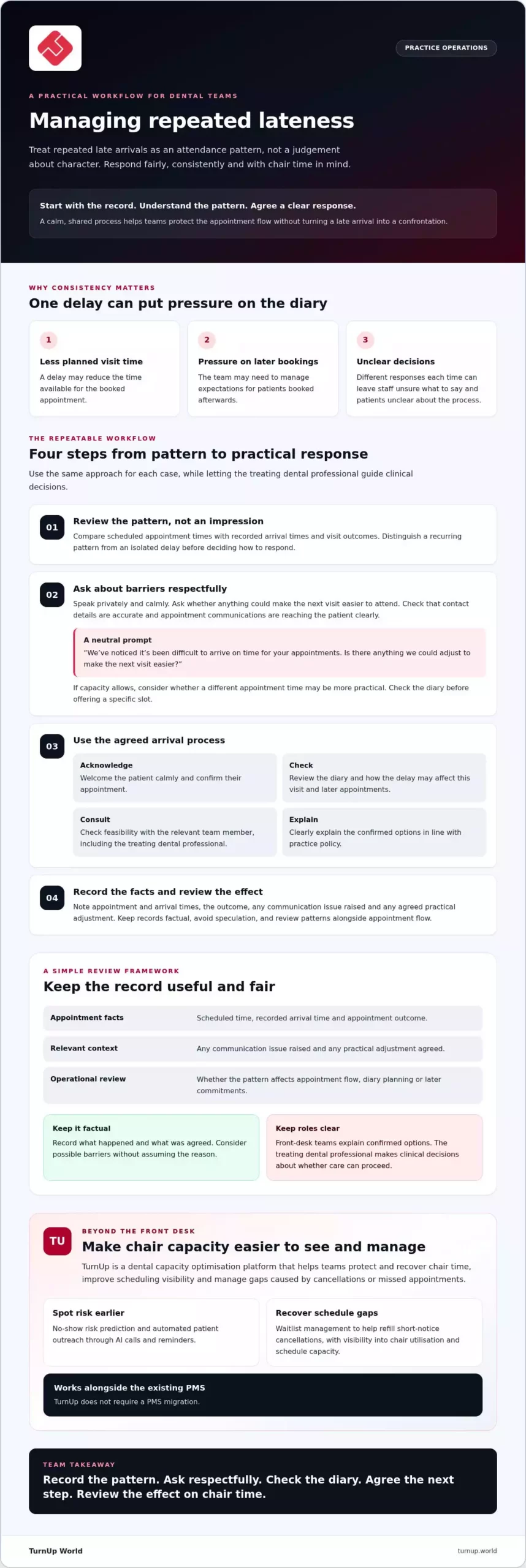
A clear arrival process helps the team respond consistently without making assumptions about whether an appointment can still go ahead. Agree the steps in advance, including who checks feasibility and who speaks with the patient. A practical workflow is:
- Acknowledge: Welcome the patient calmly and confirm their appointment.
- Check: Review the diary and establish how the delay affects the booked visit and later appointments.
- Consult: Ask the relevant team member, including the treating dental professional where needed, to confirm what is feasible.
- Explain: Tell the patient what can happen next, without promising the appointment can proceed before the practice has confirmed.
Give staff clear options for the current appointment
Set out who checks appointment feasibility and who updates the patient. Reception staff can explain confirmed options, such as proceeding if the clinician agrees it is feasible or discussing an alternative appointment, but shouldn’t make clinical decisions. Speak privately where possible. Keep the explanation calm, brief and consistent, and make the next step clear so the patient knows what to expect.
Set expectations for future appointments
Once the immediate issue is resolved, explain the practice’s arrival expectations in plain language. Check that the patient understands what to do if they’re delayed and how to contact the practice. Apply the established policy proportionately and consistently, rather than creating a new consequence at reception. Record the outcome and any agreed follow-up in line with practice procedures.
For teams considering how to deal with consistently late patients at scale, separate the attendance conversation from wider diary management. TurnUp helps dental teams improve schedule visibility, predict no-show risk and recover short-notice cancellations through automated waitlist management. Explore dental capacity optimisation to support a more efficient scheduling workflow.
Protect chair time with better visibility and follow-up
A consistent response at reception handles the immediate arrival. Reviewing patterns over time helps the practice see whether the issue is isolated or points to a wider scheduling problem. Track factual details such as scheduled and arrival times, appointment outcome, and whether the planned visit could proceed. Review these alongside diary changes and unfilled chair time, following the practice’s established processes for handling patient information.
Measure patterns without turning patients into a score
Use records to identify operational trends, not to rank or label patients. For example, a recurring timing issue around a particular appointment time may prompt a review of appointment planning. Repeatedly unsuccessful contact may suggest checking whether contact details or communication methods need updating. Keep notes objective and limited to relevant facts. The aim is to find practical improvements, not assign blame.
Review the findings with the team responsible for scheduling. Ask whether appointment lengths, diary processes or patient communications need adjustment. Agree a follow-up action and check whether it improves appointment flow. This gives practice leaders a repeatable way to understand how lateness affects usable chair time, rather than relying on individual recollections.
Connect attendance follow-up with chair-capacity recovery
Managing lateness is one part of protecting capacity. Teams also need visibility into gaps caused by cancellations and missed appointments, and a workable process for contacting patients who may be able to take an available slot. TurnUp supports this broader workflow with no-show risk prediction, automated patient outreach and waitlist management for short-notice cancellation recovery. Its capacity insights help teams review chair utilisation and scheduling patterns.
For practices considering how to deal with consistently late patients as part of a wider capacity plan, TurnUp offers tools for appointment scheduling, cancellation recovery and operational workflow automation. The platform supports teams in improving chair utilisation, while staff retain responsibility for patient conversations and operational decisions.
Make attendance management part of a stronger capacity plan
Knowing how to deal with consistently late patients starts with a fair process: identify repeat patterns from factual records, explore practical barriers without blame, and give staff a clear workflow for managing late arrivals. Review appointment outcomes too. They can show whether communication, diary planning or follow-up needs attention.
These steps help teams respond consistently while keeping chair capacity in view. TurnUp supports the wider workflow with no-show prevention, AI calls for appointment confirmation, cancellation and rebooking, and waitlist management to help recover short-notice cancellations.
Explore how TurnUp supports dental capacity optimisation and see how improved schedule visibility can support more efficient operations. With clear expectations and a repeatable approach, your team can protect usable chair time while treating patients respectfully.
Frequently Asked Questions
How should a dental practice speak to a patient who is repeatedly late?
Speak privately, describe the recorded pattern neutrally and ask whether anything would make future visits easier to attend. For example: “We’ve noticed you’ve arrived after your appointment time on several occasions. Is there anything we could adjust?” Listen without demanding personal details. Check whether appointment times or contact methods are practical, then explain the practice’s consistent process. Keep the conversation factual, respectful and focused on the next appointment.
Can a dental practice change an appointment if a patient arrives late?
A practice may need to alter the plan for a late arrival, but it should first check what is feasible under its policies and the clinician’s assessment. Reception staff should avoid promising treatment can proceed or making clinical decisions. Explain confirmed options calmly, such as proceeding if the clinician agrees or arranging another appointment. Make the next step clear to the patient.
How can a dental practice identify patterns in patient lateness?
Compare the scheduled appointment time with the recorded arrival time and note the appointment outcome for each visit. Review records over time to distinguish an isolated delay from a recurring pattern, and look for operational signals such as particular appointment times or communication problems. Keep notes factual and follow the practice’s established processes for patient information. Use findings to review diary planning or follow-up, not to label or rank patients.
What can a practice do when a late arrival disrupts the rest of the schedule?
Use an agreed sequence: acknowledge the patient, check the diary, consult the relevant team member, then explain confirmed options. The treating dental professional should decide whether the appointment can proceed where clinical judgement is needed. If the schedule must change, tell the patient privately and calmly, clarify what happens next, and record the outcome. Review the effect on later appointments so the team can coordinate the remaining diary.
Can appointment reminders help reduce repeated lateness?
Appointment communications may help if lateness is linked to forgotten appointments or unclear details, but they won’t address every barrier. Confirm that contact details are accurate and ask which communication method is useful. Review outcomes to see whether the approach helps. TurnUp supports automated patient outreach, including AI calls for appointment confirmation, cancellation and rebooking, as part of its dental capacity optimisation platform.