
Adding practices does not automatically make a dental group stronger. The toughest DSO growth challenges arise when reporting fails to show what is happening across locations, operating standards restrict appropriate clinical autonomy, or teams cannot recruit and retain the people needed to deliver care.
Growth is easier to manage when leaders establish consistent reporting and workflows without imposing a one-size-fits-all approach to clinical decisions. Clear visibility into scheduling, capacity and performance shows where operations are under strain, while structured processes give teams a reliable way to respond.
This article explains how to spot scaling risks early and address them without losing sight of profitability or patient care. You’ll learn how to standardise data, protect local clinical judgement, and include recruitment and retention in the operating plan. It also covers how better visibility into chair utilisation and cancellations can help dental groups recover lost production time and run scheduling more efficiently.
Key Takeaways
- Standardise how practices record and report performance so leaders can spot trends and act on comparable data.
- Set consistent operational processes while preserving clinical judgement at practice level.
- Make recruitment and retention part of the growth plan, with attention to onboarding, staff development and the conditions that support teams to stay.
- Use chair utilisation insights, no-show prevention and waitlist recovery to protect capacity alongside the existing PMS, without requiring a migration.
The 39% DSO Tipping Point?
The 39% figure is not a usable growth threshold because it does not define what the percentage measures. For UK dental groups, readiness depends on whether people, processes and reporting can support expansion.
Operational readiness before expansion
Operational readiness means having reliable processes and clear decision-making in place before adding another practice. Without them, acquisition demands can expose gaps in staffing, reporting and local management.
Rising interest rates increase borrowing costs, while existing debt can limit the ability to finance acquisitions or absorb integration costs. Leaders need to assess whether projected returns still justify the financing burden.
NHS contract pressures and demand for private dentistry shape which practices appear viable and where capacity is needed. Expansion plans should account for each practice’s patient mix, contract commitments and ability to deliver the intended care.
Visibility and decision-making
Operational visibility means comparing consistent performance information across practices. It helps leaders distinguish a local issue from a group-wide trend before committing resources or changing processes.
For example, compare appointment delays, staffing gaps and patient feedback across locations, then assign an owner to each recurring issue. Inconsistent patient reviews or unclear performance data can signal that operating processes are not keeping pace with growth.
Useful reporting also clarifies which decisions belong centrally and which require local input. That distinction helps organisations act on emerging trends without adding approval steps to routine practice decisions.
Standardising operations across practices
Standard operating procedures define repeatable processes while allowing clinical teams appropriate autonomy. They matter because acquired practices may bring different workflows, records and expectations.
In 2006, UK law changed to allow dental practices to be operated as Dental Bodies Corporate, according to UK Government. As groups acquire practices, integration risks include duplicated tasks, inconsistent data and confusion over who owns operational decisions.
Set group-wide standards for reporting and administrative workflows, then document where local teams retain discretion. This gives staff a shared operating baseline without treating every clinical decision as a central process.
Centralising data and operations
Centralising data means bringing information from practice-level systems into a consistent view for group decisions. It helps leaders compare locations, even when acquired practices use different tools.
Start with shared definitions for measures such as cancellations, capacity and staffing, then map each practice’s data to them. A centralised view can reveal recurring operational problems that isolated reports conceal.
Future-proofing means building repeatable onboarding and reporting processes that can accommodate another acquisition. Review data quality, decision ownership and unresolved workflow gaps before expanding. Otherwise, new locations can multiply existing inconsistencies.
Centralised reporting and data standardisation
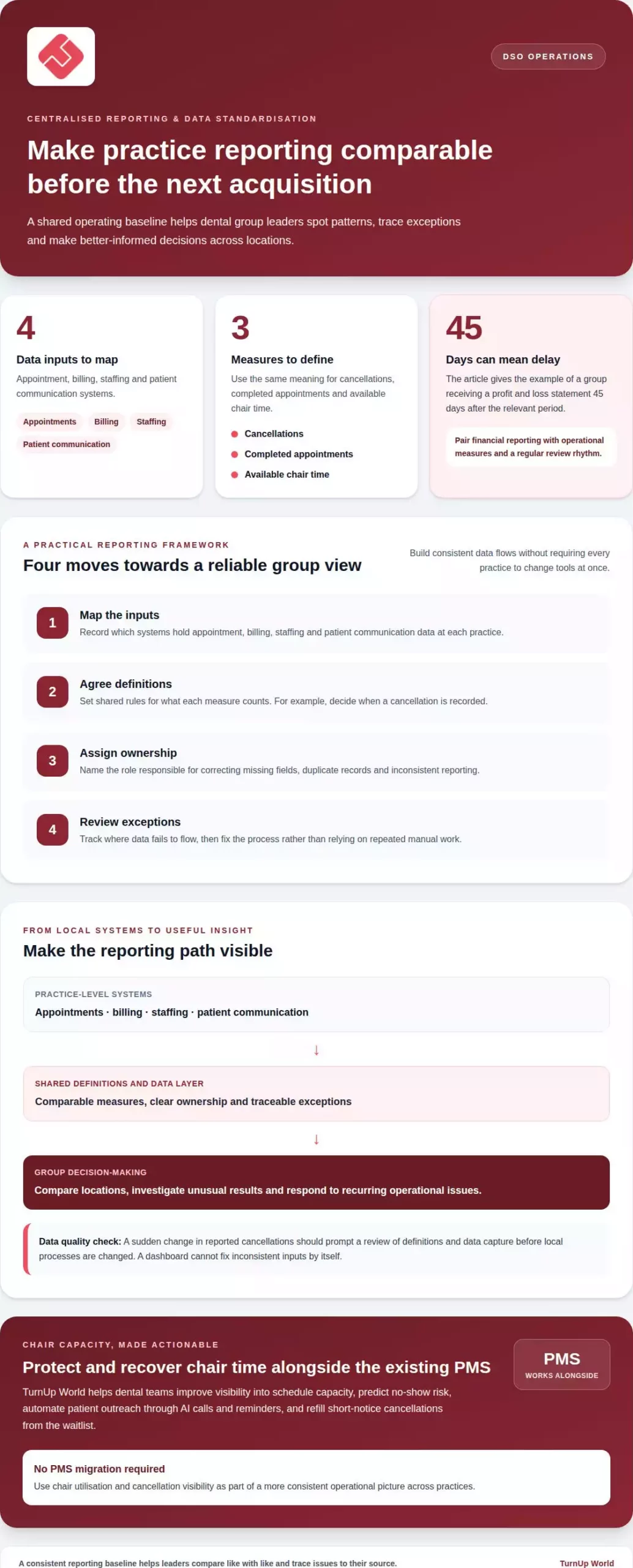
Centralised reporting gives leaders a comparable view of practice performance, even when locations use different systems. Without shared definitions, identical metrics can mean different things: one practice may count a cancellation when notice arrives, while another counts it when the booking is removed. This makes group-wide trends unreliable and weakens decisions about staffing, capacity and further acquisitions. A core DSO growth challenge is comparing practice performance on a like-for-like basis.
Build reporting infrastructure around clear ownership and repeatable data flows. For each measure, define what it counts, where its source data sits, how often it updates and who resolves exceptions. Connect acquired practices to a centralised data layer during onboarding, rather than waiting until local reporting becomes difficult to reconcile. This creates a consistent baseline without requiring every location to change tools at once.
- Map the inputs. Record which systems hold appointment, billing, staffing and patient communication data at each practice.
- Agree definitions. Standardise the meaning of measures such as cancellations, completed appointments and available chair time.
- Assign ownership. Name the role responsible for correcting missing fields, duplicate records and inconsistent reporting.
- Review exceptions. Track where data fails to flow, then fix the process rather than relying on repeated manual work.
Fragmented systems can force staff to repeat tasks, transfer information manually and correct recurring errors. A dashboard cannot fix inconsistent inputs by itself. It is useful when leaders can compare like with like and trace unusual results to their source. For example, a sudden change in reported cancellations should prompt a review of definitions and data capture before leaders alter local processes. Addressing these issues early helps prevent DSO growth challenges from compounding during expansion.
Timeliness matters too. Some groups receive a profit and loss statement 45 days after the relevant period, leaving leaders with a delayed view of performance. Pair financial reporting with operational measures, then establish a regular review rhythm. As the group grows, shared infrastructure strengthens resilience, supports patient-focused decisions and gives each acquisition a repeatable route into group reporting.
Balancing short-term profit with clinical quality
Financial efficiency supports growth, but cuts that damage care can weaken patient trust. Compare operational gains with patient experience, clinical capacity and the quality of each practice’s service.
Costs, profitability and patient access
DSOs can centralise functions and spread some operating costs across practices, while independent practices retain more direct local control. Neither structure guarantees higher profitability or better access. Outcomes depend on costs, service mix, appointment availability and how effectively each practice uses its capacity.
For example, compare billing accuracy, staffing costs and unfilled appointment time across locations before changing a process. Then assess patient access by looking at appointment availability and delays. This helps leaders determine whether a proposed efficiency improves performance or simply shifts pressure onto patients and clinical teams.
Sustainable growth and care quality
Sustainable growth means improving operational performance without weakening clinical standards or patient trust. Define which processes should be consistent across the group, while preserving local clinical judgement where care decisions require it.
Use a balanced review that considers financial results alongside patient feedback, appointment delays and recurring complaints. If a cost reduction coincides with longer waits or a poorer patient experience, investigate the workflow before extending the change to other practices. This gives leaders a practical way to protect quality while evaluating new opportunities.
Before implementing a change, document its intended benefit, the teams affected and the measures of success. For instance, assess a revised billing process for accuracy and administrative efficiency, not speed alone. A change to appointment capacity should consider whether patients can still access suitable appointments and teams can deliver care effectively.
Shared platforms can support consistent processes, but technology does not replace clinical oversight. Assign responsibility for reviewing results, gather feedback from patients and staff, and adjust procedures when evidence points to a problem. This keeps short-term financial decisions connected to the service patients actually receive.
Recruiting and retaining dental professionals
Recruitment gaps can constrain appointment capacity, increase pressure on existing teams and slow practice expansion. Workforce planning should link hiring, onboarding and retention to each practice’s operating needs.
In the UK, the legal framework includes Dental Bodies Corporate, which became permissible in 2006, according to UK Government. Treat ownership structure, CQC registration and practice management as distinct governance workstreams, with clear accountability for each.
Start workforce forecasting with the appointment book. Compare planned clinical capacity with staffing availability, then identify where vacancies or leave could disrupt patient access. For example, a practice with recurring gaps in a key role may need a recruitment plan before adding sessions or extending opening capacity.
Retention depends on the day-to-day experience of working in the practice, not just recruitment campaigns. Review staff feedback, turnover patterns and workload pinch points. If front-desk teams repeatedly handle scheduling changes manually, examine the workflow and remove avoidable steps before treating the issue as an individual performance problem.
Make onboarding consistent across locations. A practical process covers role expectations, local workflows, escalation routes and access to the systems needed for the job. Pairing new starters with an experienced colleague can also clarify responsibilities during the transition.
Build improvement into regular management. Give team leads responsibility for discussing development, reviewing workload and identifying process changes. Document recurring tasks so people can follow a shared approach, while giving practice teams a way to raise local issues. This balance supports working relationships and helps new colleagues understand how the dental group operates.
Innovation should reduce friction for staff, not add another disconnected process. Review whether technology makes routine coordination easier and whether teams understand how it fits their workflows. Leaders can then assess changes against staff feedback, appointment availability and operational continuity.
To connect capacity planning with day-to-day scheduling, explore ways to streamline dental appointment workflows.
TurnUp World
TurnUp World helps dental practices and multi-site DSOs manage capacity as they grow. Its platform brings scheduling visibility together with workflows that help teams protect chair time, reduce avoidable no-shows and recover short-notice cancellations. No-show risk prediction and automated patient outreach through AI calls and reminders support earlier intervention, while waitlist management helps teams refill newly available appointments.
TurnUp World is particularly relevant when inconsistent scheduling processes or limited visibility make it difficult to see where capacity is being lost across practices. It works alongside the existing practice management system, with no PMS migration required. The focus is practical: keep chairs occupied, recover lost production time and run scheduling operations more efficiently.
Contact TurnUp World to discuss your group’s dental capacity challenges.
Set the next growth decision up to succeed
Before approving another expansion, turn the opportunity into a decision brief. State the intended outcome, name the executive accountable for delivery and record the assumptions behind the plan. Set an early review point and define a clear signal that would prompt leaders to adapt their approach. This gives the group a way to learn from implementation rather than relying on projections alone.
The same discipline helps leaders respond to DSO growth challenges as operating conditions change. Treat each expansion as a decision to manage, not simply a milestone to reach. Keep measures relevant to the intended outcome and make responsibility for acting on them explicit.
If scheduling capacity is part of your next growth decision, contact TurnUp World to discuss how its platform could fit your group’s operations. A focused next step can help your team move forward with greater clarity.
Frequently Asked Questions
How can I avoid common scaling pitfalls in dental practice management?
Use an acquisition integration plan with a named owner, clear milestones and a record of unresolved decisions. For each incoming practice, map patient communications, referral handling and escalation routes before changing them. For example, record which team answers patient queries during a transition. Review exceptions regularly with practice managers so local issues reach the people who can resolve them.
Is it beneficial for local practices to keep autonomy?
Yes. Local autonomy can help practices respond to patient preferences and established community relationships. A practice manager may understand why patients prefer particular appointment patterns or communication approaches. Include that local knowledge in decisions about patient-facing workflows, while defining group-wide expectations for reporting, governance and administrative controls. This gives teams room to respond locally without making group performance difficult to understand.
What are the main challenges facing dental service organisations (DSOs) in the UK?
UK DSOs must coordinate acquired practices, maintain clear performance oversight and manage differences between NHS and private work. These pressures interact: a change in patient mix can affect appointment demand, staffing needs and practice-level processes. Leaders need to understand local conditions before applying group-wide decisions. Otherwise, a policy designed for one practice may not suit another’s operating model.
What are the biggest challenges recruiting and retaining dentists and dental staff in DSOs?
Recruitment and retention can be difficult when vacancies, workload and unclear role expectations combine. A new clinician may struggle if onboarding does not explain how decisions, referrals and team support work across the group. Make role expectations explicit, provide a consistent induction and give staff a way to raise operational concerns. Regular conversations can reveal friction early and help managers respond before it drives people away.