A cancellation policy protects chair time only when the team applies it consistently. Effective dental short notice cancellation management starts with a clear notice period, a fair approach to illness and emergencies, and accurate records of what happened.
A practice policy commonly sets 24 or 48 hours for cancelling or rescheduling without charge, but the exact terms should be clear to patients and staff. Illness and emergencies need a consistent, compassionate response, not an improvised decision at the front desk.
This guide explains how to set and communicate notice periods, handle unavoidable cancellations, and record the reason separately from whether the cancellation was short notice. It also shows how a reliable process helps teams track lost chair time and act quickly to refill cancelled appointments.
Key Takeaways
- Set a clear cancellation and rescheduling window, and explain how your team will apply it consistently.
- Use a calm, documented process for illness and emergencies that distinguishes unavoidable events from routine short-notice changes.
- Record the cancellation reason separately from a short-notice flag so reports reveal the operational impact on chair time.
- Pair a consistent policy with an active waitlist workflow to help recover appointments and keep chairs filled.
Illness and emergency circumstances
Illness or an emergency can make attending an agreed appointment impractical. A patient might report sudden illness, an accident or an urgent family situation. Ask when they became aware of the problem, record their explanation neutrally, and note when they contacted the practice. This helps distinguish an unavoidable disruption from a routine change of plans.
A waiver means deciding not to apply a cancellation charge to a particular missed or late-cancelled appointment. Some practices waive the charge on a first occasion when illness or an emergency makes cancellation unavoidable. Set clear criteria for considering a waiver and apply them consistently. Record the decision and reason, including whether the patient received a goodwill allowance.
Charges for missed NHS or private appointments can lead to disputes if patients did not understand the policy or staff apply it inconsistently. A private charge may be challenged, while NHS attendance policies can affect whether a practice offers further appointments. Explain the relevant policy clearly and document the circumstances, decision and communication.
Emergency dental care is urgent clinical care for a dental problem, not a cancellation decision. Keep the workflows separate: record the cancellation and follow the practice’s established route for urgent dental concerns. A cancellation policy must not replace clinical assessment or emergency support.
Use a consistent response when illness or emergencies arise:
- Record the patient’s stated reason and the time they gave notice.
- Apply the written policy, including any waiver criteria or goodwill allowance.
- Explain the decision and offer an appropriate rescheduling option.
- Escalate urgent dental concerns through the practice’s clinical process.
This approach gives the team a clear record without treating every short-notice cancellation as deliberate. For example, a patient reporting sudden illness can receive a documented policy review, while an urgent dental concern follows its separate clinical pathway.
Cancellation and rescheduling notice period
A notice period specifies how far in advance patients should cancel or rearrange an appointment. Practices need clear terms, consistent records and a practical plan for filling released chair time.
Cancellation fees and appointment policies
A cancellation policy explains when a practice treats a late change or non-attendance as chargeable. UK practice policies differ: some use a 24-hour window, while others require one clear working day’s notice. Some private practices also set deposit terms. A practice may publish charges, but don’t present one practice’s policy as a universal rule. Explain the applicable terms before patients book.
For NHS England and GDC, distinguish a local practice policy from a national rule. Explain NHS attendance arrangements separately from any private cancellation terms, without suggesting that one fee applies across all dental care.
Reducing last-minute cancellations
Reducing last-minute cancellations means making it easier for patients to act before their slot becomes difficult to refill. A 24- or 48-hour notice window gives the team time to offer released capacity to someone else. Greenside Dental Care uses 24 hours for cancelling or rescheduling without charge. March Dental Surgery requires at least one clear working day’s notice.
Make cancellation routes straightforward and record when a call, voicemail or email arrives. Greenside Dental Care uses the time it receives a voicemail or email when assessing notice. Apply the same timing method across channels so staff can explain decisions consistently.
Filling cancelled appointments at short notice
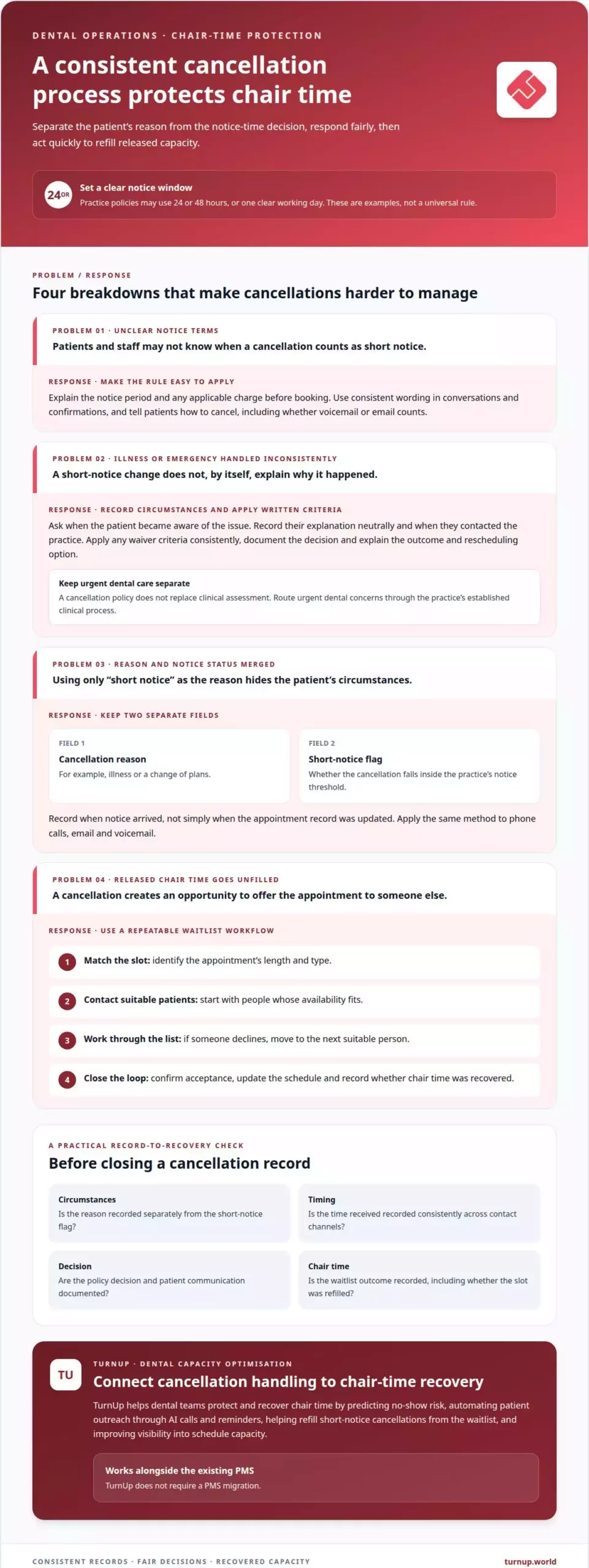
Short-notice recovery means offering a released appointment to a suitable patient who can attend. First, identify the appointment’s length and type. Then contact people on the waiting list whose availability fits the slot. Confirm acceptance, update the schedule and record whether the chair time was recovered.
This process prioritises fit and speed while keeping track of the original cancellation. Keep the list current and record the outcome of each contact. If someone declines, the team can move to the next suitable person instead of restarting the search.
Communicating charges and policies
Policy communication means giving patients clear terms before an appointment, including the notice period and any applicable charge. Family-oriented clinics such as Hour Dental show how establishing transparent booking expectations from the outset helps maintain patient trust while minimising missed appointments. Use consistent wording in booking conversations and written confirmations. Explain how patients can cancel, whether voicemail or email counts, and how the practice records receipt.
If a charge applies, explain the reason and decision directly. For example, distinguish a cancellation received within the notice period from one made earlier. Record what the patient was told and when. This supports consistent conversations and gives staff a clear basis for answering questions.
Recording short-notice cancellations
A short-notice cancellation record captures both why an appointment changed and whether notice fell within the practice’s threshold. Keeping these details separate gives managers a clearer view of patient circumstances and chair-time impact. If a patient reports illness, record that reason; assess whether it was short notice using the time the practice received the message.
If staff select only “short notice” as the cancellation reason, the record loses the underlying cause. Keep the genuine reason and add a separate flag for whether the cancellation met the practice’s short-notice definition. Include the flag in appointment reports so teams can distinguish, for example, an illness-related cancellation from a change of plans.
Apply the same rule across phone, email and voicemail. Record the time notice arrived, not simply when staff later updated the appointment. A practice using a 48-hour policy can flag cancellations received inside that window, regardless of the reason. This makes reporting consistent and helps identify cancellations that affect chair time.
For each changed appointment, capture practical details that support follow-up and reporting:
- The appointment date, time and type of dental care.
- The time and channel through which the patient gave notice.
- The stated cancellation reason and separate short-notice flag.
- Whether the slot was rescheduled or offered to another patient.
- The final outcome, including whether chair time was recovered.
Keep clinical information proportionate to the scheduling task. A brief note such as “patient reports sudden illness” records the operational reason without turning a cancellation entry into a clinical assessment. Review appointment reports regularly to see which reasons recur, whether teams apply the threshold consistently, and how often released capacity is refilled. Use the findings to refine staff guidance and the cancellation workflow, not to infer a patient’s intent from a single missed appointment.
How can dental practices reduce last-minute cancellations and failed appointments?
A prevention review identifies operational causes behind missed appointments and assigns a targeted response. Strong dental short notice cancellation management starts before the diary is full: examine where booking friction or appointment mismatches may be creating avoidable gaps.
Group cancellation patterns by appointment type, time of day and booking route. A cluster around a particular slot may point to a scheduling issue, while repeated changes after online requests may indicate a booking journey that patients find difficult. Treat these patterns as signals to investigate, not proof of why an individual cancelled.
At booking, make the appointment purpose and expected duration clear, using the practice’s approved scheduling criteria. Check that the selected slot fits the appointment type and that the patient understands what has been booked. If a patient has limited availability, offer suitable choices early rather than relying on a later rearrangement.
Use this decision sequence when reviewing a recurring pattern:
- Identify the appointment types and diary periods affected.
- Check whether booking details and slot allocation match practice criteria.
- Review whether patients can complete booking or changes through the available channels.
- Assign an operational change, then compare the pattern in a later review.
For example, if cancellations cluster around appointments booked through one route, trace the steps from request to confirmation. Look for unclear appointment descriptions, limited slot choices or handovers that leave patients uncertain. If the pattern centres on a particular appointment type, review how those slots are allocated. Address the identified process, and avoid changing clinical scheduling criteria without appropriate clinical input.
TurnUp World: Automated waitlist management and short-notice cancellation recovery
TurnUp World is a dental capacity optimisation platform that helps practices protect and recover chair time through automated waitlist management and short-notice cancellation recovery. When teams struggle to refill gaps manually, the platform coordinates patient outreach and rebooking through AI calls and automated reminders. No-show risk prediction and waitlist recovery support a connected capacity workflow.
TurnUp World works alongside your existing PMS, so practices do not need to migrate their system. For multi-site DSOs, capacity visibility helps teams monitor chair utilisation and cancellation recovery across practices. The result is a clearer operational view of available capacity, beyond reminders alone.
Contact TurnUp World to discuss short-notice cancellation recovery for your dental operation.
Build a more resilient scheduling operation
Make cancellation handling part of a wider capacity plan. Assign clear ownership for reviewing schedule gaps, tracking recovery outcomes and escalating recurring workflow issues. This turns dental short notice cancellation management from a front-desk reaction into an operational process that leaders can refine across practices.
Choose a review rhythm that fits your team’s operations. Use it to identify where handovers stall, which appointment types are hardest to refill, and whether local teams follow the same process. These insights help practice and DSO leaders focus on where chair time is most exposed, without treating every cancellation as the same problem.
For support connecting cancellation recovery with wider capacity operations, contact TurnUp World. A clearer process gives your team a stronger foundation for keeping schedules productive and adapting as practice needs change.
Frequently Asked Questions
What is a short-notice cancellation in a UK dental practice?
A short-notice cancellation is an appointment cancelled inside the timeframe set by the practice’s policy. Practices commonly define that window as 24 or 48 hours, so the term has no single threshold for every UK practice. For example, a cancellation received the day before an appointment may count under a 48-hour policy, but not under a shorter one.
How should dental practices use cancellation lists, SMS reminders and online booking?
Connect these channels into one workflow. Keep cancellation-list entries up to date with patients’ availability and appointment requirements, then offer released slots to suitable people. Send SMS reminders with a clear way to confirm or cancel. Online booking can make rescheduling easier, while staff should keep the practice diary updated to prevent duplicate bookings.
Which dental appointment reminder and short-notice booking software options are available in the UK?
UK practices can consider tools within their practice management software, dedicated patient communication products, or capacity platforms that combine reminders with cancellation recovery. TurnUp World focuses on dental capacity optimisation, including no-show risk prediction, automated patient outreach through AI calls and reminders, and waitlist recovery. It works alongside an existing PMS rather than replacing it, connecting appointment communication with the wider goal of recovering chair time.
How can a dental practice measure short-notice cancellation rates and recovery rates?
Use consistent definitions and a fixed reporting period. Calculate the short-notice cancellation rate by dividing appointments cancelled inside the policy window by all booked appointments, then multiply by 100. Calculate the recovery rate by dividing short-notice cancellations that were rebooked by the total short-notice cancellations, then multiply by 100. Report both measures alongside unrecovered chair time to show operational impact.