
What if the fastest way to fill an open hygiene slot isn’t another round of ad hoc calls, but a clear recovery workflow? Knowing how to fill hygiene schedule gaps starts with acting quickly and matching each appointment to a patient whose recall and appointment requirements fit the available time.
Late cancellations leave chairs unused, and a recall list is only useful when staff can quickly identify whom to contact and which slots suit them. Without a shared process, teams can duplicate calls, overlook suitable patients or spend time offering appointments that don’t fit.
This guide sets out a repeatable approach: record the gap, prioritise suitable patients, coordinate outreach and track the outcome. You’ll learn how to turn short-notice availability into a manageable workflow, measure which actions recover chair time and identify where gaps persist.
TurnUp World supports this process with no-show risk prediction, AI calls and reminders, automated waitlist management and capacity insights. It works alongside your existing practice management system, so you don’t need to migrate your PMS to improve visibility and recover lost hygiene chair time.
Key Takeaways
- Learn how to fill hygiene schedule gaps by turning each opening into a prioritised recovery task, rather than an ad hoc search.
- Check appointment type, duration and provider requirements before choosing patients who may be ready to attend sooner.
- Give each step, from recording the opening to confirming a replacement, a clear owner so opportunities aren’t missed.
- Track responses, confirmed replacements and unfilled time using consistent definitions to see where your process can improve.
How to Fill Hygiene Schedule Gaps: Start by Protecting Chair Time
A hygiene schedule gap is appointment time that becomes available and remains unfilled. It leaves usable chair capacity idle, can disrupt the day’s planned workflow and may create extra work as the team searches for a replacement. Schedule-gap recovery means matching newly available chair time with a suitable patient before that time is lost.
Not every opening needs the same response. Advance-booked availability gives the team more time to review recall and availability records. A late cancellation calls for a focused short-notice response, because there is less time to offer the slot. Distinguishing between the two helps staff prioritise instead of treating every gap as equally urgent.
Which hygiene gaps need attention first?
Start by checking how soon the appointment is, how long the slot is and whether it can still be offered. Check provider, room and appointment requirements before contacting patients. A slot may look available in the diary but be unusable if the required provider or room isn’t available. Separate these operationally blocked periods from genuine openings so the team can focus on recoverable chair time.
Why repeated manual calls are not a complete process
Calling patients can help recover an opening, but an unprioritised list can consume front-desk time without showing who has been contacted, whether anyone accepted or which gaps remain. Outreach is one step, not the whole capacity strategy. Teams need a consistent process to record the opening, check suitability, contact candidates, confirm a replacement and update the diary. General appointment scheduling software provides context for managing bookings, but gap recovery also depends on matching patients to usable time.
TurnUp supports this wider capacity workflow with automated waitlist management, short-notice cancellation recovery and scheduling capacity insights. It works alongside the existing PMS, with no PMS migration required.
Match the Open Hygiene Slot to the Right Patient
A quick booking only helps if the appointment fits. Before contacting anyone, check the slot’s appointment type, duration, provider and room requirements. Then use the practice’s existing recall and availability records to identify patients who have indicated they’re open to an earlier appointment. Confirm their current availability before making an offer, and follow the practice’s usual communication process.
Use recall information as a starting point
A recall list helps identify whom the team might contact, but it isn’t the cancellation-recovery workflow itself. Staff still need to verify that a patient can attend and that the opening matches the appointment details on record. For guidance on organising recall processes, see hygiene recall-list management. The American Dental Association also outlines recare appointment systems, a useful reference to consider alongside your practice’s established processes.
Check the wider diary before confirming
Review provider availability and connected appointments before confirming a replacement. An apparently open slot may depend on another booking or a particular provider being available. For wider context on coordinating associate diaries and chair capacity, see managing dental associate schedules.
Slot-matching checklist:
- Does the appointment type match the opening?
- Can the appointment duration fit?
- Are the required provider and room available?
- Do connected bookings allow the slot to be offered?
- Has the patient’s availability been checked before confirming?
This checklist keeps the process focused on suitable matches without adding clinical judgement to an administrative task. To coordinate patient outreach and short-notice openings as part of a wider chair-time workflow, explore TurnUp’s dental capacity optimisation platform.
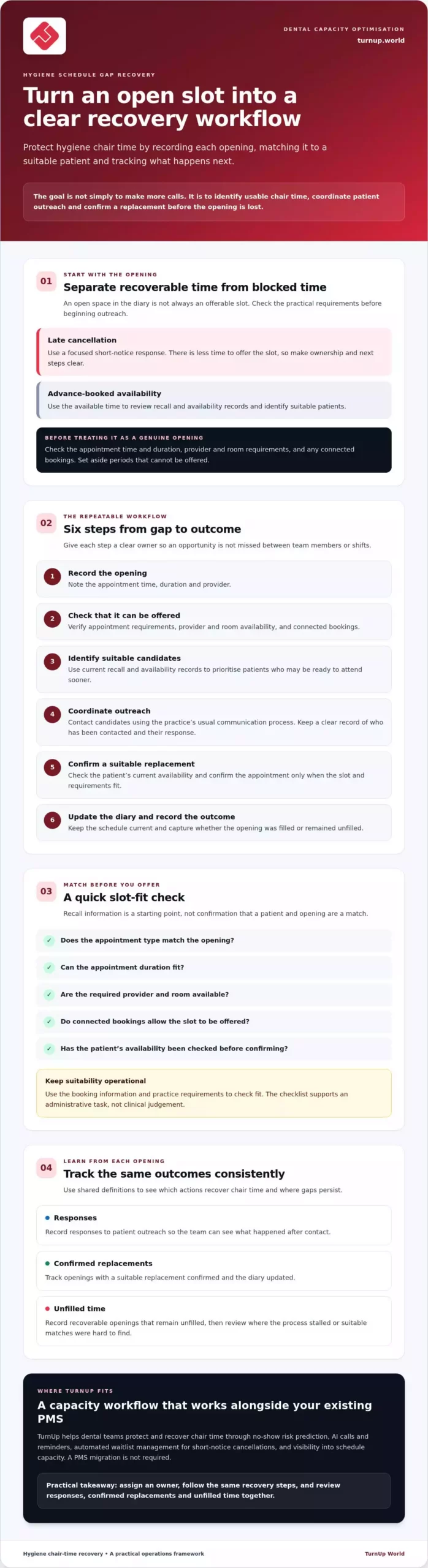
Fill Hygiene Schedule Gaps with a Repeatable Recovery Workflow
Once a slot and potential patient appear to be a suitable match, follow the same recovery sequence each time. A defined process makes ownership visible and reduces the risk of an opening being left between shifts or team members.
- Record the opening: note the appointment time, duration and provider.
- Check suitability: confirm the slot can be offered and identify any relevant booking requirements.
- Identify candidates: use current recall and availability records to create a prioritised list.
- Contact patients: follow the practice’s approved communication channels and sequence.
- Confirm and update: confirm the patient’s acceptance, then update the diary and record the outcome.
Assign an owner to each action, including checking for a response and closing the task if the slot remains open. This avoids relying on someone to assume a colleague has already acted.
Choose outreach based on the time available
For an opening with more lead time, the team may be able to follow its usual call and reminder sequence. For a short-notice cancellation, automated waitlist outreach or AI calls and reminders can support timely contact through the practice’s approved process. Automation helps coordinate outreach, while staff oversee suitability and booking decisions. Compare manual calls, reminders and automated outreach based on how well they fit the time available and the team’s workflow, not on assumed response rates.
Keep the PMS workflow intact
Record every confirmed change in the existing PMS, following the practice’s normal process. TurnUp supports cancellation recovery and waitlist workflows alongside the PMS, with no migration required. For a wider framework, read the productive dental scheduling guide.
To coordinate outreach, waitlist recovery and visibility into chair capacity, explore TurnUp’s dental capacity optimisation approach.
Measure Hygiene Gap Recovery and Improve the Process
To improve how to fill hygiene schedule gaps, track both what the team does and what happens to the available chair time. Agree a shared definition for each measure before comparing providers, practices or reporting periods. For example, decide what counts as an opening, when to start measuring time to first action and whether a replacement counts only once confirmed.
| Activity measures | Chair-time recovery outcomes |
|---|---|
| Openings recorded and time from opening to first action | Confirmed replacement appointments |
| Patients contacted and responses received | Unfilled appointment time remaining |
Find where the recovery workflow breaks down
Review each unfilled opening in sequence: was it recorded promptly, was there a suitable patient to contact, and did outreach happen? Note when cancellations occur and how much appointment time remains unfilled. Look for recurring patterns, then investigate rather than assume what caused them.
Outreach activity shows what the team attempted; confirmed recovery shows how much schedule capacity was actually refilled. Keep the measures separate. A high volume of calls or messages alone doesn’t establish that chair time was recovered.
Scale visibility across a practice group
Use consistent definitions across sites to compare cancellation recovery and chair utilisation more meaningfully. TurnUp dashboards provide visibility into capacity and recovery activity, helping leaders identify where to investigate. They support operational judgement, rather than replacing it: local teams still need to consider provider availability, patient suitability and workflow context.
Set a regular review cadence, such as a brief weekly check of recent openings followed by a monthly review of patterns across sites. Agree one process adjustment, assign an owner and assess the result at the next review. To evaluate how a capacity optimisation platform could support this work, see how TurnUp can help protect and recover dental chair time.
Make Every Hygiene Opening Count
Knowing how to fill hygiene schedule gaps starts with a consistent response: identify genuinely available chair time, match it to a suitable patient and give each recovery step a clear owner. Then review what happened. Outreach activity matters, but confirmed bookings and remaining unfilled time show whether the process recovered capacity.
TurnUp supports this wider workflow with automated waitlist management, short-notice cancellation recovery, and chair utilisation and scheduling capacity insights. It works alongside your existing PMS, so you can improve visibility and recovery without a PMS migration.
Explore TurnUp’s dental capacity optimisation platform to see how it could support your practice’s approach to protecting and recovering chair time. Start with one consistent workflow, review the results and build a more reliable process for keeping hygiene chairs in use.
Frequently Asked Questions
How can a dental practice fill a hygiene cancellation at short notice?
For teams deciding how to fill hygiene schedule gaps, start by recording the opening and checking its duration, appointment requirements, provider and room availability. Then review patients who have indicated they can attend sooner, contact suitable candidates using the practice’s established process, and confirm the booking before updating the diary. Assign an owner to follow up so the opening doesn’t remain unaddressed.
What is the best way to find patients for an open hygiene appointment?
Use current recall and availability records to identify potential patients, then verify their availability before offering the appointment. Match the slot’s duration and requirements to the patient and available provider. A recall list helps locate candidates, but it isn’t a complete recovery process by itself. Keep contact details and appointment information accurate, and follow the practice’s usual communication approach.
Can automation help fill dental hygiene schedule gaps?
Yes. Automation can support patient outreach and waitlist management when a cancellation creates an opening. AI calls and reminders can form part of a prioritised recovery workflow, helping teams coordinate contact alongside staff oversight. Automation doesn’t guarantee a replacement booking: the team still needs to check slot suitability, monitor responses, confirm any appointment and update the practice management system.
How should a practice measure hygiene schedule gap recovery?
Track openings recorded, time to first action, patients contacted, responses received, confirmed replacement appointments and appointment time left unfilled. Define each measure consistently before comparing providers, sites or reporting periods. Keep outreach activity separate from recovered chair time: calls or messages show what the team attempted, while confirmed bookings show whether the available schedule capacity was refilled.
Does TurnUp require a dental practice to replace its PMS?
No. TurnUp works alongside a practice’s existing practice management system, so a PMS migration isn’t required. It supports dental capacity optimisation through automated waitlist management, short-notice cancellation recovery and scheduling capacity insights. Practices can retain their established PMS workflow for recording confirmed appointment changes while using TurnUp to help coordinate recovery and improve visibility into chair utilisation.