Your most expensive asset is likely sitting idle right now. While your clinicians are ready, an empty chair represents more than just a missed appointment. It’s a systemic failure. You already know that high DNA rates and last-minute cancellations erode your margins. Your front desk teams are exhausted by the cycle of manual call lists and reactive scheduling. It’s a manual process trying to solve a digital-scale problem.
This guide reveals how to master dental capacity optimisation by shifting from reactive manual work to automated, high-precision management. You’ll discover how to eliminate idle chair time and standardise operations across every site in your portfolio. We’ll explore how the TurnUp Front Desk Copilot automates no-show prevention and turns last-minute gaps into predictable revenue growth. It’s time to stop reacting. It’s time to start engineering maximum occupancy across your entire organisation.
Key Takeaways
- Learn why your Practice Management System functions as a database rather than an engine, and how to transition to a strategic dental capacity optimisation framework.
- Discover how predictive automation identifies high-risk ‘Did Not Attend’ patients and fills last-minute gaps without manual staff intervention.
- Identify the ‘glass ceiling’ of standard software and why a front desk copilot is essential for scaling multi-site operations in 2026.
- Follow a five-step framework to audit true chair utilisation and standardise operational excellence across your entire DSO portfolio.
- Realise the cumulative revenue impact of filling just one additional chair per day per site through automated, silent capacity management.
What is Dental Capacity Optimisation? Beyond the Practice Management System
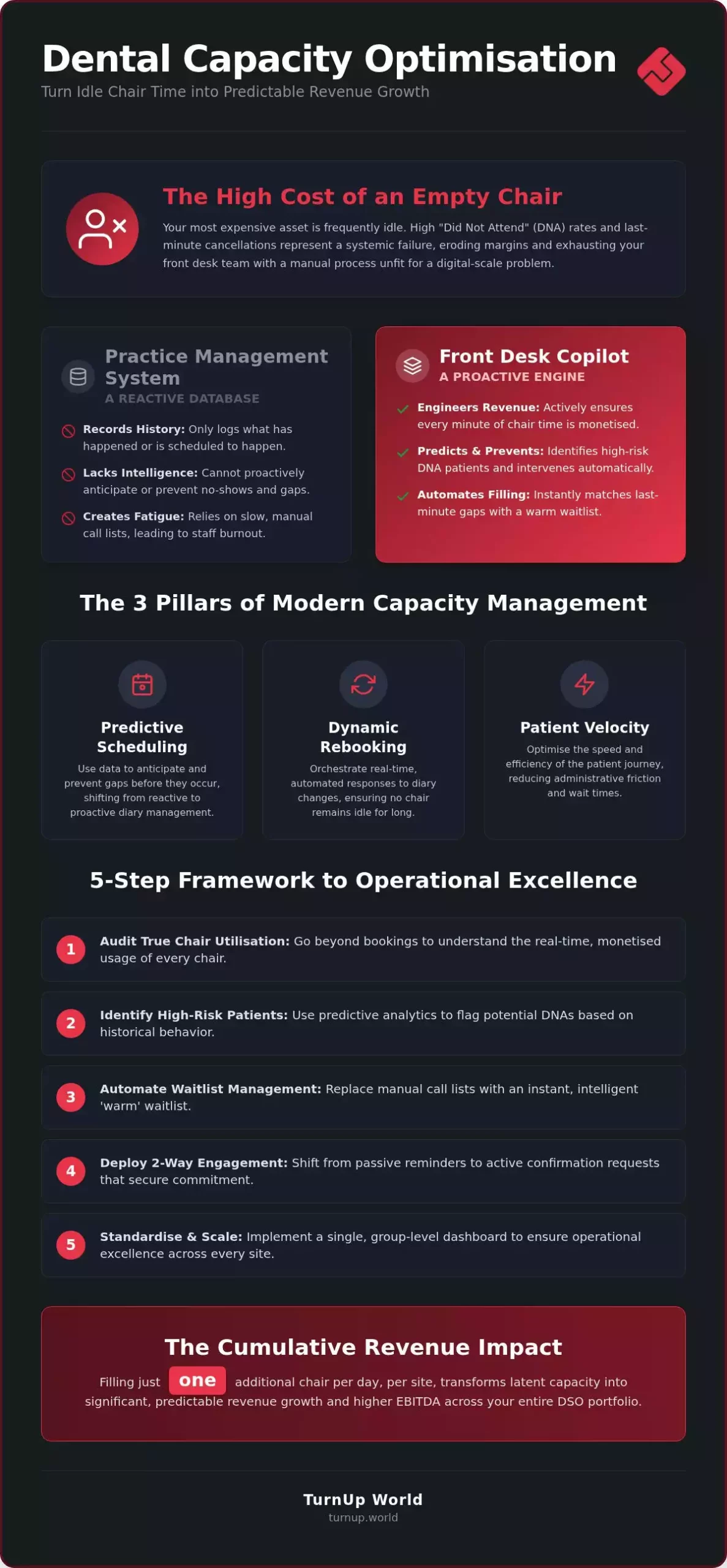
Dental capacity optimization is the strategic management of chair time to ensure maximum patient throughput across a multi-site organisation. It’s not just about filling a diary; it’s about engineering the flow of revenue. Most DSOs rely on their Practice Management System (PMS) for this task. However, a PMS is a database, not an optimisation engine. It records what happened or what is scheduled to happen, but it lacks the proactive intelligence to ensure that every minute of chair time is monetised.
For a DSO executive, capacity is the primary lever for EBITDA growth. An empty chair is a perishable asset; once that hour passes, that revenue is lost forever. This directly impacts valuation. To scale effectively, you must distinguish between clinical capacity (the number of clinicians and hours available) and operational capacity (the efficiency with which those resources are utilised). While clinical capacity is often fixed by recruitment, operational capacity is elastic and can be expanded through better operations management. This is where high-growth groups find their competitive edge.
The Three Pillars of Modern Capacity Management
Achieving true dental capacity optimization requires a shift from reactive booking to proactive flow management. This rests on three distinct pillars:
- Predictive Scheduling: Using data to anticipate gaps before they occur, rather than waiting for a cancellation to happen.
- Dynamic Rebooking: Orchestrating real-time responses to diary changes across multiple sites to ensure no chair remains idle.
- Patient Velocity: Optimising the speed and efficiency with which patients move through their treatment journey, reducing administrative friction.
Why Traditional Waiting Lists Fail DSOs
The traditional approach to cancellations is a static waiting list. It’s a manual, slow process that relies on front desk staff making dozens of calls. This “receptionist fatigue” cycle leads to staff burnout and high turnover. More importantly, it’s inefficient. A manual call list is too slow to fill a gap created by a last-minute cancellation. If a 15-minute gap isn’t filled, it creates revenue leakage that compounds across every site in the group. Static lists simply cannot keep pace with the modern patient’s expectations or the DSO’s need for standardised operational excellence. Automation executes where databases only record.
The Mechanics of Automated DNA Prevention and Last-Minute Filling
Standard SMS reminders are a baseline, not a solution. They notify patients of an existing appointment but do little to change the outcome if that patient is likely to miss it. Effective dental capacity optimization requires a shift from passive notification to predictive intervention. By analysing historical attendance patterns and booking behaviour, advanced platforms identify high-risk ‘Did Not Attend’ (DNA) patients long before the appointment time. This allows for targeted engagement rather than generic broadcast messaging. You’re no longer just reminding; you’re actively securing the chair.
Centralising these operations is vital for DSO executives. Managing capacity on a site-by-site basis creates silos and inconsistent performance. A group-level dashboard provides a single source of truth. It allows you to monitor DNA rates and chair utilisation across the entire portfolio in real time. This visibility enables you to deploy resources where they’re needed most. It ensures that operational excellence is standardised across every clinic in the organisation. Automation executes where databases only record.
Smart No-Show Prevention Strategies
Passive reminders often go ignored. Modern strategies focus on 2-way engagement that requires a response. This creates a psychological commitment from the patient. If a risk is detected, the system can automatically trigger a confirmation request or offer a more convenient slot. You can explore more on how can a dental group reduce no-shows to see how these behavioural nudges transform attendance. Automated rebooking for hygiene and routine check-ups further secures the pipeline. It moves the administrative burden from the front desk to the software.
Eliminating Idle Chair Time Automatically
When a cancellation occurs, the clock starts ticking. Manual call lists are too slow to rescue that revenue. The ‘Last-Minute’ solution automates the cancellation-to-booking pipeline by instantly matching the opening with a ‘warm’ waitlist of patients who need urgent care. This process of last minute dental appointment filling happens in minutes, not hours. It bypasses the need for phone calls entirely. By maintaining an active, digital queue, your clinics can maintain maximum occupancy even when the schedule shifts unexpectedly. To see this in action, consider how a front desk copilot can act as the silent engine of your practice.
PMS vs. Front Desk Copilot: The Essential Tech Stack for 2026
Standard Practice Management Systems (PMS) serve a purpose, but they aren’t designed for the complexities of modern dental capacity optimization. Most DSOs hit a ‘glass ceiling’ where the sheer volume of manual data entry and site coordination overwhelms the front desk. A PMS is essentially a digital ledger. It records appointments and patient history, but it doesn’t actively manage the flow of the clinic. To scale in 2026, executives need a technology stack that moves beyond record-keeping into automated execution.
The TurnUp Front Desk Copilot acts as a silent engine sitting on top of your existing database. It doesn’t require you to rip and replace your current software. Instead, it integrates seamlessly to provide the predictive intelligence your PMS lacks. This shift from reactive administration to proactive capacity management is what separates high-performing groups from those struggling with revenue leakage. It provides the data-driven authority needed to drive growth across a multi-site portfolio.
The Limitations of Legacy Dental Software
Legacy systems create manual bottlenecks that become visible as a dental group expands. Central management often lacks real-time, cross-site visibility, making it impossible to standardise operations. Standard SMS reminders are a prime example of this failure. They notify patients but don’t offer a mechanism to recover the chair if a cancellation occurs. This leaves the reception team stuck in a cycle of ‘receptionist fatigue,’ manually calling lists that are often hours out of date. Without an automation layer, your PMS is just a database of missed opportunities.
The TurnUp Front Desk Copilot Advantage
The TurnUp Front Desk Copilot removes the administrative ‘busy work’ that drains your team’s energy. It automates the execution of no-show prevention and last-minute gap filling, allowing your receptionists to focus on patient experience. You gain access to real-time reporting that distinguishes between clinical efficiency vs operational efficiency in dentistry. This clarity allows you to identify which sites are underperforming and why. Scalability becomes a reality, as you can add new clinics to your organisation without a corresponding increase in administrative headcount. You’re finally able to engineer a high-performance business through consistent dental capacity optimization.
5 Steps to Implementing a Capacity Optimisation Framework
Execution is the bridge between strategy and EBITDA growth. While many groups have policies for chair usage, few have the tools to enforce them across twenty or fifty locations. A robust dental capacity optimization framework moves beyond manual oversight. It creates a self-correcting system that identifies gaps and fills them without executive intervention. Following these five steps ensures your organisation treats capacity as a manageable flow rather than a random variable.
- Audit: Identify your current ‘true’ chair utilisation rate by looking at actual clinical minutes versus scheduled time.
- Standardise: Implement standardising procedures across dental clinics to ensure every site follows the same efficiency protocols.
- Automate: Deploy an execution layer to handle cancellations and DNA prevention instantly.
- Train: Empower your front desk teams to act on AI-driven insights rather than chasing manual call lists.
- Measure: Track the direct impact on EBITDA and the reduction in DNA rates site-by-site.
Auditing Your Utilisation Gaps
You can’t fix what you don’t measure accurately. Start by calculating the true cost of an empty chair across your group. This figure is often higher than executives realise when you factor in clinician downtime and lost treatment plan opportunities. Identify ‘trouble sites’ where cancellation rates consistently exceed your group average. Setting realistic benchmarks for 2026 performance requires this baseline data. It allows you to move from guesswork to precise, data-backed operational adjustments.
Scaling Operational Excellence
Consistency is the hallmark of a successful DSO. Create a centralised ‘Front Desk’ playbook that defines exactly how capacity is managed at every location. This doesn’t just improve revenue; it reduces staff churn. By automating high-stress tasks like emergency rebooking, you protect your team from burnout. A seamless patient journey is the final result. When a patient cancels, the system should offer a solution before they’ve even ended the call. To begin building your framework, book a demo of the TurnUp Front Desk Copilot today.
TurnUp Front Desk Copilot: The Future of DSO Operational Excellence
The TurnUp Front Desk Copilot isn’t an administrative add-on. It’s the silent engine that powers your entire organisation. In a landscape where clinical costs are rising, the competitive advantage belongs to the technology-first DSO. These groups don’t just hope for attendance; they engineer it through precise automation. Real-world ROI from automated capacity management shows that filling just one extra chair per day per site can fundamentally shift a group’s annual EBITDA. This isn’t a theoretical improvement. It’s a calculated operational standard.
Success in 2026 requires a departure from legacy thinking. While traditional groups are still hiring more staff to manage growing call lists, innovators are using software to eliminate the list entirely. This is the core of dental capacity optimization. It’s about doing more with your existing footprint rather than simply expanding it. Efficiency is the new growth engine.
Empowering Your Front Desk Team
Your receptionists shouldn’t function as a manual call centre. Outbound calling for cancellations is a low-value, high-stress task that leads to rapid burnout. By deploying TurnUp, you shift their focus toward becoming a patient experience centre. AI handles the repetitive execution of filling gaps and preventing no-shows. This reduces administrative friction and significantly lowers staff turnover. You’re building a culture of proactive care where your team is empowered by insights rather than exhausted by manual data entry.
Future-Proofing Your Dentistry Group
The UK dental market is shifting, and DNA trends are becoming more volatile. Predictive analytics allow you to stay ahead of these changes by identifying risks before they manifest as empty chairs. Dental capacity optimization is the most effective lever for DSO success because it maximises the revenue potential of your current assets. You don’t necessarily need more clinics to scale; you need more from the clinics you already have. Predictive tools ensure your group remains resilient regardless of market fluctuations.
The next step is a clear-eyed look at your current operations. Auditing your group’s capacity potential reveals exactly where revenue leakage is occurring. Most DSOs find they’re operating significantly below their true chair utilisation limit. It’s time to stop leaving your schedule to chance and start engineering your growth.
Master Your Operational Flow
Operational excellence in 2026 isn’t about working harder; it’s about deploying more intelligent systems. You’ve seen how legacy software creates a glass ceiling for growing DSOs and why manual waiting lists are a primary source of revenue leakage. By shifting to a proactive model, you transform your clinics from a collection of sites into a high-precision engine. Effective dental capacity optimization ensures that every minute of chair time contributes to your group’s EBITDA. It’s the difference between reacting to gaps and preventing them entirely.
The TurnUp Front Desk Copilot provides the execution layer needed to eliminate idle time across your portfolio. With specialised NoShow prevention for DSOs and predictive AI-driven scheduling, you can automate last-minute appointment filling without increasing administrative pressure. This technology-first approach positions your organisation as a leader in a competitive market. It’s time to empower your staff and secure your margins with a silent, reliable solution. Optimise your DSO capacity with TurnUp Front Desk Copilot and start engineering a more predictable, profitable future for your organisation today.
Frequently Asked Questions
What is the difference between dental capacity and chair utilisation?
Capacity represents the total potential treatment time available based on your clinicians and surgeries. Chair utilisation is the percentage of that time actually being monetised. While capacity is often fixed by your recruitment levels, utilisation is elastic. It serves as the primary metric for measuring the success of your dental capacity optimization efforts across a multi-site organisation.
How can a DSO reduce no-shows without hiring more staff?
You can reduce no-shows by deploying automated, 2-way engagement tools that require active patient confirmation. Predictive AI identifies high-risk patients based on historical behaviour and triggers targeted interventions. This removes the administrative burden from your receptionists. Instead of manual call lists, the system handles the heavy lifting, allowing your existing team to focus on the patient experience.
Does capacity optimisation software replace my current PMS?
No, capacity optimisation software acts as an execution layer that sits on top of your existing Practice Management System. It doesn’t replace your database; it enhances it. While your PMS records the schedule, the TurnUp Front Desk Copilot actively manages it. It integrates seamlessly to pull data and automate the booking of last-minute gaps that standard software often overlooks.
Can automated rebooking tools handle complex dental treatments?
Automated tools respect the specific clinical requirements of complex treatments. The system uses intelligent matching to ensure that gaps are only offered to patients whose treatment needs fit the available time and clinician skill set. It doesn’t just fill slots; it optimises for the right patient in the right chair. This maintains clinical standards while ensuring high operational efficiency.
How does capacity management improve DSO profitability and EBITDA?
Capacity management directly impacts EBITDA by monetising hours that would otherwise be lost to cancellations. Every filled chair represents pure margin once fixed costs are covered. For a DSO, scaling this efficiency across dozens of sites creates a massive cumulative impact on valuation. It’s the most effective way to drive growth without the capital expenditure of opening new locations.
What is a typical DNA rate for a high-performing dental group in 2026?
High-performing dental groups in 2026 typically aim for DNA rates below 2%. While industry averages vary, those using advanced dental capacity optimization tools consistently outperform their peers. Achieving this requires moving beyond simple reminders to predictive, behavioural-based interventions. Groups that fail to automate often see rates significantly higher, leading to substantial and avoidable revenue leakage.
Is TurnUp Front Desk Copilot suitable for both NHS and private practices?
Yes, the platform is engineered to support the unique scheduling demands of both NHS and private dentistry. In NHS settings, it helps manage high patient volumes and contract delivery targets. For private practices, it focuses on high-value treatment throughput and premium patient engagement. The flexibility of the TurnUp Front Desk Copilot ensures every clinic type in your organisation operates at peak efficiency.
How long does it take to implement a capacity optimisation platform across multiple sites?
A typical implementation across a multi-site organisation takes between 4 and 8 weeks. The process is designed to be non-disruptive. Because the software integrates with your existing PMS, there’s no need for data migration or extensive staff retraining. Your teams can start seeing the benefits of automated gap filling and no-show prevention almost immediately after the initial activation phase.