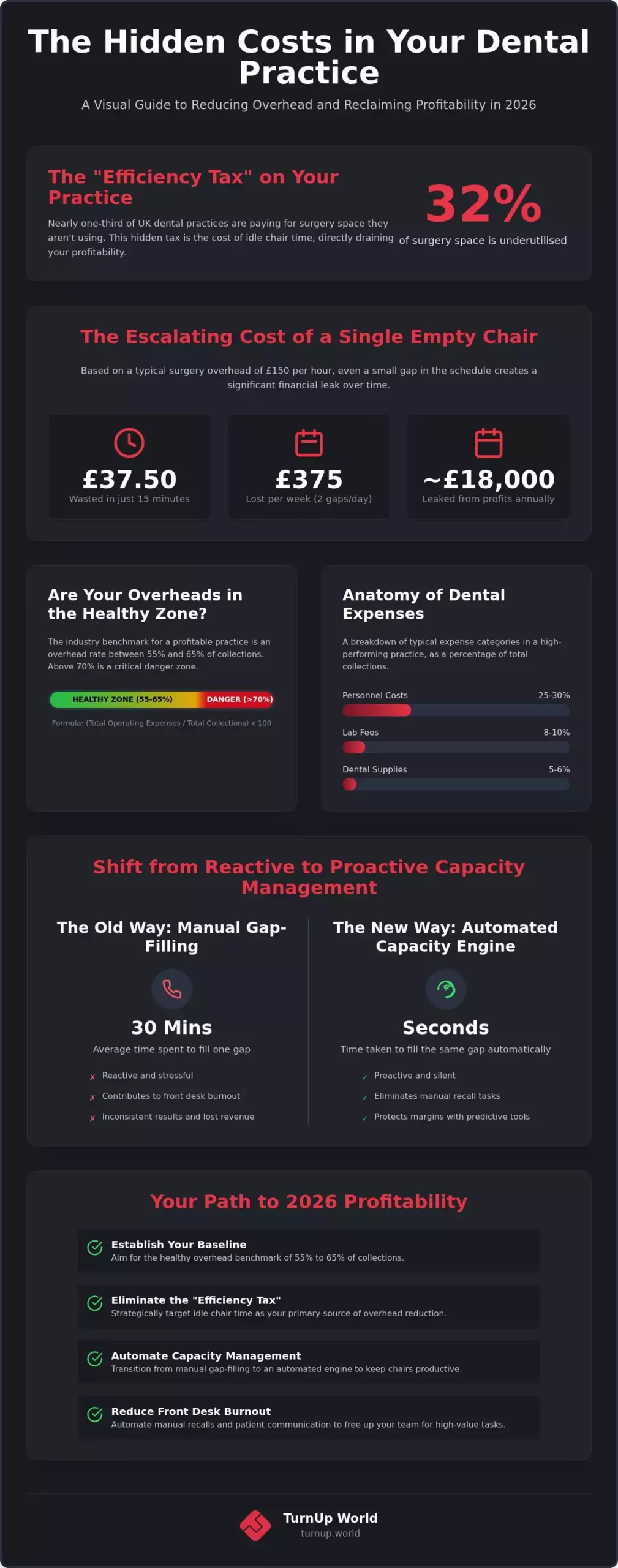
Nearly 32% of dental practices are currently paying for surgery space they aren’t actually using. When a chair sits empty due to a last-minute cancellation, you’re still paying for the staff, the utilities, and the lease. This hidden “efficiency tax” is the primary reason many UK practices struggle to maintain profitability. With staff salary demands at an all-time high, the traditional manual approach to scheduling is no longer enough to protect your margins.
Achieving sustainable dental practice overhead cost reduction in 2026 requires a shift from reactive gap-filling to proactive capacity optimisation. You don’t need to sacrifice clinical quality or stretch your team to breaking point to see results. Instead, you can reclaim the 60-65% overhead benchmark by automating the way you handle short-notice gaps and manual recall tasks. This guide outlines how to eliminate front desk burnout and improve operational visibility across your entire DSO. You will learn how to replace outdated scheduling habits with a silent, reliable engine that keeps your surgeries productive and your overhead controlled.
Key Takeaways
- Establish your 2026 profitability baseline by aiming for the healthy overhead benchmark of 55% to 65%.
- Execute a strategic dental practice overhead cost reduction by identifying and eliminating the “Efficiency Tax” caused by idle chair time.
- Transition from manual gap-filling to automated capacity management to reduce the time spent on scheduling from 30 minutes to seconds.
- Protect DSO-wide margins with predictive NoShow prevention tools that act as a proactive shield against revenue loss.
- Reduce front desk burnout and operational friction by automating manual recall tasks and patient communication workflows.
Understanding Dental Practice Overhead: Benchmarks for 2026
Dental practice overhead is the total cost of operating your surgery before you, the owner, take a single pound in compensation. It’s the financial weight your business carries every day. In the 2026 market, achieving meaningful dental practice overhead cost reduction isn’t about cutting corners on patient care; it’s about surgical precision in resource allocation. For most UK practices, the “Healthy Zone” for overhead sits between 55% and 65%. If your costs exceed 70%, your profitability isn’t just under pressure; it’s in a danger zone that requires immediate intervention.
To master your margins, you must distinguish between fixed and variable costs. Fixed overhead includes rent, business rates, and basic utilities. These costs remain static whether you see one patient or fifty. Variable overhead, such as dental supplies and lab fees, fluctuates based on your clinical volume. However, the most critical metric is your “Chair-Hour Overhead.” This is the fixed cost of an operatory existing every hour. If your surgery costs £150 per hour to run, an empty chair is a direct withdrawal from your profit. Mastering Understanding Practice Management starts with categorising these expenses correctly to identify where your money is actually going.
The Anatomy of Dental Expenses
A high-performing practice typically breaks down its largest expenses into three primary categories. Personnel costs, including salaries and benefits for nurses and front desk staff, should ideally range between 25% and 30% of collections. Dental supplies should account for 5% to 6%, while lab fees typically sit between 8% and 10%. The friction between clinical efficiency vs operational efficiency in dentistry often determines whether these percentages remain stable or creep upward. Beyond these, you must monitor “Discretionary Costs.” These are often overlooked expenses like redundant software subscriptions, over-specified marketing packages, or premium maintenance contracts that don’t offer a clear return on investment.
Calculating Your Current Efficiency Rate
You can’t manage what you don’t measure. To find your efficiency rate, use this simple formula: (Total Operating Expenses / Total Collections) x 100. Always use collections rather than production for this calculation. Production is a vanity metric; you can’t pay your staff or your suppliers with production figures that haven’t hit your bank account yet. This calculation provides a transparent view of your dental practice overhead cost reduction progress.
Once you have your percentage, look closer at your daily schedule to identify “Capacity Leakage.” This occurs when gaps in the diary or late cancellations leave your fixed costs uncovered. If your overhead is £150 per hour, a 15-minute gap isn’t just a quiet moment. It’s £37.50 in pure waste. Identifying these leaks is the first step toward reclaiming your profit margins and moving toward the 55% benchmark.
Identifying the Efficiency Tax: The High Cost of Idle Chairs
In many UK practices, overhead is viewed as an unavoidable burden of rent and supplies. This perspective misses the most volatile expense: the “Efficiency Tax.” This is the fixed cost you pay for every minute a dental chair sits empty. While you can negotiate a lab fee or switch suppliers, you cannot recover the lost value of an idle operatory. An empty chair is the most expensive “item” in your practice because it consumes resources without generating revenue.
Consider the math. If your surgery overhead is £150 per hour, a 15-minute gap in the diary represents £37.50 in pure waste. Over a standard working week, just two such gaps a day lead to a £375 weekly loss. Annually, this leaks nearly £18,000 from your bottom line. The damage isn’t just financial; it’s operational. A no-show creates a “ripple effect” that disrupts the entire daily workflow. Clinical teams lose momentum, while the front desk enters a reactive crisis mode. Implementing healthcare capacity optimization is the only way to stop this cycle. It ensures your resources are utilized predictably, reducing the need for expensive last-minute temp staff to cover sudden surges in demand.
The Hidden Impact of No-Shows
A no-show rate of 3-5% might seem manageable on paper. In reality, for a multi-surgery practice, it equates to tens of thousands in lost annual profit. Beyond the balance sheet, there’s a significant psychological toll. Constant cancellations cause front desk burnout, as staff feel they’re fighting a losing battle against the clock. This friction directly hinders your dental practice overhead cost reduction efforts by increasing administrative churn and recruitment costs. There’s a direct correlation between high no-show rates and an inflated administrative budget that fails to produce a return.
Why Manual Short-Notice Lists Fail
Traditional “short-notice lists” are inherently flawed. When a gap appears, a receptionist often spends 20 minutes playing “phone tag” to fill a 30-minute slot. It’s a low-yield activity with high operational friction. The opportunity cost is massive. While they’re tied to the phone, they aren’t engaging with patients in the lounge or discussing treatment plans. High-growth DSOs have abandoned this manual struggle in favour of automated last minute dental appointment filling. This shift moves the front desk from reactive calling to proactive patient management. To see how automation can reclaim these lost hours, you can explore how a digital copilot handles scheduling gaps without human intervention.
How to Reduce Dental Overhead: A Systematic 4-Step Framework
Meaningful dental practice overhead cost reduction isn’t achieved through minor cuts to the supply budget. It requires a fundamental restructuring of how you manage your practice capacity. In the 2026 market, the most successful surgeries treat their schedule as a perishable asset. If a surgery hour isn’t used, its value is lost forever. To protect your margins, you must move from a reactive front desk model to a proactive, automated system. This four-step framework provides the roadmap to reclaim your profitability.
Step 1 & 2: Audit and Automate
The first step is a comprehensive capacity audit. Your Practice Management Software (PMS) contains the data needed to identify “dead zones” in your weekly schedule. These are the specific hours where production consistently fails to cover your fixed chair-hour costs. Often, these gaps occur on specific days or during mid-afternoon slumps. Once you’ve mapped these leaks, you can’t rely on manual effort to plug them. Manual scheduling is slow, expensive, and prone to human error.
Instead, you must automate patient communication. Implementing two-way SMS and automated reminders can lower your baseline no-show rate by up to 3% without adding to your staff’s workload. This shift eliminates the salary cost associated with manual confirmation calls. Digital intake forms further reduce administrative friction. By moving to a paperless system, you slash the direct costs of stationery and, more importantly, the indirect costs of manual data entry. Your team should spend their time on patient care, not on scanning forms or chasing signatures.
Step 3 & 4: Predict and Standardise
True efficiency requires foresight. Step three involves implementing predictive scheduling. Modern AI tools can now identify “high-risk” patients who are statistically likely to cancel based on their historical behaviour or appointment type. By flagging these risks early, your system can prepare automated backup workflows to fill the potential gap before it even happens. This proactive stance turns a potential £150-per-hour loss into a revenue-generating slot.
For Dental Service Organisations (DSOs), the final step is scale. You must focus on standardising procedures across dental clinics to eliminate management bloat. When every location follows the same automated protocol, the need for site-specific administrative oversight vanishes. This standardisation allows for centralised capacity management. One coordinator can effectively manage the schedules of multiple sites from a single dashboard. This model replaces the need for a full-time scheduling manager at every location, drastically reducing your total personnel overhead while improving operational visibility across the entire group.
Manual vs. Automated Capacity Management: A Cost Comparison
Manual scheduling is a drain on your most expensive resource: human time. When a receptionist manually manages a short-notice list, you’re paying for their salary, National Insurance, and pension to perform a task that software executes in seconds. This inefficiency is a direct barrier to dental practice overhead cost reduction. A manual approach typically requires 30 minutes or more of active phone time to fill a single gap. An automated blast notification reaches your entire patient base in seconds. The difference isn’t just minutes; it’s the difference between a filled surgery and a dead hour.
Data accuracy also suffers under manual systems. Spreadsheets and paper lists are static and prone to human error. AI-driven assistants integrate directly with your PMS to provide real-time updates. This ensures your capacity data is always precise. Beyond the numbers, automation tackles the 54.2% staffing shortage crisis by reducing the administrative friction that causes burnout. Keeping your existing team is far cheaper than the recruitment and training costs associated with high staff turnover. When your team feels supported by technology rather than buried by paperwork, retention rates stabilise.
The ROI of the Front Desk Copilot
The break-even point for automation is remarkably low. If your system fills just two or three cancellations a month that would have otherwise gone empty, the investment has paid for itself. This calculation ignores the “Silent ROI.” When your front desk isn’t tethered to the phone playing “phone tag,” they can focus on patient experience and high-value treatment coordination. Predictive AI handles the mundane tasks of confirmation and gap-filling. This frees your clinical staff to focus on complex procedures rather than worrying about the afternoon’s gaps. You can see how the TurnUp Front Desk Copilot automates these workflows to reclaim your team’s time.
Reducing DSO Management Overhead
For multi-site groups, the cost of decentralised scheduling is immense. It requires frequent check-in meetings and manual reporting to understand group-wide capacity. This management bloat is a silent profit killer. Centralised automation allows a lean corporate headquarters to maintain total visibility without adding headcount. Real-time data replaces the need for “status update” calls. You no longer need a regional manager to manually audit diaries; the system provides a single source of truth for every location. This technological shift allows DSOs to scale their patient volume without proportionally increasing their administrative overhead costs.
Scaling Efficiency: The TurnUp Approach to DSO Profitability
Sustainable dental practice overhead cost reduction requires more than just better software. It demands a specialised engine built for the unique pressures of multi-location dentistry. The TurnUp Front Desk Copilot serves as this engine. It doesn’t just manage appointments; it protects your margins by addressing the root cause of capacity leakage. By automating the most volatile parts of the schedule, it transforms the front desk from a cost centre into a high-efficiency revenue driver.
The NoShow prevention tool acts as a proactive shield against revenue loss. While traditional reminders are reactive, this system uses predictive AI to identify patterns before they become empty slots. Verified 2026 data indicates that predictive AI can reduce no-show rates by up to 3%. For a large DSO, this minor percentage shift represents hundreds of thousands of pounds in recovered annual revenue. When a gap does occur, the LastMinute solution takes over. It maintains chair utilisation rates of 95% or higher by instantly connecting with patients ready to fill short-notice openings. This level of precision is the new foundation for DSO valuations. Investors and buyers no longer just look at collections; they look at operational efficiency and the reliability of your patient flow during exit strategy assessments.
The TurnUp Front Desk Copilot in Action
Efficiency shouldn’t create more work for your team. The TurnUp Front Desk Copilot is built on a “No-Click” philosophy. It integrates seamlessly with your existing UK Dental PMS, working silently in the background. Your staff doesn’t need to learn a complex new interface or manually trigger notifications. The system identifies a gap, matches it with the right patient, and handles the communication autonomously. The TurnUp Copilot is a 24/7 autonomous capacity manager for dental groups that eliminates the need for manual intervention.
Future-Proofing Your Practice for 2027 and Beyond
The landscape of UK dentistry is shifting toward total automation. Waiting to implement these systems creates an “Opportunity Overhead” that your practice can no longer afford. Every day you rely on manual scheduling is a day you pay for idle capacity. Practices that adopt these tools now gain a massive competitive advantage. They can offer same-day gap appointments to new patients, capturing market share that traditional surgeries simply can’t reach. This responsiveness builds patient loyalty while keeping your overhead firmly within the healthy benchmark. Don’t let manual processes cap your growth. You can book a demo of the TurnUp Front Desk Copilot to see your potential overhead savings and secure your practice’s financial future.
Future-Proof Your Practice Operations
Achieving sustainable dental practice overhead cost reduction isn’t a matter of luck; it’s a matter of logic. You’ve seen how the “Efficiency Tax” of idle chairs and manual scheduling friction erodes your bottom line. By shifting to a systematic, automated framework, you move from reactive chaos to proactive control. This transition protects your staff from burnout while ensuring every surgery hour contributes to your profitability. You don’t need to work harder to see better margins; you just need to work smarter.
The TurnUp Front Desk Copilot is built specifically for DSOs and multi-site groups ready to lead the market. It uses predictive AI to reduce no-shows by up to 3% and deploys automated LastMinute solutions to maintain maximum chair utilisation. This isn’t just another software tool; it’s a silent engine for operational excellence that works in the background of your existing PMS. You can optimise your dental practice capacity with the TurnUp Front Desk Copilot today. Reclaiming your healthy 55-65% overhead benchmark is within reach. Take control of your schedule and watch your margins stabilise.
Frequently Asked Questions
What is a good overhead percentage for a dental practice in 2026?
A healthy target for a UK dental practice in 2026 is an overhead between 55% and 65% of total collections. While the industry average typically sits between 59% and 67%, top-performing practices aim for 55% or lower. If your overhead exceeds 70%, your practice is likely struggling with profitability and requires immediate operational intervention to reduce waste.
How does reducing no-shows directly impact my overhead costs?
Reducing no-shows lowers your overhead percentage by increasing the total collections that cover your fixed expenses. You pay for your staff, rent, and utilities regardless of whether a patient attends. By filling an empty slot, you convert a pure loss into revenue. This recovery of idle capacity is the most effective strategy for dental practice overhead cost reduction available today.
Can I reduce overhead without laying off front desk staff?
You can lower overhead while retaining your existing team by focusing on capacity optimisation. Automation isn’t about replacing people; it’s about eliminating the low-value manual tasks that cause burnout. By using technology to handle recall and gap-filling, your front desk can transition into high-value roles like treatment coordination. This increases production without the need for additional recruitment or staff cuts.
What are the biggest “hidden” costs in a dental office P&L?
The most significant hidden cost is the “Efficiency Tax,” which represents the fixed cost of an operatory existing every hour it sits empty. Other overlooked expenses include the high cost of staff turnover and the salary waste associated with manual scheduling. If a receptionist spends 20 minutes playing “phone tag” to fill a 30-minute gap, you’ve lost money on both clinical and administrative fronts.
How much can AI-driven capacity optimization save a DSO annually?
AI-driven capacity optimisation can save a DSO hundreds of thousands of pounds across multiple locations by reclaiming lost surgery time. Predictive AI can reduce no-show rates by up to 3%, while automated gap-filling ensures chair utilisation remains above 95%. For a multi-site group, these incremental gains accumulate into a massive increase in EBITDA and overall group valuation without increasing headcount.
Is it better to cut supply costs or focus on chair utilisation for overhead reduction?
Focusing on chair utilisation offers a far higher return than cutting supply costs. Dental supplies typically account for only 5% to 8% of collections, whereas personnel and facility costs are the largest burdens. Increasing your chair utilisation by even 2% provides a much larger impact on your bottom line than negotiating a 10% discount on clinical consumables.
How does the TurnUp Front Desk Copilot integrate with my current dental software?
The TurnUp Front Desk Copilot integrates directly with your existing UK Dental Practice Management System (PMS). It operates as a silent, background engine that reads your live diary without requiring manual data entry or complex uploads. This “No-Click” philosophy ensures that your team doesn’t have to manage another dashboard or disrupt their established clinical workflows to see results.
What is the ROI of automated last-minute appointment filling?
The ROI of automated last-minute filling is typically achieved within the first few recovered appointments each month. If your surgery overhead is £150 per hour, filling just two or three cancellations that would have otherwise gone empty pays for the software investment. Beyond the direct revenue, the “silent ROI” includes significantly reduced staff stress and a more responsive experience for your patients.