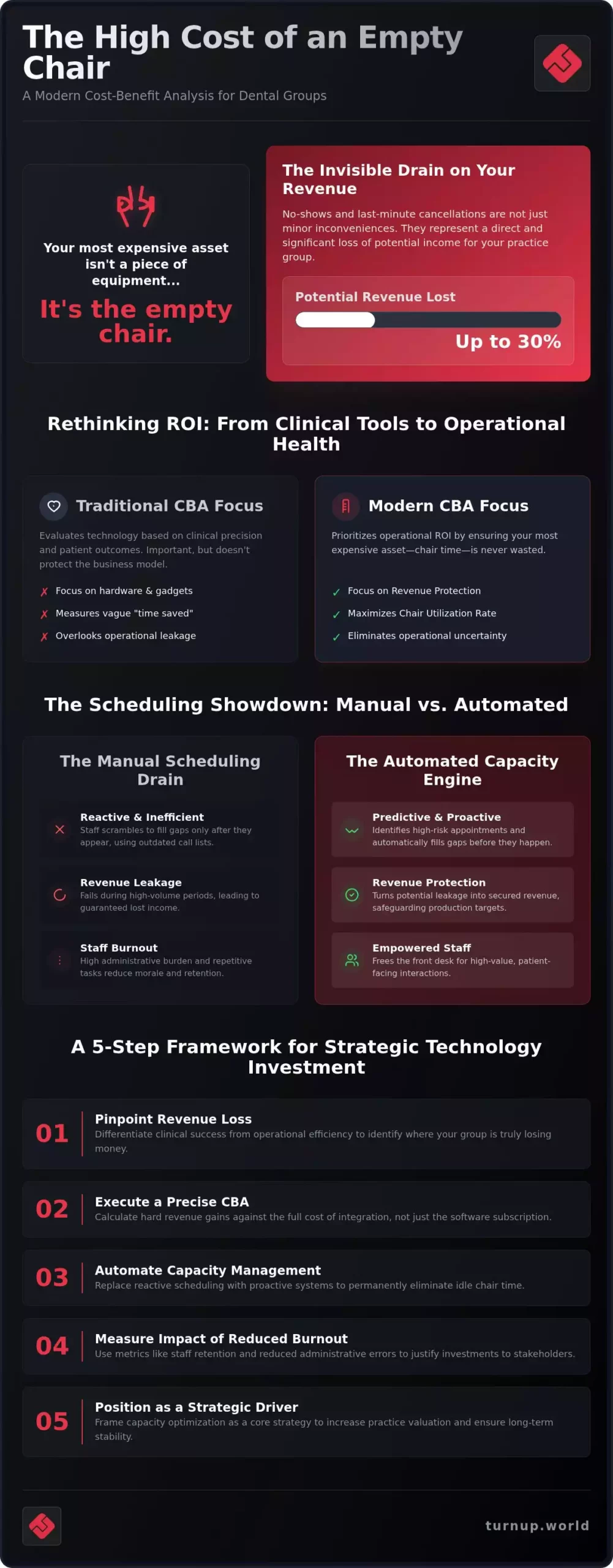
Your most expensive asset isn’t your $20,000 intraoral scanner; it’s the empty chair in Operatory 3. While clinical hardware is vital, a truly effective cost-benefit analysis of dental technology must prioritize revenue protection over mere gadgetry. Industry data shows that no-shows and last-minute cancellations can strip away up to 30% of your potential revenue. You’re likely already battling high overheads and the administrative burnout that comes from manual scheduling; it’s a reactive cycle that limits your group’s growth.
We’re here to provide the framework you need to break that cycle and eliminate idle capacity for good. You’ll learn how to evaluate technology investments through the lens of operational ROI to ensure every dollar spent translates into protected revenue. This guide moves past the vague promise of “efficiency” to deliver a concrete business case for automation. We’ll explore how to maximize chair utilization and turn your front desk into a high-performance engine for clinical success.
Key Takeaways
- Differentiate clinical success from operational efficiency. Pinpoint exactly where your group loses revenue.
- Execute a precise cost-benefit analysis of dental technology. Calculate hard revenue gains against the full cost of integration.
- Replace manual, reactive scheduling with automated capacity management. Permanently eliminate idle chair time.
- Measure the financial impact of reduced staff burnout. Use these metrics to justify investments to stakeholders.
- Position capacity optimization as a strategic driver. Increase practice valuation and ensure long-term stability.
Beyond the Chair: Redefining Cost-Benefit Analysis for Dental Technology
A Cost-Benefit Analysis in the dental sector often focuses on the wrong variables. Most clinical evaluations look at patient outcomes or the technical precision of new hardware. While these factors are vital for care, they don’t sustain a DSO’s growth on their own. For high-volume groups, a cost-benefit analysis of dental technology must prioritize operational ROI. It’s the difference between buying a tool that performs a procedure and investing in a platform that protects the entire business model.
Traditional metrics like “time saved” are deceptive. Saving a staff member five minutes on a phone call is useless if that time isn’t redirected toward revenue-generating activity. Modern SaaS solutions don’t just save time; they eliminate operational uncertainty. The primary driver of ROI isn’t administrative speed. It’s Revenue Protection. This means ensuring that your most expensive resource, the clinical chair, never sits idle due to preventable gaps in the schedule.
The Shift from Clinical to Operational ROI
The Cost of “Doing Nothing” in a Competitive Market
Choosing not to upgrade your scheduling workflow is a financial decision. It carries a heavy price tag. Manual scheduling relies on reactive effort. Your staff waits for a cancellation, then scrambles to fill it using outdated call lists. This approach fails during high-volume periods. Administrative bottlenecks lead to revenue leakage and poor patient retention because the system cannot keep up with the pace of a modern DSO.
Legacy systems are a hidden drain. They lack the foresight to predict no-shows before they happen. Research indicates that no-shows and last-minute gaps can deplete up to 30% of a practice’s potential revenue. In a competitive market, the opportunity cost of manual labor is too high to ignore. Staying with outdated methods isn’t a strategy for stability; it’s a slow-motion loss of market share. You don’t just lose the appointment; you lose the compounding value of a loyal patient who finds a more efficient provider elsewhere.
Quantifying Operational ROI: Direct vs. Indirect Gains
Measuring the true return on investment requires a dual-track approach. You must look at both hard financial data and the qualitative improvements that stabilize your workforce. A robust cost-benefit analysis of dental technology isn’t just a spreadsheet of expenses; it’s a map of recovered revenue and operational longevity. Without precise measurement, you’re guessing at your group’s health.
The ultimate metric for any DSO is the Chair Utilisation Rate. This figure reveals the percentage of time your providers spend in active production versus idle capacity. Every minute a chair remains empty represents a permanent loss of clinical revenue. To perform a valid CBA, your data must be grounded in reality. “Dirty” data from manual logs leads to skewed results. Automation ensures that your baseline is accurate, allowing you to see the real Impact of New Dental Technology on your bottom line.
Hard ROI: Revenue Protection and Leakage Prevention
Hard ROI is the direct increase in your bank balance. It starts with understanding the cost of an empty dental chair per hour. When a patient no-shows, you don’t just lose the treatment fee; you lose the fixed costs of staffing and utilities that continue to run. Predictive no-show prevention identifies high-risk appointments before they fail. By filling these gaps automatically, you turn potential leakage into protected revenue. This isn’t just about efficiency; it’s about safeguarding your clinical production targets. Many groups find that recovering even a small percentage of these lost hours pays for the technology investment within the first quarter. Automation acts as a silent guard, monitoring your schedule to ensure no chair stays cold for long.
Indirect Gains: Staff Retention and Patient Lifetime Value
Soft ROI is harder to track but equally critical for long-term margins. Administrative burnout is a silent killer of DSO profitability. When your front desk staff spends hours chasing cancellations, they’re not building patient relationships. Reducing this burden directly impacts staff retention. High turnover at the front desk is expensive and disruptive. By using a capacity optimization platform, you empower your team to focus on high-value interactions. This creates a seamless patient experience that builds trust and increases lifetime value. A patient who feels cared for by a calm, attentive team is far more likely to accept treatment plans and refer others. This compounds your ROI over years, not just months.
The Invisible Drain: Comparing Capacity Optimisation to Manual Scheduling
Manual scheduling is a silent revenue killer. It relies on a reactive philosophy that waits for a problem to occur before attempting a fix. In a high-volume DSO, this approach creates an invisible drain on resources. When you perform a cost-benefit analysis of dental technology, you quickly see that human-only front desk teams cannot scale with your business. They are limited by the speed of a phone call, whereas your overhead is fixed by the second.
The core issue is one of capacity. A manual system treats every cancellation as an isolated emergency. A proactive system treats it as a data point in a broader Cost and Production Analysis. Transitioning from reactive to proactive management is the only way to protect clinical margins in a tightening market. Relying on manual labor to solve a high-speed data problem is a recipe for idle chairs and frustrated staff.
Why Manual Call Lists are Obsolete
Traditional call lists are remarkably inefficient. It takes a receptionist an average of ten calls to fill a single empty slot. That represents thirty minutes of focused labor for one appointment. If that slot remains empty, you’ve lost both the clinical revenue and the cost of the staff’s time. Automated systems use a “first-response” advantage. Instead of one-to-one calling, they deploy SMS or app notifications to fifty qualified patients simultaneously. The success rate for automated last minute dental appointment filling far exceeds manual efforts. It isn’t just faster; it’s more precise, reaching patients who are statistically more likely to say yes.
Predictive Intelligence vs. Human Intuition
Human intuition is valuable, but it’s limited by memory and bias. A receptionist might remember a frequent canceller, but they can’t track the subtle no-show patterns across a database of 10,000 patients. AI identifies these risks weeks in advance. It looks at historical behavior, procedure types, and even seasonal trends to forecast capacity gaps. This predictive power allows you to move from filling gaps to preventing them entirely. The TurnUp Front Desk Copilot acts as this intelligent bridge. It empowers your team with real-time capacity forecasting, ensuring they stay ahead of the schedule rather than chasing it. This shift is essential for DSO growth; you can’t manage what you can’t predict.
Building the Business Case: A 5-Step CBA Framework for DSOs
Constructing a bulletproof business case requires moving from anecdotes to hard numbers. A cost-benefit analysis of dental technology provides the objective evidence needed to secure stakeholder buy-in. It isn’t just about the purchase price; it’s about the net gain in clinical throughput. For a DSO, this framework serves as a roadmap to transition from a reactive cost center to a proactive revenue engine.
The process starts with a Baseline Audit. You must calculate your current chair utilisation and no-show rates across every location. Most groups find their manual tracking is optimistic; automation reveals the true gaps. Once you have a baseline, you can move through revenue forecasting and efficiency analysis to see the compounding impact of small operational gains.
Step 1 & 2: Establishing the Baseline and TCO
Identifying the “True Cost” of current inefficiencies is the foundation of your CBA. You aren’t just losing the treatment fee when a chair is empty; you’re paying for the fixed overhead of a room that isn’t producing. You must also account for the Total Cost of Ownership (TCO). Total Cost of Ownership in a dental SaaS context is the comprehensive sum of subscription fees, integration labor, and the training hours needed to reach full operational proficiency. Hidden costs, such as the staff time required for software implementation, must be included to ensure your ROI projections remain realistic and credible.
Step 3 involves Revenue Forecasting. Predictive AI can reduce no-show rates by up to 3%. For a high-volume group, this small percentage translates into hundreds of thousands of dollars in protected clinical revenue. Step 4 is the Efficiency Analysis. Quantify the hours saved per front-desk staff member. When automation handles the “heavy lifting” of filling last-minute gaps, your team recovers hundreds of hours annually that can be redirected toward patient care and case acceptance.
Step 5: The Impact on Practice Valuation
Investors and DSOs pay a premium for optimised operations because they represent lower risk. A business that relies on manual, personality-driven scheduling is difficult to scale. Conversely, a business built on automated systems is highly predictable. There is a direct correlation between automated capacity management and business scalability. By standardising procedures across dental clinics, you ensure that every site operates at peak efficiency regardless of local staffing changes. This operational maturity significantly increases your EBITDA and exit value, making the technology a driver of long-term wealth rather than just a monthly expense.
Ready to see how these numbers apply to your group? You can optimize your clinical capacity by implementing a data-driven framework today.
Maximising Practice Valuation with TurnUp Front Desk Copilot
A comprehensive cost-benefit analysis of dental technology reveals that software is no longer a luxury; it’s a fundamental driver of practice valuation. For high-volume DSOs, the TurnUp Front Desk Copilot functions as a proactive revenue engine rather than a traditional cost centre. It addresses the two most persistent drains on clinical profit: the empty chair and the overworked administrative team. By shifting from reactive scheduling to automated capacity management, you move your group into a higher tier of operational maturity.
The TurnUp platform operates on a “Copilot” philosophy. It doesn’t aim to replace your front desk team; it empowers them to achieve peak performance. By handling the repetitive, high-speed data tasks associated with filling gaps, the software allows your staff to focus on patient experience and treatment acceptance. This synergy ensures that your clinical production stays on track without increasing your administrative overhead. It’s a silent, reliable engine that eliminates the uncertainty of the daily schedule.
Why High-Volume Groups Choose TurnUp
DSOs managing multiple locations face unique challenges that single practices don’t. You need centralised capacity oversight to maintain margins across a diverse portfolio. TurnUp provides this transparency, allowing group leaders to monitor and optimise chair utilisation from a single dashboard. The specific ROI drivers are clear and measurable:
- NoShow Prevention: Predictive AI identifies high-risk appointments, allowing for early intervention.
- LastMinute Solutions: Automated notifications reach qualified patients instantly to fill sudden gaps.
- PMS Integration: The platform connects seamlessly with your existing Practice Management System to ensure data integrity.
Real-world data shows that predictive AI can reduce no-show rates by up to 3%. In a high-volume environment, this small shift creates a massive ripple effect across your clinical revenue. When every location in your group operates with this level of precision, your collective EBITDA rises, making the entire organisation more attractive to investors and buyers.
Future-Proofing Your DSO Operations
The next generation of dentistry is AI-driven. Practices that continue to rely on manual, analog workflows will find it increasingly difficult to compete with data-driven groups. A data-driven front desk is your most significant competitive advantage. It ensures that your growth is built on a foundation of efficiency rather than just aggressive acquisition. By adopting TurnUp, you’re not just solving today’s scheduling problems; you’re future-proofing your operations against shifting market demands and staffing shortages.
Don’t let idle capacity drain your practice’s potential. You can book a discovery session to see your potential ROI with TurnUp and take control of your clinical production today.
Secure Your Clinical Revenue with Operational Precision
Operational efficiency is the bedrock of sustainable DSO growth. A rigorous cost-benefit analysis of dental technology shows that your highest returns come from protecting your most valuable asset: clinical chair time. While clinical excellence is your baseline, it’s the elimination of idle capacity through automation that drives long-term valuation. You’ve seen how manual scheduling creates an invisible drain on resources; it’s time to transition to a proactive model.
TurnUp Front Desk Copilot is specialized for UK DSOs. Its predictive AI reduces no-show rates by up to 3% and provides automated last-minute gap filling to keep your production targets on track. This technology empowers your team to focus on patient care rather than administrative recovery. It’s a reliable engine designed to eliminate operational uncertainty across your entire group. By integrating these tools, you ensure that every location operates at peak performance regardless of staffing challenges.
Ready to see the impact on your bottom line? Calculate your capacity ROI with the TurnUp Front Desk Copilot today. Your path to a more automated and profitable future starts with a single data-driven decision.
Frequently Asked Questions
How do you calculate the ROI of dental software?
ROI is calculated by subtracting the Total Cost of Ownership (TCO) from the total protected revenue and dividing that figure by the TCO. A rigorous cost-benefit analysis of dental technology must include subscription fees, staff training hours, and PMS integration labor. You measure success by the increase in chair utilisation rates and the reduction in manual administrative hours recovered for patient care.
What is the true cost of an empty dental chair per hour?
The true cost is the sum of your fixed hourly overhead plus the lost clinical production revenue. Fixed costs include staff salaries, rent, and utilities that you pay regardless of patient presence. When a chair sits empty, these expenses continue without any offsetting income. For high-volume DSOs, this loss represents a permanent depletion of potential profit that cannot be recovered.
Can dental technology really reduce no-show rates?
Predictive AI identifies high-risk appointments by analysing historical patient behaviour and procedure types. These systems can reduce no-show rates by up to 3% through targeted intervention and automated reminders. This proactive logic is also transforming personal wellbeing; for example, Cura+ provides a predictive health guide at curaplus.co.uk to help patients manage severe fatigue. By predicting schedule failures before they occur, technology ensures your clinical team remains productive even when patients cancel at the last minute.
Is it better to hire more staff or invest in automation?
Automation is the superior choice for scaling repetitive tasks like filling schedule gaps. Hiring more staff increases your fixed overhead and adds management complexity. Technology acts as a force multiplier for your existing team. It handles the “heavy lifting” of manual calling, which allows your staff to focus on high-value patient interactions and treatment acceptance.
How does capacity optimisation affect practice valuation?
Capacity optimisation directly increases EBITDA by eliminating revenue leakage from idle chairs. Investors and DSOs pay a premium for practices with predictable, system-dependent operations. Automated scheduling makes your group more scalable and less reliant on individual staff performance. This operational maturity reduces investment risk and significantly raises your exit value in a competitive market.
What are the hidden costs of implementing new dental technology?
Hidden costs typically involve staff training time, initial workflow adjustments, and integration with legacy Practice Management Systems. A comprehensive cost-benefit analysis of dental technology must factor in these “soft” integration expenses. While these are often one-time costs, failing to account for them can skew your short-term ROI projections. Proper planning ensures these investments lead to long-term stability.
How long does it take to see a return on investment for a front desk copilot?
Most DSOs observe a positive return on investment within the first 90 days of implementation. The ROI is driven by the immediate recovery of lost treatment fees from no-shows and last-minute cancellations. Once the system fills the first few major clinical gaps, the platform often covers its own annual cost. The speed of return depends on your current no-show baseline.
What is the difference between clinical and operational efficiency in dentistry?
Clinical efficiency measures the speed and precision of treatment inside the operatory. Operational efficiency measures the systems that ensure a patient is actually in the chair to receive that treatment. You can have the most efficient clinical team in the country; however, their skill is irrelevant if the chair remains empty. Operational efficiency protects the revenue that clinical skill generates.