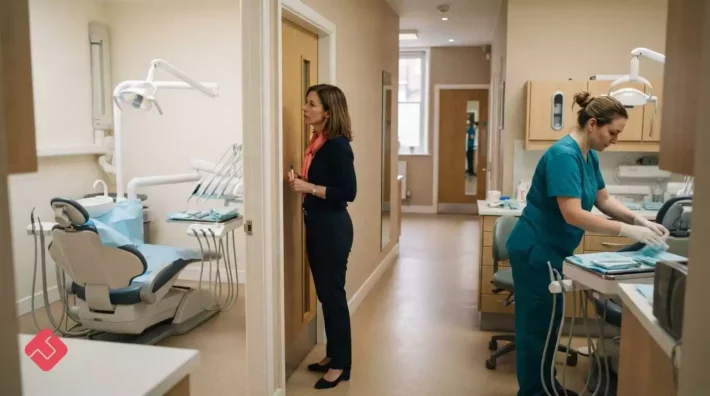
Reducing dental FTA rates starts with a clear threshold that counts failures to attend alongside short-notice cancellations. Treating each as a separate issue can hide a pattern; a combined view helps teams decide when to follow up, apply a deposit policy or review future bookings.
Missed appointments leave chair time unused, and reminders alone will not recover every gap. A consistent process helps the team respond clearly and fairly. This guide explains how to define and apply an attendance threshold, communicate deposit terms before appointments, and follow up after a missed visit. It also covers how to track patterns over time, so practice leaders can improve workflows using their own appointment data rather than relying on a one-size-fits-all figure.
Key Takeaways
- Set a clear policy for missed appointments and short-notice cancellations, then apply it consistently across patient groups.
- Explain any deposit terms before booking, including when a late cancellation or non-attendance may mean the deposit is lost.
- Record each missed visit and follow up with a consistent process to support rebooking and identify repeat patterns.
- Measure your own FTA rate over time; a defined national figure is not provided here, so avoid treating a local result as a UK-wide benchmark.
Combined FTA and short-notice cancellation thresholds
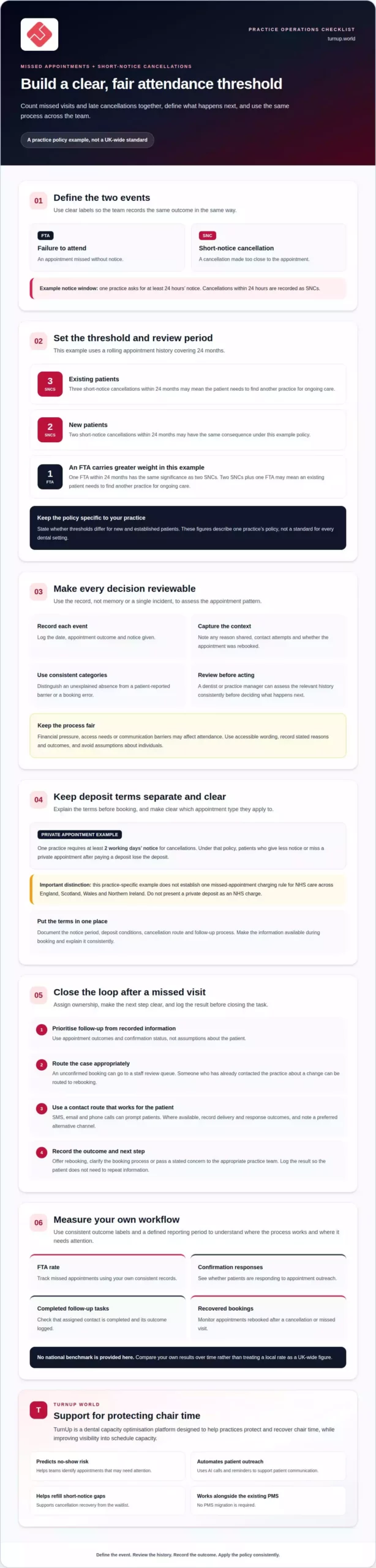
A failure to attend (FTA) is an appointment missed without notice. A short-notice cancellation (SNC) is a cancellation made too close to the appointment. A combined threshold considers both when reviewing appointment history, rather than treating each event in isolation.
Thresholds are practice policies, not a single UK-wide rule. One practice asks patients for at least 24 hours’ notice when cancelling and records cancellations within 24 hours as short-notice cancellations. This defines both the event and the time window clearly.
Under that practice’s policy, three SNCs within 24 months may mean an existing patient needs to find another practice for ongoing care. For new patients, two SNCs within 24 months may have the same consequence. The different thresholds show why practices should state whether policies vary for new and established patients.
An FTA can carry greater weight than one late cancellation. In this example, one FTA within 24 months has the same significance as two SNCs. An existing patient with two SNCs and one FTA within that period may need to find another practice for ongoing care. These are examples of one practice’s policy, not a standard for every dental setting.
To make a threshold practical, define each event, the review period and the response in the appointment policy. Use the same recording method across the team. For example, log the date, appointment outcome and notice given so staff can distinguish an FTA from an SNC. Before acting, review the relevant appointment history. A dentist or practice manager can then assess the pattern consistently instead of relying on memory or a single incident. Clear definitions support fair decisions and help patients understand the policy. This gives the practice a usable framework for reducing dental FTA rates without confusing a late cancellation with a missed appointment.
Loss of deposits for late cancellations or non-attendance
A deposit is an advance payment used to secure a private appointment or treatment. One practice policy requires at least 2 working days’ notice for cancellations; patients who give less notice lose their deposit. Patients who miss a private appointment after paying a deposit also lose it under that policy.
For NHS appointments in England, Scotland, Wales and Northern Ireland, distinguish NHS care from private deposit terms. The practice-specific example above does not establish one missed-appointment charging rule for all four nations. Clearly state the terms that apply to each appointment, and do not present a private deposit as an NHS charge.
Appointment reminders prompt patients to attend, confirm or rearrange a booking. Use a consistent sequence that gives people time to respond, and include the appointment date, time, practice contact route and cancellation steps. For example: “Your appointment is on 14th November at 10:30 am. Contact TurnUp World if you need to cancel or rearrange.” Keep the message direct, clear and easy to act on.
Deposits and cancellation fees clarify the consequences of late changes, but the examples here do not establish that they reduce FTAs. Overbooking is not an automatic fix either: if everyone attends as booked, patients may face delays or a shared chair. Consider clear terms and cancellation-recovery processes before changing capacity.
Fees and strict policies can affect people differently. Financial pressure, access needs or communication barriers may make attendance or timely cancellation harder. Share terms before booking, use accessible wording and provide a consistent way to explain exceptional circumstances. Record the reason and outcome so staff apply the policy consistently instead of making assumptions.
For a practical policy review, document the notice period, deposit conditions, cancellation route and follow-up process in one place. Make the information available during booking, and ensure front-desk staff explain it consistently. This clarifies patients’ options and gives the team a shared basis for handling late changes and missed appointments.
Recording and follow-up after missed appointments
A useful missed-appointment record helps the team decide what to do next. Capture the appointment outcome, any reason shared, contact attempts and whether the appointment was rebooked.
Consistent categories make patterns easier to interpret. Distinguish an unexplained absence from a patient-reported barrier or a booking error. If someone says they did not receive the appointment details, record that response rather than labelling the event as disengagement. This gives practice managers clearer evidence for improving the booking process.
Risk review should support timely, appropriate contact, not assumptions about individuals. Use recorded appointment outcomes and confirmation status to prioritise follow-up. For example, place an unconfirmed booking in a staff review queue, while routing someone who has already contacted the practice about a change to rebooking.
SMS, email and phone reminders
SMS, email and phone calls can prompt patients about upcoming appointments. Their value depends on whether the chosen channel reaches the person and makes responding straightforward. Where available, record delivery and response outcomes, and note when a patient prefers another channel. This helps the team distinguish an ineffective contact route from a confirmed appointment that the patient later cannot attend.
After a missed visit, assign clear ownership of follow-up and record the result. The next step might be to offer rebooking, clarify the booking process or pass a stated concern to the appropriate practice team. Close the task only after logging its outcome, so another staff member can continue the conversation without asking the patient to repeat information.
Measuring FTA rates and interventions
Measure performance using consistent appointment outcome labels and a defined reporting period. Alongside the FTA rate, monitor process indicators such as confirmation responses, completed follow-up tasks and recovered bookings. These measures show where the workflow succeeds or stalls, rather than relying on the overall rate alone.
When changing a process, compare equivalent appointment groups and check whether recording practices changed too. Auditing a sample of records can reveal missing outcomes or inconsistent classifications. Use the findings to refine staff workflows, then keep tracking the same indicators to assess whether the change is helping operations.
What are current NHS dental appointment failure-to-attend rates in the UK?
An NHS dental FTA rate is meaningful only when its definition, geography and reporting period are clear. For practice decisions, distinguish a locally measured rate from a wider NHS figure, and do not treat them as interchangeable.
An FTA rate measures missed appointments against a defined set of bookings. Its value depends on which outcomes count. A patient who cancels in advance is different from someone who misses an appointment without notifying the practice. Keep short-notice cancellations separate unless the reporting method explicitly combines them.
For UK reporting, label the nation and period rather than presenting one unqualified figure. England, Scotland, Wales and Northern Ireland should each be identified in any comparison. Also state whether the measure covers NHS appointments alone, which appointment types it includes, and how the practice records late cancellations. Without those details, readers cannot tell whether two rates describe the same thing.
A practical dashboard can make local performance useful without turning it into a national benchmark. Record booked appointments and FTAs using one consistent definition. Then segment results by practice, appointment type and stage of the patient journey, such as a new-patient assessment or follow-up treatment. Review changes alongside reminder activity and rebooking outcomes. This helps managers identify where capacity is lost and whether a workflow change coincides with a different pattern.
Museum Street Dental Practice’s published attendance thresholds illustrate why policy and prevalence should remain separate. A practice threshold sets a response to repeated events; it does not show how often FTAs occur across NHS dentistry. Use thresholds to guide consistent follow-up, and appointment records to understand local performance.
For an operational review, define an FTA first, then apply that definition consistently across every site and reporting period. Present the result with its geography, appointment scope and timeframe. This gives practice leaders a clearer basis for comparing like with like and deciding where to focus prevention and follow-up.
TurnUp World
TurnUp World helps dental practices and multi-site DSOs manage appointment attendance and protect chair capacity. Its platform predicts no-show risk and supports automated patient outreach through AI calls and reminders, alongside cancellation and rebooking workflows.
When appointments change, automated waitlist management helps recover short-notice cancellations. Scheduling capacity insights give teams visibility into chair use, connecting prevention with practical action across the appointment workflow. TurnUp sits on top of an existing PMS, with no migration required.
For practices seeking a more connected way to manage attendance and capacity, book a demo with TurnUp World to discuss your scheduling operations.
Make attendance part of the operating rhythm
Reducing dental FTA rates is not a one-off policy change. It means making attendance management a repeatable part of scheduling operations. Give the workflow a clear owner so patient contact, cancellation handling and chair recovery work together instead of becoming disconnected tasks.
Start with one operational decision: who acts when a patient does not confirm, cancels late or misses an appointment? Make ownership clear across the front desk and central scheduling team. Then use what staff learn from responses to refine the process. A consistent feedback loop helps teams spot friction early and act before an empty chair becomes a recurring pattern.
For practice and DSO leaders, the next step is to assess where the current workflow loses momentum and what would make it easier to manage. Contact TurnUp World to discuss how its platform could support your dental team’s capacity and appointment operations.
Frequently Asked Questions
What does FTA mean in UK dental services, and how is the rate calculated?
FTA means failure to attend a dental appointment without notifying the practice. Calculate the rate by comparing FTAs with the appointments included in the same reporting period, then express the result as a percentage. Define exclusions before reporting. For example, record a cancellation separately rather than classifying it as an FTA. Consistent categories make comparisons between teams and reporting periods more useful.
Which interventions reduce missed dental appointments in dental practices?
Use a coordinated approach: identify bookings that may need extra attention, contact patients through an accessible channel, and make cancelling or rebooking straightforward. When a cancellation leaves a gap, offer the slot to suitable people on a waitlist. For example, someone who cannot attend can be given a clear rebooking route, while the released chair time can be offered to someone awaiting treatment.
What are the main causes of missed dental appointments?
Missed appointments can be associated with financial pressure, access or communication barriers, ineffective reminders or booking errors. Patients may also miss appointments if they have not received the booking details.