
What if the biggest boost to reception team motivation isn’t another incentive, but a workday that feels fairer and easier to manage? Front-desk staff balance patient conversations, telephone calls and scheduling demands, often while handling problems that make good work less visible. Learning how to motivate a dental reception team starts with recognising that pressure and improving the conditions around it.
Recognition matters, but it works best alongside clear expectations, useful feedback and appropriate autonomy. When the team can influence its work and avoidable administrative obstacles are reduced, it becomes easier to build a supportive environment where contribution is noticed.
This guide covers practical ways to make those changes, from setting fair standards to improving scheduling workflows. TurnUp World supports dental practices and DSOs by predicting no-show risk, automating patient outreach and helping refill short-notice cancellations from the waitlist. It works alongside your existing practice management system, without requiring a migration, so the team can focus more attention on patients and less on preventable schedule friction.
Key Takeaways
- Learn how to motivate a dental reception team with specific recognition, clear expectations and appropriate autonomy.
- Use a simple cycle: listen to staff, identify a recurring pressure point, agree one practical change and review its effect.
- Map call peaks, rebooking tasks and short-notice cancellations to find where everyday workflows create avoidable pressure.
- Improve capacity visibility and cancellation recovery with operational support that works alongside your existing practice management system.
Why motivating a dental reception team takes more than praise
Motivation is more than a positive mood or a busy day. It means sustained engagement, clarity about what the role requires and the practical ability to do good work. Reception staff manage patient queries, calls, cancellations and appointment coordination, often in quick succession. Managers should assess the conditions behind performance, not just the outcome.
Praise helps when it is timely and specific. “You handled that difficult rebooking clearly and kept the patient informed” identifies a contribution the team member can repeat. A general “great work”, delivered much later, may feel disconnected from the effort. Recognise quality, judgement and patient care, not speed alone. The Employee Recognition overview offers context on different approaches. In practice, a useful starting point is to notice real contributions consistently.
What motivates reception staff in a dental practice?
Respect, clear expectations, useful feedback and appropriate autonomy give people a stronger basis for doing their role well. Explain what good handling of calls, appointment changes and patient interactions looks like. Then define where staff can use their judgement without seeking approval for every decision. To understand how to motivate a dental reception team, ask each person what helps them feel supported. Some value private feedback; others prefer team recognition. Listen rather than assume.
Why morale suffers when friction becomes routine
Repeated interruptions can turn planned work into constant triage. A cancellation may require contacting patients, checking availability and updating the schedule while calls continue. If the same avoidable problems recur, staff may feel responsible for outcomes they cannot control. Treat that as an operational signal, not proof of poor effort. Ask where work routinely stalls, which tasks compete for attention and what information arrives too late. Managers can then separate performance issues from process issues and respond fairly.
Build motivation through recognition, autonomy and useful feedback
Turn good intentions into a consistent management routine. Recognition is most credible when it names an observable contribution and explains why it mattered. For example, thank a receptionist for giving a patient a clear update during a delay, recording an accurate handover or finding a practical solution to a booking issue. Don’t reward speed alone if it risks accuracy or thoughtful patient communication.
Make recognition specific and fair
Apply the same standard across the team, including quieter contributions that may be less visible than handling a busy telephone queue. Gathering immediate patient sentiment can also help uncover these everyday positive interactions, with platforms like Siempre Feedback demonstrating how real-time micro-feedback captures on-the-ground service far better than delayed surveys. Recognise people in the way they prefer: a brief private thank-you may feel more genuine to one colleague, while another may welcome acknowledgement in a team meeting. Ask about preferences and keep praise proportionate. This helps recognition feel fair rather than like favouritism.
Give feedback that leads to action
Use regular one-to-ones to discuss what’s working, what’s getting in the way and what the team member wants to develop. Balance constructive feedback with concrete examples of effective work. If handovers are often incomplete, agree one improvement, such as a shared prompt for the details colleagues need. Revisit that action at the next conversation. This turns feedback into support, rather than a judgement delivered after a problem.
Set service and scheduling expectations, then define where staff can make decisions independently. For instance, agree which booking changes a receptionist can resolve directly and when to escalate an issue. Clear boundaries reduce uncertainty without removing initiative. Ask each person: “What decision would you handle more confidently with clearer guidance?” Their answer may reveal both a coaching need and a process gap.
Financial incentives can play a part, but they won’t suit everyone or fix unclear expectations, unsustainable pressure or poor processes. Start by understanding what staff value and what prevents them from doing good work. For teams facing recurring scheduling friction, dental capacity optimisation provides operational support alongside people-focused management.
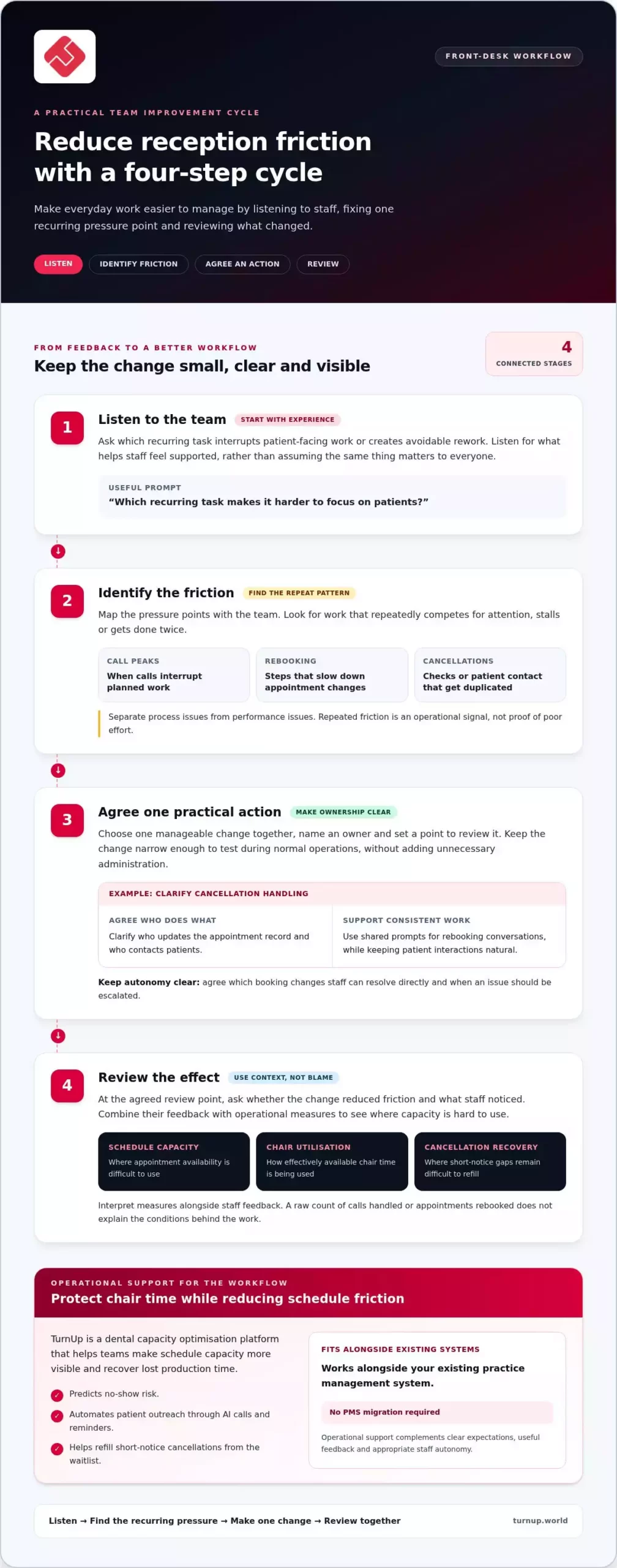
Reduce front-desk friction with a practical motivation framework
Turn staff feedback into a small, visible workflow improvement. Use a four-step cycle: listen, identify friction, agree an action and review its effect. This gives managers a practical way to improve the conditions behind performance, rather than treating motivation as something measured by output alone.
Turn staff feedback into a manageable improvement
Ask a focused question: which recurring task interrupts patient-facing work or creates avoidable rework? Map pressure points with the team, such as busy call periods, rebooking steps or short-notice cancellations. Choose one change together, name an owner and set a review point. For consistent rebooking conversations, agree prompts that support staff without making patient interactions feel scripted.
For example, if a cancellation repeatedly triggers duplicated checks, clarify who updates the appointment record and who contacts patients. Keep the change narrow enough to test during normal operations. The aim is to remove friction, not add another layer of administration.
Measure conditions for success, not just activity
Review staff feedback alongside schedule capacity, chair utilisation and cancellation recovery. These measures can show where workflows are creating bottlenecks or where available appointment capacity is difficult to use. Interpret them in context. A raw count of calls handled or appointments rebooked won’t explain differences in demand, complexity or staffing, so don’t use it alone to rank individuals.
At the review point, ask whether the change reduced interruptions, duplicated work or uncertainty. Keep it, adjust it or test a different approach. Wider capacity insight can also help leaders identify where scheduling processes need attention across a practice or group.
Use this cycle to make progress without turning every pressure point into a performance issue. TurnUp’s dental capacity optimisation platform provides visibility into scheduling capacity and supports cancellation recovery.
Support a motivated dental reception team with better capacity visibility
Reliable processes give reception staff more room to focus on patient interactions instead of repeatedly chasing confirmations or rebuilding a schedule by hand. Motivation depends partly on whether people have the tools and information to do their work well. A practical approach to how to motivate a dental reception team should therefore consider the systems around the role, not just individual performance.
Use automation to support the team, not replace it
TurnUp is a dental capacity optimisation platform designed to help practices protect and recover chair time. It predicts no-show risk, supports prevention through automated patient outreach and helps refill short-notice cancellations from the waitlist. Its AI Call Center supports appointment confirmation, cancellation and rebooking workflows. These tools support schedule management while reception staff remain central to patient communication and use their judgement where context matters.
Better visibility into schedule capacity can help teams see where gaps are emerging and where follow-up is needed. TurnUp works alongside the existing practice management system and does not require a PMS migration. It supports capable reception staff rather than replacing them.
Make the next step a focused operational review
Practice and DSO leaders can start by reviewing one recurring source of schedule friction with the reception team. Look at where no-shows create gaps, how cancellations are handled and whether staff can see available capacity clearly. Then identify which parts of the workflow need more reliable support and where human judgement remains essential. This keeps the review grounded in the team’s day-to-day experience, rather than adding technology without a defined operational need.
Examine how your current processes protect chair time and support patient-facing work. Explore TurnUp’s approach to dental capacity optimisation.
Make the next improvement visible
A motivated reception team is built through the everyday experience of work, not a one-off initiative. Choose a practical priority with your team and make its impact visible. That might mean giving staff more confidence to resolve routine booking issues or making it easier to see where schedule pressure is building.
As you decide how to motivate a dental reception team, keep the conversation open. Ask what would make a meaningful difference to the team’s working day, agree how you’ll recognise progress and return to the discussion as needs change. Consistent management creates the conditions for people to contribute well and feel that their contribution matters.
For a focused look at how operational support can fit into that approach, explore how TurnUp supports dental teams and capacity optimisation. Review your current scheduling workflow, identify where chair time is being lost, and take the next step with TurnUp.
Frequently Asked Questions
How can a dental practice manager motivate reception staff without offering bonuses?
Start by making good work easier to deliver and easier to notice. Agree what a strong patient handover looks like, then recognise examples such as clear notes that help a colleague continue a booking without asking the patient to repeat information. Ask staff what would remove a daily obstacle and follow through on one manageable change. Consistent action builds trust more reliably than a reward that doesn’t address the cause of frustration.
Can automation improve motivation for a dental reception team?
Yes, if it reduces repetitive work without removing staff judgement. For example, automated patient outreach can support appointment workflows while receptionists focus on patient questions that need a considered response. TurnUp’s dental capacity optimisation platform supports appointment confirmation, cancellation and rebooking workflows, as well as visibility into schedule capacity. Review whether a tool genuinely reduces duplicate tasks or simply adds another screen. A short team check-in after a process change can reveal whether it has made work clearer or more complicated.
How should managers measure whether reception team morale is improving?
Combine direct feedback with operational observations. In regular check-ins, ask whether staff feel able to complete key tasks and raise concerns. Track themes over time, such as repeated interruptions or uncertainty about who owns a task, rather than treating one comment as a verdict. Compare those themes with schedule pressures and workflow changes. The aim is to see whether working conditions are improving, not to turn morale into an individual score.
Do team-building activities motivate dental reception staff?
They can strengthen working relationships, but they won’t resolve unclear responsibilities or recurring workload problems on their own. Choose an activity that suits the team and makes participation comfortable, then connect it to everyday collaboration. For instance, use a short team discussion to agree how colleagues will flag an urgent booking issue during a busy period. Shared routines often make the benefit last beyond the activity itself.
What should a manager do when a dental receptionist feels overwhelmed?
Speak privately, listen without rushing to defend the current process, and identify what is driving the pressure. Is the workload peaking at particular times, are tasks being duplicated, or is the person unsure what to prioritise? Agree an immediate adjustment, such as redistributing a non-urgent task, then set a time to review whether it helped. If the pressure continues, examine staffing and workflow conditions rather than placing responsibility solely on the receptionist.