The operational landscape of modern dentistry is defined by a single, critical challenge: capacity. Every empty chair represents lost revenue, every minute of administrative friction burns out your staff, and every no-show erodes your bottom line. Traditional methods of managing a practice are no longer sufficient. To thrive in 2026 and beyond, practice managers and DSO directors need more than just a digital diary; they need an intelligent operational engine.
This guide redefines what dental practice productivity software means today. It moves beyond the concept of simple administrative tools to introduce the power of capacity optimisation—the science of keeping every clinical chair productive. Discover how to eliminate idle time, automate front-desk workflows, and protect your revenue with a new class of technology designed to work as an intelligent copilot for your practice.
What is Dental Practice Productivity Software in 2026?
In 2026, dental practice productivity software is the operational engine that actively manages and maximises a practice’s clinical capacity. It has evolved far beyond the simple record-keeping functions of a traditional Practice Management System (PMS). Instead of passively storing information, this software actively protects revenue by focusing on three core pillars: maximising chair utilisation, boosting staff efficiency, and optimising patient flow. Its primary function is to maximise clinical output through intelligent, automated scheduling and workflow management.
While competitors like Dentally define productivity through broad concepts like “stress-free dentistry,” this new approach offers a specific, measurable ROI. It’s not just about cloud features; it’s about the direct financial impact of a fully booked diary. True productivity software is a tool for maximising clinical output through automated scheduling.
- Operational Engine: It actively manages the practice’s capacity, not just its records.
- Revenue Protection: It moves beyond administration into a role of active financial safeguarding.
- Core Focus: Its success is measured by chair utilisation, staff efficiency, and seamless patient flow.
The Shift from PMS to Capacity Optimisation
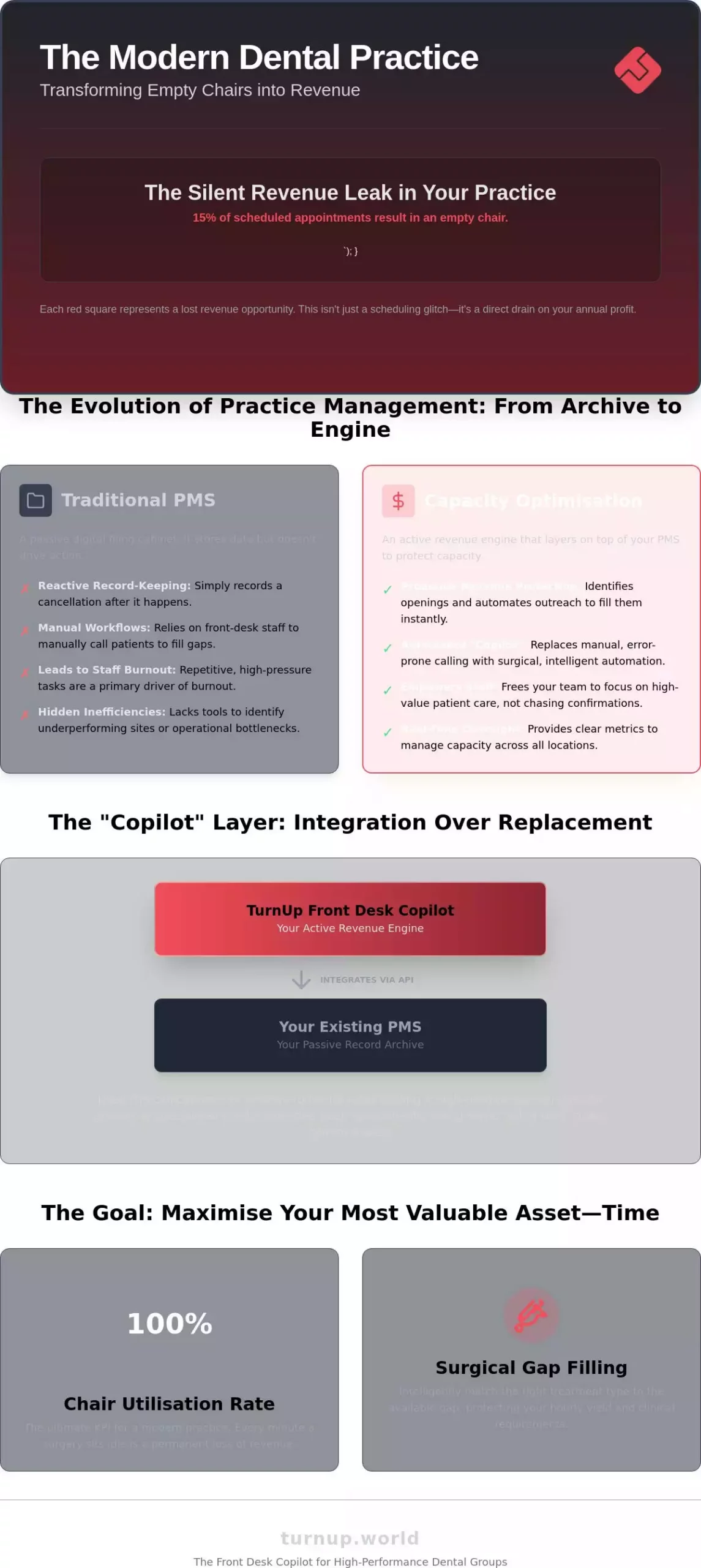
For decades, the Practice Management System (PMS) has been the digital heart of a dental practice. However, its fundamental role is that of a digital filing cabinet—a system of record for patient data, treatment plans, and billing. While essential, a PMS is passive. It records what has happened but does little to influence what will happen. It cannot solve the persistent, costly problem of empty chairs.
This is where modern productivity tools create a new paradigm. They act as a “Front Desk Copilot,” an intelligent layer that works alongside your PMS to actively manage the diary. While the PMS holds the data, the Copilot uses that data to make real-time, revenue-driven decisions. It automates the complex, time-consuming tasks that drain front-desk resources, such as filling last-minute cancellations, confirming high-value appointments, and managing a dynamic waitlist. Record-keeping alone is a reactive strategy; capacity optimisation is a proactive one.
Key Metrics for Measuring Dental Productivity
To effectively manage productivity, you must measure it correctly. The old metrics are no longer sufficient. The focus is shifting from provider-centric data to a more holistic, capacity-focused view of the entire operation.
- Chair Utilisation Rate: This is the ultimate Key Performance Indicator (KPI) for modern UK dental practices. It measures the percentage of available clinical time that is used for revenue-generating activity. A high utilisation rate is the most direct indicator of operational and financial health. Even a small percentage increase can translate into tens of thousands of pounds in annual revenue.
- Production Per Hour: While tracking production per provider is useful, measuring production per available clinical hour provides a clearer picture of efficiency. This metric reveals the true financial cost of idle time and highlights the impact of effective scheduling.
- Impact of Automated Gap Filling: The most advanced practices now measure the monthly revenue recovered directly by automated last-minute gap-filling technology. This metric quantifies the ROI of their productivity software and demonstrates its role as a revenue-generating asset, not just a cost centre.
The Capacity Optimisation Layer: Why Your PMS Isn’t Enough
Many practices believe their all-in-one PMS is sufficient for managing productivity. However, a generalist system, by its nature, cannot achieve the specialised efficiency of a dedicated tool. A true capacity optimisation platform is not a replacement for your PMS; it’s an intelligent enhancement layer that sits on top of it, transforming your existing software from a passive database into a dynamic, performance-driven engine.
This “Copilot” approach is more effective than a generic suite because it focuses with surgical precision on the most significant source of lost revenue: idle time. It automates the complex, “human” element of scheduling—the constant phone calls, the guesswork of filling a specific time slot, the manual waitlist management—that leads to errors, burnout, and empty chairs. By providing real-time capacity analysis, it identifies gaps before they become lost revenue, a feat most PMS systems are not designed to accomplish.
Automating the Front Desk Workflow
The front desk is the practice’s command centre, yet it’s often bogged down by repetitive, low-impact tasks. A capacity optimisation copilot automates these workflows, liberating staff to focus on high-value, in-person patient care.
The most significant change is the reduction of manual outbound calls. Instead of staff spending hours confirming appointments or chasing patients to fill a cancellation, the system handles it automatically. Advanced AI manages the complex logic required to fill a specific diary gap. For example, it understands that a 45-minute hygiene cancellation can’t be offered to a patient needing a 90-minute crown preparation. It intelligently matches the open slot with the right treatment type from an automated waitlist, contacts qualified patients instantly, and secures the booking without a single phone call. This empowers your team to deliver an exceptional patient experience rather than being tethered to the telephone.
Predictive Scheduling vs. Reactive Booking
The traditional approach to managing cancellations is entirely reactive: a patient cancels, and the front desk scrambles to fill the gap. This is an inefficient, high-stress model that often fails. Modern dental practice productivity software flips this model on its head with predictive scheduling.
- Reactive Booking: The old method. You wait for a cancellation to occur, then manually search for a replacement. The process is slow, labour-intensive, and the chair often remains empty.
- Predictive Scheduling: The new standard. The software uses data—such as patient history, appointment type, and time of day—to identify high-risk appointments before they are missed. This allows for proactive interventions, such as targeted, automated confirmations or pre-emptive offers to reschedule. Intelligent waitlists work in concert with this system, creating a constant, on-demand flow of patients ready to fill any potential gap, ensuring the diary remains robust and productive.
Eliminating the Cost of Empty Chairs: Automated No-Show Prevention
No-shows and last-minute cancellations are not minor inconveniences; they are a direct drain on profitability. The average UK dental practice loses thousands of pounds each month in lost hourly revenue from “Fail to Attend” (FTA) appointments. While standard SMS reminders have become common, they are a blunt instrument. Specialised No-Show prevention tools offer a far more sophisticated and effective solution.
These advanced systems go beyond simple reminders. They use predictive analytics to identify high-risk patients and trigger early, intelligent interventions. Automated LastMinute solutions can then fill any unavoidable cancellations in minutes, not hours, by instantly broadcasting the availability to a curated list of patients. A platform like TurnUp Front Desk Copilot, for example, identifies appointments with a high probability of becoming a no-show and automatically engages the patient with smart, frictionless options to confirm or reschedule, protecting the appointment slot long before it becomes a problem.
The Anatomy of a Last-Minute Appointment Filler
When a cancellation does occur, a modern productivity system executes a flawless, automated sequence to fill the gap with zero staff effort. This process is a seamless blend of speed and intelligence.
- Instant Notification: The moment an appointment is cancelled in the PMS, the system automatically identifies the newly available slot. It then sends an instant notification (via SMS or a dedicated app) to qualified patients on the automated waitlist who are a suitable match for the appointment type and duration.
- Self-Service Booking: The notified patient receives a simple link to accept the appointment. With a single tap, they can claim the slot and book themselves in without ever needing to speak to a receptionist. This frictionless experience is highly valued by patients and dramatically increases the fill rate.
- Seamless Synchronisation: Once the patient confirms, the system instantly and automatically updates the practice diary in your PMS. This eliminates the risk of double-booking and ensures the schedule is always accurate and up-to-date, providing a reliable single source of truth for the entire clinical team.
Behavioural Insights and Patient Communication
The most advanced systems use behavioural science to enhance patient communication and encourage commitment. It’s not just about sending messages; it’s about sending the right message to the right patient at the right time. Intelligent messaging uses varied and personalised language to avoid “reminder fatigue” and prompt a genuine confirmation.
By offering frictionless rescheduling options, these tools reduce FTA rates significantly. If a patient knows they can’t make an appointment, the system makes it incredibly easy for them to reschedule online, preserving the patient relationship and freeing up the original slot with enough notice for it to be filled automatically. Communication frequency and style can even be customised based on a patient’s history, treating reliable attendees differently from those with a pattern of no-shows.
Scaling Operational Excellence for DSOs and Large Dental Groups
For Dental Service Organisations (DSOs) and large dental groups, the challenge of capacity optimisation is magnified across multiple locations. Inconsistency in front-desk processes can lead to significant variations in performance, with some sites thriving while others struggle with empty chairs. Dental practice productivity software designed for DSOs solves this by standardising front-desk excellence and centralising capacity management.
Scaling these multi-site operations often requires physical renovations to increase clinical space; for your US-based locations, Book Your Dumpster USA provides the roll-off dumpster rentals needed to manage site waste and keep projects on track.
This technology provides a unified view of performance across 10, 50, or 100+ locations, allowing leadership to identify underperforming sites and implement targeted improvements. It moves beyond the passive “group visibility” offered by some systems, which only shows you the problem. A true DSO solution actively fixes capacity issues across all sites. By analysing group-wide data, DSOs can make smarter decisions about resource allocation, provider scheduling, and marketing efforts, ensuring every location operates at peak efficiency.
Centralised Control with Local Flexibility
Effective DSO management requires a balance between centralised oversight and local autonomy. A sophisticated capacity optimisation platform delivers exactly that. From a single dashboard, operational directors can monitor key metrics like chair utilisation, no-show rates, and recovered revenue across the entire organisation. This allows for the enforcement of high-efficiency scheduling protocols, ensuring every site adheres to the same best practices.
This centralised approach significantly reduces the administrative burden on individual practice managers. They are freed from the minutiae of diary management and can focus on team leadership and patient care, secure in the knowledge that an automated system is working tirelessly in the background to keep their schedules full.
DSO-Specific No-Show Solutions
For a large dental group, even a small percentage of no-shows can translate into millions in lost annual revenue. Protecting these high-volume revenue streams is paramount. DSO-specific no-show solutions are tailored for this scale. They allow for the analysis of no-show trends across different demographics, regions, and treatment types, providing invaluable business intelligence.
Most importantly, they scale the process of automated gap filling to ensure that no chair stays empty in any branch. A cancellation in one location can be instantly offered to patients from a neighbouring practice if desired, maximising the entire group’s patient pool. This level of networked, automated efficiency is impossible to achieve with manual processes or standard PMS software; it is the key to unlocking the full revenue potential of a multi-site dental organisation.
Implementing TurnUp Front Desk Copilot for Maximum Chair Utilisation
TurnUp Front Desk Copilot is the intelligent layer designed for the next generation of UK dentistry. It embodies the shift from passive management to active capacity optimisation. It is not another bloated, all-in-one system that requires weeks of training and disrupts your established workflows. Instead, it offers a seamless integration with your current PMS, delivering immediate impact from day one.
The return on investment is clear and measurable, calculated through the tangible reduction in idle chair time and the corresponding increase in production. For ambitious UK dental practices and DSOs looking to gain a decisive competitive edge in 2026, implementing a dedicated capacity optimisation engine is no longer an option—it is an operational necessity, and many owners also explore Personal Tax Services with Davis & Co LLP to manage the resulting financial growth.
Why TurnUp is the Reliable Choice
TurnUp is engineered to be a “silent engine” for your practice. It works tirelessly in the background, automating complex scheduling tasks without disrupting clinical work or adding complexity for your staff. Its specialised focus on healthcare capacity optimisation for dentistry groups means it is purpose-built to solve the industry’s most pressing operational challenges.
The results are proven. Practices using TurnUp consistently see a measurable reduction in their no-show rates—often by up to 3% or more—which translates directly into protected revenue and a healthier bottom line. It is a reliable, powerful tool that empowers your team to work smarter, not harder.
Next Steps: From Chaos to Capacity
Moving from a reactive, chaotic scheduling environment to one of automated, optimised capacity is a straightforward process. The first step is to understand the hidden potential within your own practice diary.
- Audit Your Current Utilisation: Begin by analysing your current chair utilisation rate to identify the true financial cost of your empty chairs and no-shows.
- See the Copilot in Action: The best way to understand the power of automation is to witness it firsthand. See how the Front Desk Copilot can fill gaps and manage your waitlist automatically.
- Take Control: Equip your practice with the tools to move from defensive scheduling to proactive capacity management.
Book your TurnUp demo today and transform your practice’s productivity.
Frequently Asked Questions (FAQ)
- What is the difference between dental productivity software and a PMS?
- A Practice Management Software (PMS) is primarily a system of record—a digital filing cabinet for patient charts, billing, and history. Dental productivity software, especially a “Copilot” system, is an active management layer that sits on top of your PMS. It uses PMS data to automate workflows, predict no-shows, and automatically fill empty chair time to maximise revenue.
- How does automated last-minute appointment filling work?
- When a cancellation occurs, the software instantly identifies the open slot and automatically notifies suitable patients on an intelligent waitlist via SMS. Patients can accept and book the appointment with a single click. The system then seamlessly updates the main practice diary in your PMS, all without any manual intervention from your staff.
- Can TurnUp integrate with my existing dental practice management software?
- Yes. TurnUp is designed as a “Front Desk Copilot” that integrates with and enhances your existing PMS. It is not a replacement. This approach allows you to gain powerful new capabilities without the disruption of migrating to an entirely new core software system.
- How much revenue can a dental practice save by reducing no-shows?
- The savings are substantial. A single empty chair can cost a practice hundreds of pounds per hour in lost production. By reducing the “Fail to Attend” rate by even a few percentage points and automatically filling unavoidable gaps, a typical practice can recover tens of thousands of pounds in lost revenue annually.
- Is TurnUp suitable for small independent practices as well as DSOs?
- While TurnUp has powerful features specifically designed for the scale and complexity of DSOs, its core mission is to eliminate idle chair time. The principles of capacity optimisation provide a significant ROI for any practice, from a single independent clinic to a large national group, that is serious about maximising efficiency and profitability.
- Will this software require extensive training for my front-desk team?
- No. TurnUp is designed to be a “silent engine” that automates tasks in the background. Its purpose is to reduce the workload and stress on your front-desk team, not add another complex system to their plate. The implementation is streamlined, and the user interface is intuitive, ensuring a minimal learning curve.
- How does predictive scheduling help prevent no-shows?
- Predictive scheduling uses data analysis to identify appointments that have a high statistical probability of being missed. It looks at factors like patient history, appointment type, and lead time. By flagging these appointments, the system can trigger proactive, automated interventions, such as enhanced confirmations or smart rescheduling offers, to secure the appointment before it becomes a problem.
- What is healthcare capacity optimisation in a dental context?
- In dentistry, healthcare capacity optimisation is the science of using technology and data to ensure that every available clinical resource—especially treatment chairs, provider time, and equipment—is used to its maximum revenue-generating potential. It’s about systematically eliminating waste and inefficiency to improve patient throughput, staff productivity, and overall financial performance.