
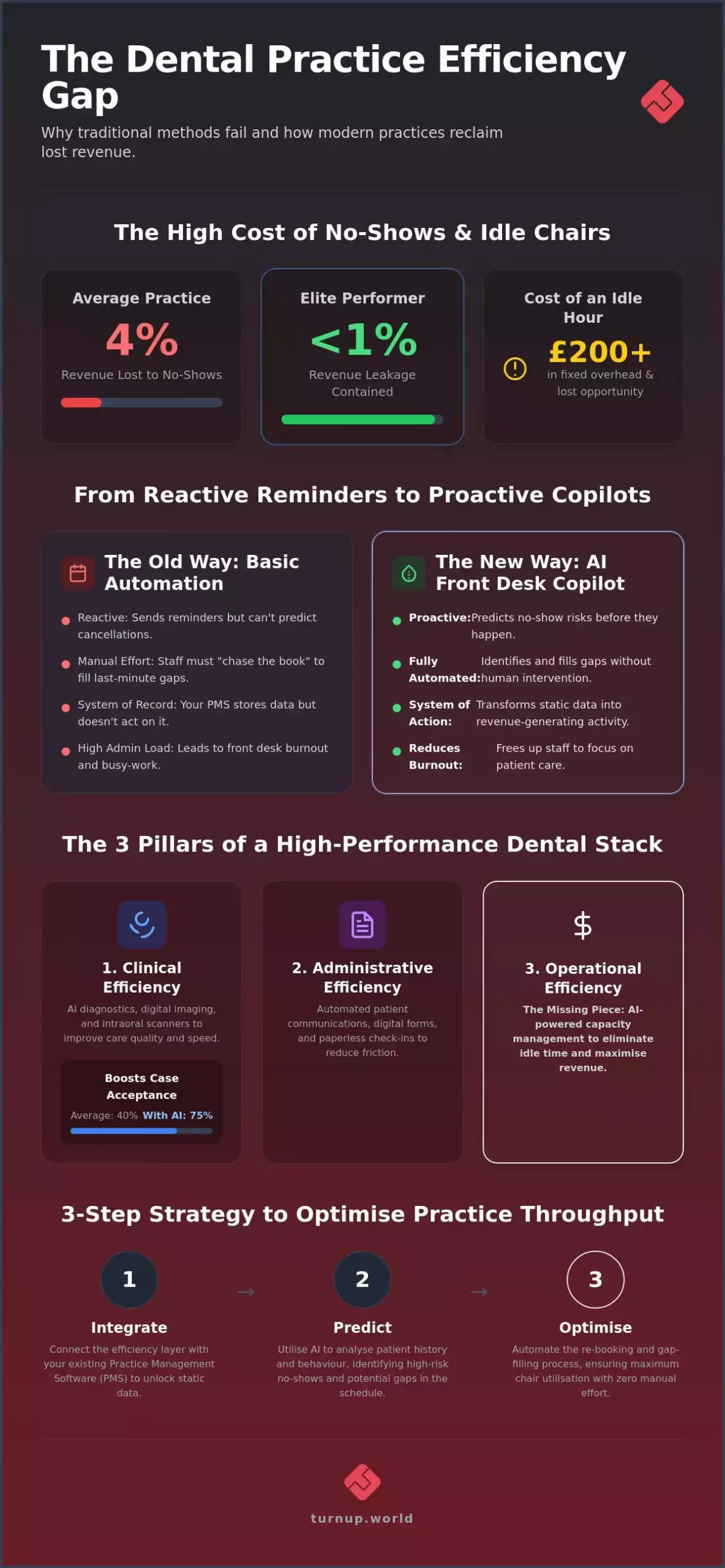
Why does the average dental practice lose 4% of its revenue to no-shows while elite performers keep that leakage under 1%? It isn’t luck. It’s the result of moving beyond basic automation. You likely feel the pressure of a burnt-out front desk team and the frustration of seeing idle chairs despite your existing reminder system. Traditional methods are failing to keep pace with modern demands. By implementing the right dental practice efficiency tools, you can transform your practice into a high-capacity engine that runs with surgical precision.
Maintaining a 60% overhead requires more than just a full calendar; it requires a proactive strategy. We understand that your goal is to eliminate operational uncertainty without increasing staff workload. This article reveals the strategic tools, such as the TurnUp World Front Desk Copilot, that move beyond simple reminders to maximise your practice capacity. We will preview seven essential technologies for 2026 that automate last-minute gap filling and provide total visibility across your entire group. You’ll learn how to scale your standards and finally reclaim your lost chair time.
Key Takeaways
- Understand the Efficiency Paradox and why adding more software often creates administrative noise instead of filling chairs.
- Categorise your technology into clinical, administrative, and operational pillars to build a balanced, high-performance workflow.
- Shift from reactive automated reminders to proactive dental practice efficiency tools that predict no-show risks before they happen.
- Learn how to scale operational standards across multiple locations using standardised data reporting for group-wide capacity visibility.
- Master a three-step implementation strategy to integrate, predict, and optimise your practice throughput with precision.
The Efficiency Paradox: Why Modern Dental Practices Still Have Empty Chairs
True efficiency in a dental practice isn’t measured by how fast your clinicians work or how many software icons sit on your desktop. It’s a precise mathematical ratio: utilised chair time divided by available clinical hours. If your surgeries are open for eight hours but only generate revenue for six, your efficiency is 75%. Most UK practices operate with a 3-5% capacity gap caused specifically by last-minute cancellations and short-notice gaps. This is the Efficiency Paradox. Despite investing in more dental practice efficiency tools than ever before, many principals find their teams are busier with admin, yet their chairs remain empty.
The problem lies in the distinction between “busy-work” and revenue-generating efficiency. Sending manual texts to fill a gap is busy-work; it consumes staff time without guaranteeing a result. Revenue-generating efficiency happens when the system identifies and fills that gap automatically. With dental supply and staffing costs rising, the margin for error has disappeared. For example, hourly earnings for dental staff increased by 2% in early 2026, and equipment costs rose by 6%. You can’t afford to pay for clinical time that isn’t being utilised.
The Hidden Cost of Idle Chair Time
In a modern UK practice, the cost of an empty surgery is staggering. When you account for fixed overheads, clinician drawings, and lost opportunity, an idle hour can easily cost upwards of £200. This financial leak is what we define as Capacity Leakage. For Dental Service Organisations (DSOs), this metric is the most accurate predictor of group-wide profitability. Beyond the balance sheet, idle time destroys staff morale. Front desk teams feel the constant stress of “chasing the book,” while clinicians grow frustrated with fragmented schedules. High staff burnout is often a direct symptom of poor capacity management rather than a heavy patient load.
Why Traditional Practice Management Software (PMS) Isn’t Enough
Your PMS is a system of record. It’s excellent at storing patient histories, managing billing, and holding the calendar. However, it’s rarely a system of action. While there are various dental software categories designed to manage these foundational tasks, they are fundamentally reactive. A standard calendar view tells you that you have a gap, but it doesn’t tell you which patient is most likely to fill it or who has the highest no-show risk.
Traditional systems lack the foresight to move beyond simple automation. They can send a reminder, but they can’t predict a cancellation or initiate a complex re-booking sequence without human intervention. To achieve true growth, you must move beyond the system of record. A dedicated efficiency layer is the only way to transform static data into proactive clinical capacity.
Categorising the Dental Efficiency Stack: From Clinical AI to Capacity Tools
Modern dentistry requires a structured technology stack to remain competitive. We categorise dental practice efficiency tools into three distinct pillars: Clinical, Administrative, and Operational. While most practices invest heavily in the first two, the third pillar, Capacity Management, remains the missing piece for many UK dentistry groups. Building a cohesive, intelligent stack is essential for those looking to define the future of dental practice and eliminate operational uncertainty.
Clinical Efficiency: AI Diagnostics and Digital Imaging
AI-assisted X-ray analysis is no longer a luxury; it’s a high-impact clinical category. These tools flag caries, calculus, and bone loss with surgical precision. This reduces clinician fatigue and significantly boosts case acceptance rates. Currently, the average case acceptance rate sits in the mid-40% range. Top-performing practices using AI diagnostic tools often reach 75%. Intraoral scanners further streamline this pillar by eliminating the mess of traditional impressions and reducing chair time. The goal isn’t just speed. It’s about using the saved time to build patient rapport and improve the quality of care without rushing the clinical process.
By freeing up clinical time, practices can focus on high-end aesthetic transformations; to see how this looks in a premier setting, check out Khan Dental.
Administrative Efficiency: Automated Patient Communications
The front office has evolved from manual phone calls to multi-channel automated reminders. Digital forms and paperless check-ins have removed the friction of patient intake, allowing staff to focus on the patients in the building. However, “set and forget” automation is becoming obsolete. In a market where practice overheads average 60-65% of revenue, basic reminders aren’t enough to stop the bleed of no-shows. You need systems that don’t just send a message but actually manage the response. Beyond communication, Revenue Cycle Management (RCM) tools are now essential for streamlining billing and insurance verification. These ensure your collections rate hits the 97% benchmark achieved by top performers.
The final, and often overlooked, pillar is Capacity Management. This is where you move from managing records to managing throughput. While your Practice Management Software (PMS) stores data, capacity tools like the TurnUp Front Desk Copilot act on it in real-time. This operational layer ensures that your clinical and administrative efforts result in utilised chairs, rather than just a busy staff. It provides the foresight needed to fill gaps before they impact your bottom line.
Automated Reminders vs. AI Front Desk Copilots: A Comparison
Traditional dental practice efficiency tools have focused on the “system of record” logic. They wait for a patient to forget an appointment before sending a nudge. This is a reactive approach. In contrast, an AI Front Desk Copilot operates with foresight. It doesn’t just remind; it predicts. By analysing historical attendance patterns and current patient behaviour, predictive AI identifies individuals with a high no-show risk days before the appointment occurs. This allows the practice to take preemptive action rather than reacting to a silent surgery and a lost hour of clinical time.
Research into dental practitioners’ perspectives highlights that environmental context and resource limitations are primary barriers to efficiency. Standard reminders often hit these barriers because they lack the intelligence to adapt to real-world patient friction. To move beyond these limitations, practices must adopt tools that act as a silent, reliable engine for their operations.
The Limitation of Standard Reminders
Generic SMS reminders are losing their impact. In 2026, patients are overwhelmed by digital noise. A simple “Reply YES to confirm” is often treated as a chore rather than a firm commitment. This leads to the “Confirmation Trap.” You see a fully confirmed book at the start of the day, yet by the afternoon, you have two empty chairs. The patient confirmed out of habit but never actually intended to attend. This happens because standard reminders don’t account for human psychology. Relying solely on these basic tools creates a robotic experience that lacks the personalised touch needed for high retention.
The Rise of the Front Desk Copilot
The Front Desk Copilot is an intelligent operational layer. It sits on top of your existing software to assist staff in real-time. Unlike a static calendar, capacity optimisation software actively monitors for gaps. When a cancellation occurs, the system doesn’t wait for a receptionist to pick up the phone. It automatically scans a digital waitlist and matches the gap with the ideal patient based on treatment type and urgency.
Filling a gap within 24 hours is the “Last Minute” problem. Human teams struggle here because they are already managing the patients in the building and answering incoming enquiries. AI precision handles the logistics, while your team provides the human empathy. This synergy transforms the front desk from a call centre into a high-value patient hub. The ROI difference is significant. Basic dental practice efficiency tools might reduce no-shows by a small fraction, but a copilot captures the revenue that would otherwise be lost entirely. It ensures the chair is never empty, protecting your bottom line with surgical precision.
Scaling Efficiency: Strategic Tools for Dental Service Organisations (DSOs)
Managing efficiency across 10, 50, or 100+ locations presents a unique set of challenges that a single practice never encounters. The primary hurdle is visibility. Without standardised dental practice efficiency tools, group leaders often struggle to identify which sites are performing and which are leaking revenue. Centralised data reporting is the only way to gain a clear view of group-wide capacity. It allows you to move beyond anecdotal reports from practice managers and instead rely on hard metrics like utilised chair time and no-show rates across your entire portfolio.
Predictive analytics take this a step further. By analysing trends across multiple sites, DSOs can allocate resources with surgical precision. If data shows a specific region has a 15% higher cancellation rate on Friday afternoons, you can adjust staffing levels or marketing spend in real-time. This level of foresight transforms a collection of individual practices into a cohesive, high-performance group. It eliminates the operational uncertainty that usually scales alongside your location count.
Standardising the Front Desk Workflow
Consistency is the foundation of a successful DSO. You need every front desk to operate with the same level of precision, regardless of staff turnover. Standard Operating Procedures (SOPs) are essential, but they are only effective if your software enforces them. Intuitive, AI-guided interfaces reduce training time for new hires from weeks to days. This ensures that your capacity management remains stable even during recruitment gaps. Learn more about How TurnUp Automates Your Dental Front Desk Workflow to maintain high standards across every location in your group.
Centralised vs. Localised Capacity Management
Many large dental groups experiment with centralised call centres to manage patient flow. While this can improve efficiency, it often sacrifices the local patient relationships that drive retention. The “Copilot” model offers a superior alternative. It allows local staff to maintain those vital human connections while the AI handles the complex logistics of gap filling and no-show prevention. This approach empowers your teams rather than replacing them.
Using group data also allows you to identify “High-Leakage” practices within your portfolio. You can see exactly where the 3-5% capacity gap is widest and deploy targeted support where it’s needed most. This proactive energy keeps your entire organisation ahead of problems before they impact the bottom line. If you’re ready to gain total visibility into your group’s performance, explore our capacity optimisation solutions for DSOs.
Implementing Your Efficiency Stack with TurnUp Front Desk Copilot
Building a high-performance practice requires more than just collecting software. It requires a dedicated capacity optimisation platform that bridges the gap between your practice management system and your actual clinical throughput. TurnUp Front Desk Copilot is designed specifically for dentistry groups that have outgrown traditional dental practice efficiency tools. Our implementation follows a streamlined, three-step process: Integrate, Predict, and Optimise. This logical flow ensures that your practice moves from data collection to revenue generation with minimal friction.
The core of our philosophy is the “silent engine” approach. Most new technologies fail because they require extensive staff retraining or a fundamental shift in daily behaviour. TurnUp works differently. It sits quietly in the background, performing the complex data analysis and patient matching that your front desk simply doesn’t have the time to execute. It empowers your team to focus on the patients in front of them while the AI manages the future of the appointment book. It is a powerful tool that eliminates operational uncertainty without adding to the administrative noise.
Just as TurnUp provides a silent engine for your practice, you can discover WazUp to act as a reliable partner for your travel logistics, offering chauffeur services in over 170 countries to ensure you reach your destinations with the same level of precision and ease.
No-Show Prevention Through Predictive Intelligence
While standard reminders react to the calendar, TurnUp uses predictive intelligence to prevent gaps before they occur. By analysing historical data patterns, our NoShow Prevention solution identifies high-risk appointments with surgical precision. This allows for proactive intervention strategies that are tailored to the individual patient’s likelihood of attendance.
The impact on your revenue is direct and measurable. While the top 10% of practices aim for a no-show rate of less than 1%, the industry average often hovers around 4%. Moving the needle by even a few percentage points can save a group-wide DSO thousands of pounds in lost clinical time. We move your practice beyond the industry standard by identifying the “Confirmation Trap” mentioned earlier and securing your capacity days in advance.
Filling Gaps with Last-Minute Automation
Cancellations are inevitable, especially during high-stress periods like flu season or school holidays. The LastMinute solution transforms these potential losses into opportunities. When a slot opens up within 24 hours, TurnUp instantly scans your digital waitlist to match the gap with the right patient. It considers treatment type, clinician availability, and patient urgency to ensure the chair is filled with the most valuable appointment possible.
This automation significantly reduces front desk stress. Instead of your team frantically calling through a list of names, the system handles the logistics. This proactive energy keeps your surgeries running at peak capacity regardless of external disruptions. If you are ready to eliminate idle chair time and scale your operational standards across every location, it is time to Optimise your dental practice capacity with TurnUp World.
Future-Proof Your Practice Operations
The operational landscape of 2026 demands a shift from busy-work to revenue-generating efficiency. You’ve seen how the right dental practice efficiency tools bridge the gap between a confirmed calendar and a truly utilised surgery. By categorising your technology stack and adopting a “Copilot” model, you empower your team to focus on patients while the system handles the complex logistics of gap filling. This transition turns operational uncertainty into a predictable engine for growth.
TurnUp Front Desk Copilot provides that silent, reliable engine for your business. As UK-based healthcare capacity experts, we offer specialised NoShow prevention for DSOs and ensure seamless integration with your existing PMS. This isn’t just another software layer; it’s a strategic tool designed to eliminate the 3-5% capacity leakage that erodes your profitability. You don’t have to change your staff’s behaviour to see a significant impact on your bottom line.
Take the next step in your operational evolution. Maximise your practice capacity with the TurnUp Front Desk Copilot. It’s time to stop chasing the book and start leading a high-capacity practice with surgical precision. Your team and your balance sheet will feel the difference immediately.
Frequently Asked Questions
What are the most effective dental practice efficiency tools in 2026?
The most effective tools combine clinical AI diagnostics with proactive capacity management platforms. While AI-assisted X-ray analysis improves diagnostic speed, operational tools like the TurnUp Front Desk Copilot ensure those clinical hours are actually utilised. Integrated Revenue Cycle Management (RCM) software is also essential to maintain the 97% collection rate seen in top-performing UK practices. These dental practice efficiency tools create a balanced ecosystem that protects your margins.
How can AI improve the efficiency of my dental front desk?
AI improves efficiency by transforming the front desk from a reactive call centre into a proactive patient hub. Instead of staff manually calling through lists to fill gaps, AI predicts no-show risks using historical patterns. It identifies high-risk appointments days in advance, allowing the system to secure the slot or find a replacement automatically. This removes the administrative noise that typically leads to front-desk burnout.
Will efficiency software replace my dental reception staff?
No, efficiency software is a tool for empowerment rather than a replacement for human staff. It acts as a silent engine that handles the complex logistics of schedule optimisation. By automating the repetitive task of “chasing the book,” your reception team can focus on delivering high-quality patient care and human empathy. The goal is to remove the “busy-work” so your team can focus on revenue-generating interactions.
How do I measure the ROI of new dental practice management tools?
You measure ROI by tracking the reduction in idle chair time and the corresponding increase in utilised clinical hours. Compare your current no-show rate against the rate achieved after implementation. If you reduce capacity leakage from the 4% industry average to under 1%, the reclaimed revenue from those clinical hours provides a clear, data-driven return on your investment. Reclaiming just two hours of idle surgery time per week can result in thousands of pounds in additional monthly revenue.
Can efficiency tools help reduce dental staff burnout?
Yes, dental practice efficiency tools directly reduce burnout by eliminating the constant stress of last-minute schedule gaps. Staff frustration often stems from the “Confirmation Trap,” where a seemingly full book falls apart by midday. Automated systems remove the mental load of frantic re-booking, creating a predictable and calm environment. When the logistics are handled by a reliable engine, your team feels more in control of their workday.
What is the difference between a PMS and a Front Desk Copilot?
A Practice Management System (PMS) is a system of record, while a Front Desk Copilot is a system of action. Your PMS is a database that stores patient history, clinical notes, and the static calendar. A Copilot sits on top of that data to actively manage patient flow. It doesn’t just hold the appointment; it predicts attendance and automatically optimises the schedule to ensure maximum clinical throughput.
How do I fill last-minute dental appointment cancellations automatically?
You fill last-minute gaps by using capacity optimisation software that integrates with a digital waitlist. When a cancellation occurs within 24 hours, the system instantly matches the open slot with the ideal patient based on treatment type and urgency. It sends an automated, personalised offer to the patient, securing the booking without any manual intervention from your front desk team. This ensures the chair remains revenue-generating even during high-cancellation periods.
Is capacity optimisation software suitable for small independent practices?
Capacity optimisation is vital for any practice looking to protect its bottom line, regardless of size. While large groups use these tools for portfolio-wide visibility, independent practices use them to eliminate the high cost of idle surgeries. In a single-surgery practice, one empty hour has a significant impact on daily profitability. Implementing a silent, automated engine ensures that your small practice operates with the same precision as a major DSO.