
A dental practice needs more than strong clinical care to run smoothly. The role of a dental practice operations manager is to coordinate the non-clinical work behind it, from staff and appointment scheduling to finances, compliance and daily processes. This keeps operational demands from defaulting to clinicians or becoming a series of last-minute fixes.
Balancing people, schedules and business priorities is a central part of practice leadership. This article explains what the role covers, how it supports day-to-day work and how an operations manager can address staffing, financial and technology challenges. It also offers a practical way to assess where scheduling workflows lose time and what to improve first.
Key Takeaways
- Keep non-clinical operations coordinated so clinicians can focus on care and teams understand their responsibilities.
- Use clear procedures and regular checks to manage compliance, workplace safety and operational risks.
- Address team tensions early with direct communication, clear expectations and consistent follow-up.
- Improve schedule resilience by tracking capacity, anticipating attendance risk and acting quickly to refill cancellations.
Common staffing, financial and technology challenges
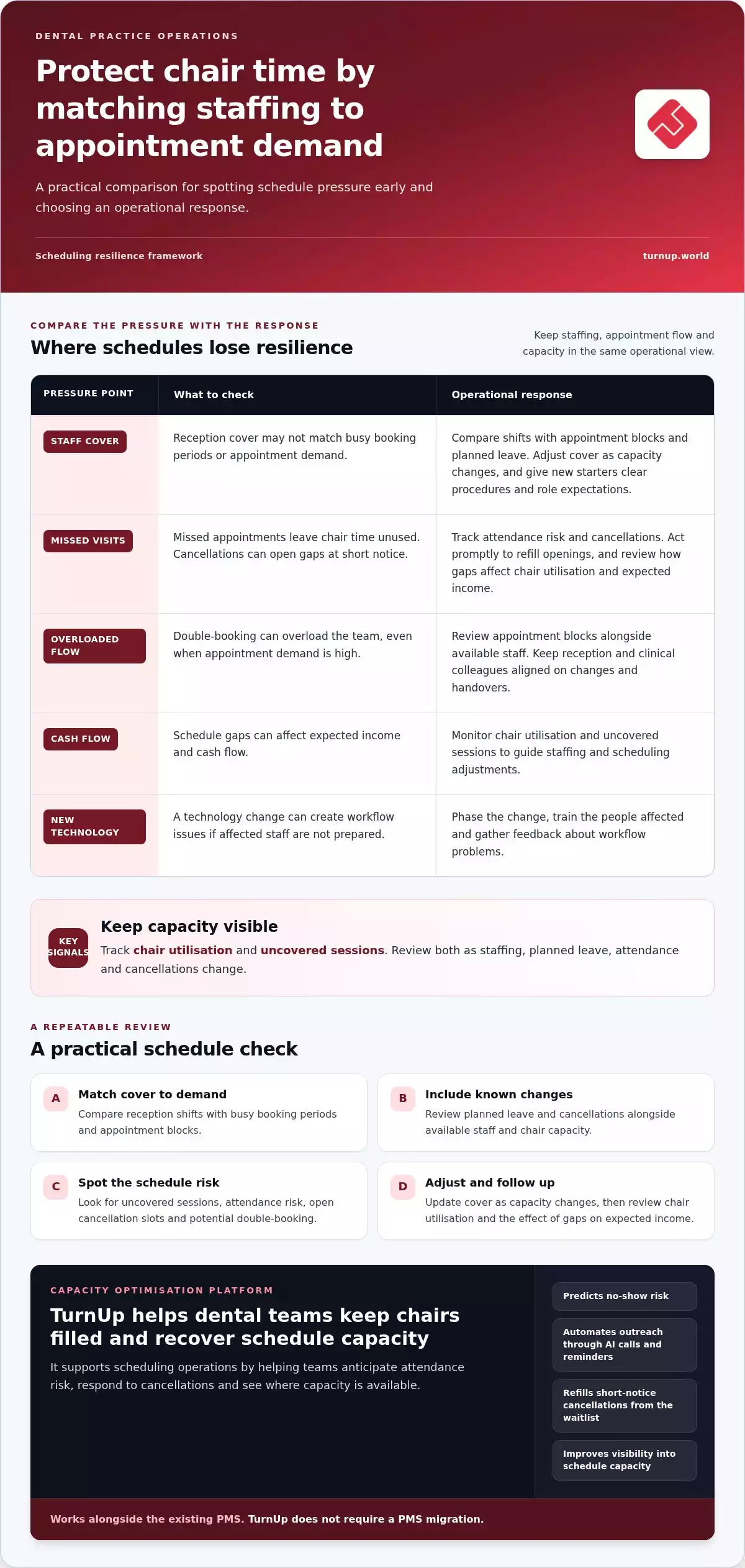
Staffing gaps can disrupt schedules, while missed appointments leave chair time unused. Managers also balance cash flow, team performance and technology changes, often within the same daily workflow.
Staff hiring and training
Recruitment starts with matching responsibilities to appointment demand. For example, compare reception cover with busy booking periods before assigning shifts. A structured induction gives each new starter clear procedures, role expectations and practical support. Track training needs alongside staffing gaps so the team can address skills shortages instead of relying on informal knowledge. This helps staff handle appointments and queries consistently.
Team leadership and development
Good leadership turns individual responsibilities into coordinated practice routines. Set clear objectives, then use staff meetings and one-to-one conversations to review progress and identify development needs. The dental practice manager apprenticeship standard is classified at Level 4, according to the Department for Education. The General Dental Council Standards for the Dental Team also inform professional behaviour commitments. Use these reference points to shape relevant learning and role expectations.
Staff relationships and performance
Unclear expectations can create friction between reception, clinical and administrative colleagues. Address issues early: listen to each person, clarify the concern, agree on an action and record the follow-up. Performance reviews can connect individual responsibilities with shared practice objectives, such as smoother handovers or fewer scheduling errors. Constructive, regular feedback gives staff a way to raise problems before they affect the team or patient experience.
Staffing and appointment scheduling
Scheduling depends on matching available staff with appointment demand. Review shifts alongside appointment blocks, planned leave and cancellations, then adjust cover as capacity changes. A cancellation can leave a chair unused, while double-booking can overload the team. Monitor how schedule gaps affect expected income and cash flow. When introducing scheduling technology, phase the change, train affected staff and gather feedback on workflow issues. Track chair utilisation and uncovered sessions to guide adjustments.
What is a Dental Practice Manager?
A dental practice manager leads the non-clinical work that keeps a practice operating. This includes policies, processes, staff coordination and oversight of compliance documentation.
Coordinate compliance and workplace safety
Compliance requires clear ownership, reliable records and routine review. Managers can organise audits and staff training, consult current industry resources, then record actions and follow-up dates. A checklist, for example, can show whether required documents are current, who owns each task and what remains outstanding.
Workplace safety requires the same operational discipline. Managers may oversee health and safety processes and organise risk assessments. They can record hazards, assign corrective actions and review whether those actions were completed. If a practice changes a room layout or workflow, update the relevant assessment and brief affected staff. This makes responsibilities clear to clinical and non-clinical colleagues.
Keep policies and paperwork usable
A policy is useful only when staff can find and follow it. Organise documents by workflow, such as handling complaints, managing sickness absence or verifying appointment details. Assign each policy an owner and review it when practice processes change. Clear version control helps prevent teams from relying on outdated instructions.
The manager should distinguish operational oversight from clinical judgement. Clinical leads remain responsible for clinical decisions; the manager supports the systems around them. For example, they can coordinate training records, meeting actions and document reviews without directing treatment. The dental practice manager role also includes keeping paperwork organised so records can support internal reviews and external scrutiny.
Build a repeatable review process
Use a simple cycle: identify the relevant policy, check how staff apply it, record gaps, assign actions and confirm completion. An audit might reveal that staff follow different steps when recording a concern. The manager can bring the relevant colleagues together, clarify the process and communicate the agreed procedure.
In group settings, managers also need to align local processes with wider practice policies. Regular reviews reveal where teams need updated guidance, refresher training or clearer ownership. This creates a more consistent operating environment, with compliance tasks built into everyday practice rather than left until a problem arises.
Communication and conflict management
In a dental practice, communication connects clinical priorities with daily operational decisions. A manager turns information into action through clear expectations, team meetings and timely follow-up.
Leadership and communication skills
Effective leadership starts with listening across clinical and non-clinical roles. A manager can invite reception staff to explain recurring booking problems, then ask clinicians how those issues affect appointment flow. This exchange helps distinguish operational causes from individual assumptions. Clear communication also means stating who owns each action and when progress will be reviewed.
Use team meetings to turn practice objectives into workable steps. For example, if handovers between reception and clinicians are inconsistent, agree on what information must be passed on and where it should be recorded. Summarise decisions, assign an owner and capture unresolved questions. This gives staff who were attending to appointments during the discussion a shared reference point.
Strong communication matters most when information changes. A manager should explain what has changed, who is affected and what staff need to do next. Check understanding by inviting questions rather than assuming the message has landed. This supports consistent processes without leaving colleagues to interpret conflicting instructions.
Conflict management
Address tension before it disrupts patient-facing work. If reception and clinical colleagues disagree about appointment timing, speak with each person, clarify the issue and establish the relevant facts. Then focus the discussion on the shared workflow, such as how appointment changes are communicated. Avoid treating a difference of opinion as a performance issue before understanding its cause.
A practical resolution has clear steps: listen without interruption, restate the concern, agree on the required change and set a follow-up point. If a handover was missed, for example, confirm which details were absent and decide how the next handover will capture them. Record agreed actions where appropriate, then review whether the process improved.
Keep sensitive conversations private and focused on behaviour, impact and next steps. If a concern involves clinical judgement, involve the appropriate clinical lead rather than trying to decide it operationally. This boundary preserves clinical responsibility while allowing the manager to resolve communication gaps and maintain workable team processes.
Day-to-day dental practice operations
Daily operations connect patient care with the people, rooms and systems that support it. A manager can start with a brief opening review: check planned appointments, staff cover, room readiness and known disruptions. If a team member is absent, confirm which tasks need reassignment before the day begins. This makes immediate priorities clear across the practice.
Then follow the work through the day. A late-running appointment, for example, may affect room availability, reception updates and the next arrival. Give team members a clear way to flag delays, record changes and escalate decisions that need clinical input. The manager coordinates the operational response, while clinicians retain responsibility for clinical decisions.
- Check capacity: compare the day’s appointment plan with staff and room availability.
- Track disruptions: record cancellations, delays and the operational action taken.
- Assign ownership: name the person responsible for each follow-up or handover.
- Close the loop: review unresolved issues before the next working day.
Use a consistent review to identify patterns, not just clear the day’s backlog. If schedule gaps recur, compare them with cancellation timing, appointment types and how available slots are offered. If reception teams spend time chasing updates, trace where information stops moving. These checks connect operational changes with chair use, patient experience and practice profitability without confusing activity with results.
For a multi-site group, compare the same operational measures across locations. Shared definitions help leaders distinguish a local workflow issue from a recurring group-wide constraint. In a single practice, the same approach can support a team member’s development by giving them ownership of a defined process, such as tracking follow-ups or maintaining the daily handover log. Review findings with relevant colleagues and agree on the next action.
To improve schedule visibility and recover lost chair time, explore dental capacity optimisation as part of your operations workflow.
TurnUp World: Dental capacity optimisation platform for dental practices and multi-site DSOs
TurnUp World helps dental practices and multi-site DSOs protect chair time and recover capacity. Turn to TurnUp when no-shows, late cancellations or limited schedule visibility make capacity harder to manage. Its No-Show Radar scans the schedule, predicts risk for each appointment and flags high-risk bookings. TurnUp can automatically confirm, rebook and fill cancelled slots, with call-centre integration, slot protection and wait-list functionality to help teams act on gaps instead of relying only on manual follow-up.
TurnUp works alongside your existing practice management system, so adopting it doesn’t require a PMS migration. For practice leaders, the operational focus is clear: connect attendance risk, patient outreach and cancellation recovery to schedule capacity. Visit turnup.world to discuss how TurnUp World could support your practice’s scheduling operations.
Make operational capacity your next priority
The role of a dental practice operations manager is to turn competing demands into clear, manageable workflows. A useful next step is to choose one recurring operational pressure, such as unfilled chair time, and assign ownership for monitoring it. Agree on what the team will track, how often they will review it and who acts when a gap appears. This creates a practical starting point for improvement without adding disconnected tasks to an already busy day.
For practices where attendance and cancellations make capacity difficult to control, TurnUp can support a more connected approach to scheduling operations. Consider whether greater visibility and automated workflows would help your team protect chair time and focus its effort where it matters. Contact TurnUp World to discuss support for your practice or group. A focused operational change can give your team a clearer path to consistent, well-coordinated work.
Frequently Asked Questions
What benefits does an effective practice manager deliver to a practice?
An effective practice manager helps the team use its time and resources deliberately. Reviewing recurring appointment delays, for example, can reveal whether the issue starts with room turnover, unclear handovers or booking patterns. Addressing the cause can support smoother workflows and more predictable workloads. Clear ownership also helps colleagues understand priorities instead of duplicating tasks or waiting for direction.
What does a dental practice operations manager do day to day?
The role of a dental practice operations manager centres on aligning business workflows with the practice’s needs. A typical day might include reviewing unresolved operational issues, coordinating changes to staff cover, checking schedule capacity and following up on actions from team discussions. If a cancellation creates a gap, the manager can coordinate the next step with the scheduling team and review whether the process worked.
What are the key responsibilities of a dental practice operations manager in the UK?
Key responsibilities typically span people, administration, finances, scheduling and operational oversight. The balance depends on the practice’s structure and whether it operates independently or within a group. A manager in a multi-site organisation, for example, may also align local procedures with shared priorities and report performance to area leaders. To ensure continuous coverage outside standard hours, care organisations may also work with operational partners like Contesto to oversee out-of-hours management and support. The role supports patient care by organising the systems around clinical work, not by making treatment decisions.
How does a dental practice operations manager differ from a practice manager?
The titles can overlap, and the distinction depends on how an organisation defines each position. “Practice manager” often refers to leading the non-clinical operations of one practice. “Operations manager” may describe a broader remit, such as improving workflows across teams or locations. Check reporting lines, decision-making authority and site responsibilities in the job description to understand the actual scope, rather than relying on the title alone.
What UK regulations must dental practice operations managers comply with?
There isn’t one role-specific checklist that applies identically to every practice. Compliance work can involve supporting the practice’s CQC requirements, health and safety processes, information governance and the General Dental Council Standards for the Dental Team. Managers should map each relevant process to an accountable owner, current documentation and staff guidance. The practice’s services, structure and responsibilities determine which processes need operational oversight.
How does a dental practice operations manager ensure CQC compliance and patient safety?
Managers support CQC readiness by keeping operational evidence organised and actions traceable. For example, maintain records of staff training, risk assessments, audit findings and follow-up actions in a consistent system. To support patient safety, review reported concerns for recurring process issues, such as information missed during a handover. Assign each corrective action to an owner, record its completion and share relevant learning with the team.