
A full diary can still hide lost chair time. A dental practice scheduling audit compares planned appointments with what happened in the chair, revealing gaps, overruns, cancellations and mismatches between appointment length and treatment needs. A manual review can begin with 2 to 4 weeks of existing records and tools.
It’s easy to assume that a busy schedule is an efficient one. Yet a diary can look full while still leaving avoidable gaps, running behind or making poor use of chair time. The key question is not just how many appointments were booked, but whether the schedule reflects the work required and the time clinicians actually have.
This guide explains what an operational dental audit covers and how to assess scheduling performance in a practical, repeatable way. You’ll learn how to review appointment history, spot patterns in gaps and overruns, match appointment templates to treatment needs, and check whether changes improve capacity. The process is simple: establish a baseline, adjust the workflow and review the results.
Key Takeaways
- Compare scheduled appointments with actual chair time to uncover gaps, overruns and recurring workflow issues.
- Separate clinical audits from operational reviews, and include the relevant UK requirements in your audit scope.
- Use appointment history alongside your existing practice management system to spot patterns by provider, procedure and chair.
- Match appointment templates to treatment needs, then repeat the review after changes to see whether capacity has improved.
Re-auditing after changes have been implemented
- Set a re-audit date before you implement a scheduling change. Dental practices typically allow 4 to 8 weeks for changes to take effect before repeating data collection. Keep the baseline and review periods comparable. Record staffing changes, closures and other disruptions that could affect appointment patterns independently of the new template.
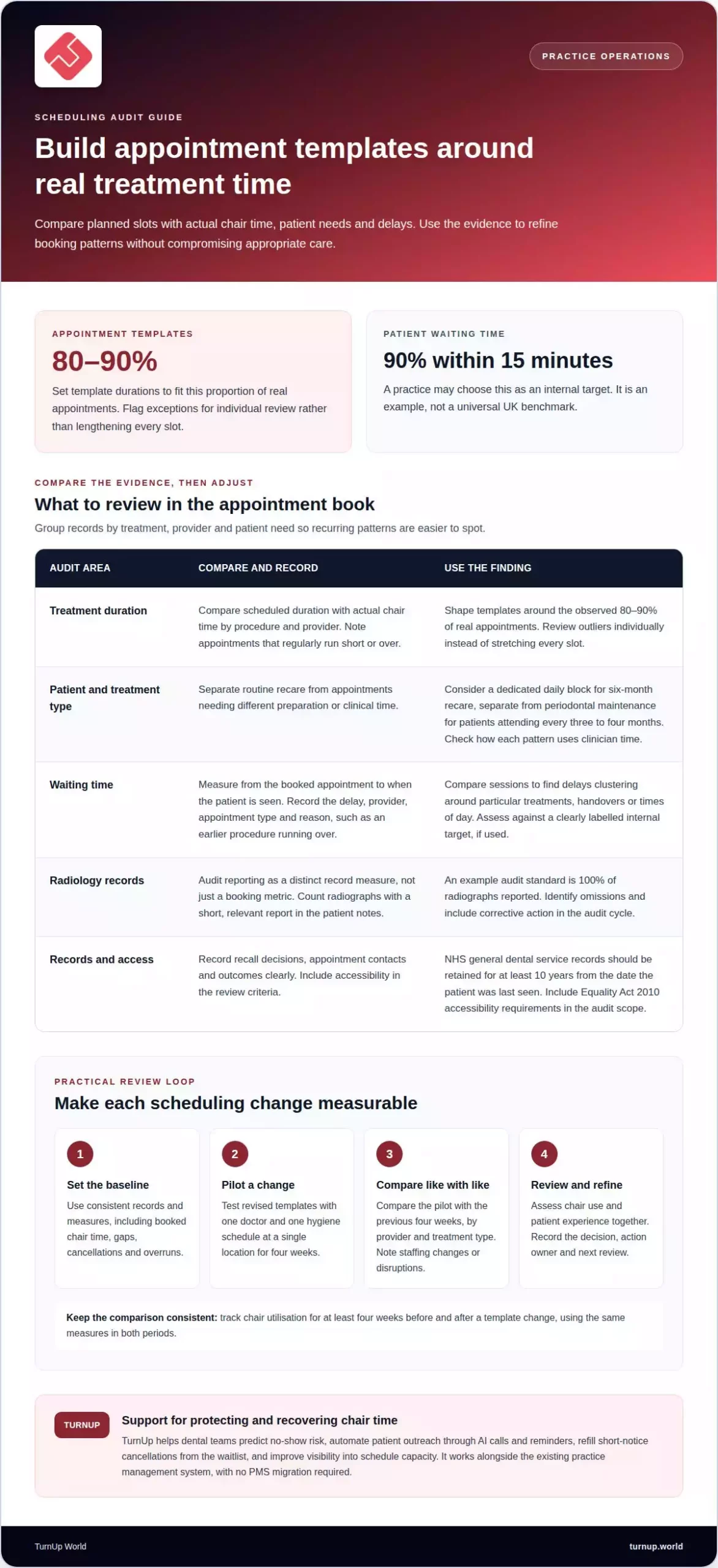
- Pilot revised templates with one doctor and one hygiene schedule at a single location. Run the pilot for 4 weeks, then compare its results with the previous 4 weeks. This limited test helps reveal practical issues before the approach reaches other clinicians, schedules or sites.
- Track chair utilisation for at least 4 weeks before and after template changes. Use the same measures in both periods, including booked chair time, unfilled gaps, cancellations and appointments that overrun. Compare like with like by provider and treatment type, so a change in case mix doesn’t obscure the template’s effect.
- Review the patient experience alongside operational results. For example, check whether revised hygiene or general dental appointment slots create avoidable waiting or make access harder. UK dental audit requirements include accessibility under the Equality Act 2010, according to UK Parliament. Include accessibility in the review criteria, not as a separate afterthought.
- Assess clinical and operational outcomes together before deciding to keep a change. A template that fills more chair time may still need adjustment if appointment lengths repeatedly conflict with treatment needs. Record the evidence, decision and person responsible for each action, so the next review can assess what the team put into practice.
- Repeat the audit cycle after making further adjustments. Compare results with the original baseline and note any changes in gaps, overruns, cancellations or patient satisfaction. Keep effective measures, refine weak points and schedule the next review. This creates a clear record of each change and its observed effect.
Scheduling different patient and treatment types
NHS general dental service records should be retained for a minimum of 10 years from the date the patient was last seen. The General Dental Council standard 7.1 requires care based on current evidence and authoritative guidance. Record recall decisions, appointment contacts and their outcomes clearly.
Measure chair-time variance, unfilled minutes, cancellations, no-shows, appointment duration accuracy and patient waiting times. A practice may set an internal target of seeing 90% of patients within 15 minutes of their appointment time.
- Group appointment history by treatment, provider and patient need. Compare scheduled durations with actual chair time, then identify procedures regularly running short or overrunning. Set appointment templates to fit 80 to 90% of real appointments. Flag the exceptions for individual review instead of stretching every slot.
- Separate routine recare from treatment that needs different preparation or clinical time. For example, consider a dedicated daily block for six-month recare appointments and a separate block for periodontal maintenance patients attending every three to four months. Review whether these patterns make effective use of each clinician’s schedule.
- Measure waiting time from the booked appointment to when the patient is seen. Record the delay, provider, appointment type and reason, such as an earlier procedure running over. Compare patterns across sessions to see whether delays cluster around particular treatments, handovers or times of day.
- Check radiological reporting as a distinct record measure, not just a booking metric. An example audit standard is for 100% of radiographs to have a short, relevant report recorded in the patient’s notes. Track the number meeting that standard, identify omissions, and include a corrective action in the audit cycle.
- Use the findings to adjust booking sequences, appointment lengths or daily blocks. Record each change and its rationale, then compare waiting times and chair use in the next audit cycle. Keep clinical requirements central: a faster diary is not efficient if it compromises appropriate care or clear records.
What Is a Dental Audit?
A dental audit compares recorded performance with defined criteria and uses the findings to guide action. For an appointment book, collect records, analyse patterns, investigate causes and agree on changes.
-
Collect and analyse audit data
Start by exporting appointment records for a consistent review period. Include the appointment date, provider, procedure, operatory, scheduled duration and outcome. Record cancellations, missed appointments, late arrivals, overruns and unused chair time. Compare similar appointment types, then summarise the results in a simple report. This makes the review traceable and highlights entries that need closer examination.
-
Use analytics with the practice management system
Use practice management system reports alongside your analysis, rather than replacing the system. Review appointment-history reports covering the previous 90 days, grouped by provider, procedure and operatory. Check that cancelled or rebooked appointments appear consistently, and avoid comparing mismatched periods. Use the system record as the source, then organise results into measures that reveal patterns across schedules.
-
Identify recurring workflow issues
Group findings by cause, not just outcome. Calculate cancellation and no-show rates from your practice’s appointment records, and track late arrivals against booked appointments. Do not treat a single rate as a universal UK benchmark: compare similar periods, providers and appointment types. Investigate repeated overruns, long waits or gaps as patterns rather than isolated incidents.
-
Map processes and investigate root causes
Map each booking from the initial appointment through confirmation, arrival and clinical handover. In a team meeting, trace a recurring gap or delay through those steps. Check whether appointment duration, booking sequence, communication or handover contributed. Flag safety concerns, such as a treatment slot that appears too short or missing relevant information, for clinical review. Assign an action and an owner.
Operational and practice audits
Separate chair-time performance from clinical quality checks, and assign each audit a clear owner and action.
- Define the audit question before collecting evidence. A scheduling review might ask whether appointment templates reflect actual chair time. A clinical audit tests care against explicit criteria. Keep their scopes distinct, while discussing shared causes, such as rushed handovers affecting patient care and schedule flow.
- Include evidence, action and follow-up in every completed audit. Record the criteria, sample or data reviewed, findings, action plan and steps taken. For a consent audit, for example, document which record details met the chosen standard and what staff will change when entries are incomplete.
- Use governance requirements to set priorities. CQC expects providers to use audit or quality improvement to demonstrate good governance under Regulation 17, safe care under Regulation 12, and clean, suitably maintained premises and equipment under Regulation 15. Link each finding to a responsible person and a review date.
- Keep decontamination within the practice audit programme. NHS England says primary dental services in England should audit decontamination processes at least every 6 months. Record the process reviewed, findings and corrective action. Do not treat a scheduling audit as evidence that infection prevention or clinical standards have been assessed.
- Close each audit cycle by reviewing whether the action worked. At a team meeting, discuss outstanding issues, assign owners and record decisions. If booking delays coincide with a clinical process concern, route each issue to the appropriate review. Keep the evidence trail clear, then plan a focused scheduling review to examine chair-time performance.
TurnUp World: Dental capacity optimisation platform for dental practices and multi-site DSOs
TurnUp World helps dental teams act on audit findings when no-shows, cancellations or unfilled chair time recur. TurnUp predicts no-show risk for each appointment and can automatically confirm, rebook and fill cancelled slots. Its No-Show Radar scans the schedule in real time and flags high-risk appointments. Automated waitlist management helps recover short-notice cancellations, while the AI Call Center supports appointment confirmation, cancellation and rebooking.
TurnUp sits on top of your existing practice management system, with no migration required. Its scheduling capacity insights, chair utilisation reporting and workflow automation help dental practices and multi-site DSOs identify recurring gaps and manage capacity. It is a practical next step when manual follow-up or limited schedule visibility makes it difficult to keep chairs filled. Book a demo to see how TurnUp can support your audit findings.
Make scheduling improvement part of daily operations
Appointment patterns shift as clinicians, treatment demand and patient preferences change. Notice those shifts early, before yesterday’s booking assumptions become today’s bottlenecks. A dental practice scheduling audit can help you assess whether current routines still meet the practice’s needs. Treat it as a recurring review, not a one-off exercise with a fixed endpoint.
Keep the focus on practical learning. Invite the team to identify friction points, distinguish isolated disruptions from recurring patterns, and use useful observations in everyday decisions. Evidence-led adjustments can help the practice stay responsive without losing sight of access or clinical priorities. A clear view of how work moves through the diary helps your team build a more resilient schedule over time.
Frequently Asked Questions
What is a dental practice scheduling audit?
A dental practice scheduling audit reviews whether appointment-book decisions support usable clinician time and appropriate access. Its scope can include booking categories, duration accuracy, attendance outcomes and diary gaps. It does not assess whether diagnosis or treatment was clinically correct. Define the boundary in advance, so operational findings go to practice management and clinical concerns reach the appropriate clinical review.
How can a UK dental practice reduce cancellations and empty appointment slots?
Start by identifying when cancellations occur and what patients report as the reason. Compare patterns by booking lead time, clinician, session and treatment category, separating patient cancellations from changes made by the practice. Use the findings to refine confirmation timing and appointment-change instructions. Record whether patients keep, move or cancel their booking, then review whether the changes affect cancellation patterns.
How should appointment lengths and clinician time be scheduled for different dental treatments?
Build each clinician’s template around observed procedure duration, allowing time for preparation, treatment, documentation and turnover. Check that the planned session matches both the clinician’s and the chair’s availability. Avoid grouping appointment types that compete for the same clinician or equipment. Review exceptions with the clinical team before changing templates, especially when treatment needs vary between patients.
How can a dental practice audit NHS and private appointment allocation and waiting times?
Track booking wait and in-practice waiting time separately. For booking access, record the date a patient requests an appointment and the date offered. For arrival delays, compare the appointment time with when the patient is seen. Analyse NHS and private activity separately, then interpret findings against the practice’s documented allocation processes and applicable local contractual arrangements.
What are typical dental practice cancellation, no-show and late-arrival rates in the UK?
There is no single UK benchmark for this audit. Calculate rates from your own appointment records and compare similar periods, providers and appointment types.
What dental practice scheduling software and audit tools are available in the UK, and how do they compare?
A practice can use appointment-history reports from its existing practice management system, alongside manual analysis and a simple report. Review records by provider, procedure and operatory; no software comparison is provided.