A private dentist may charge for a missed or late-cancelled appointment if the fee is stated in its terms. There’s no single cancellation notice period for dental appointments across the UK, so the cost of missed dental appointments depends on the practice’s policy and the booking circumstances.
It’s reasonable to want a clear answer before cancelling or missing a visit. This article explains when private practices may charge, how missed appointments during ongoing treatment can affect care, and what may apply to a new patient’s first appointment. It also outlines how NHS appointments differ from private bookings, so you can understand which policy applies.
Key Takeaways
- Separate NHS and private appointment policies before explaining possible charges to patients.
- Review the practice’s cancellation terms, including notice periods and how fees apply during ongoing treatment.
- Make new-patient booking conditions clear, as missed first visits may be treated differently from established appointments.
- Track missed and cancelled chair time, then use risk prediction and waitlist outreach to help recover short-notice gaps.
Missed appointments during ongoing treatment
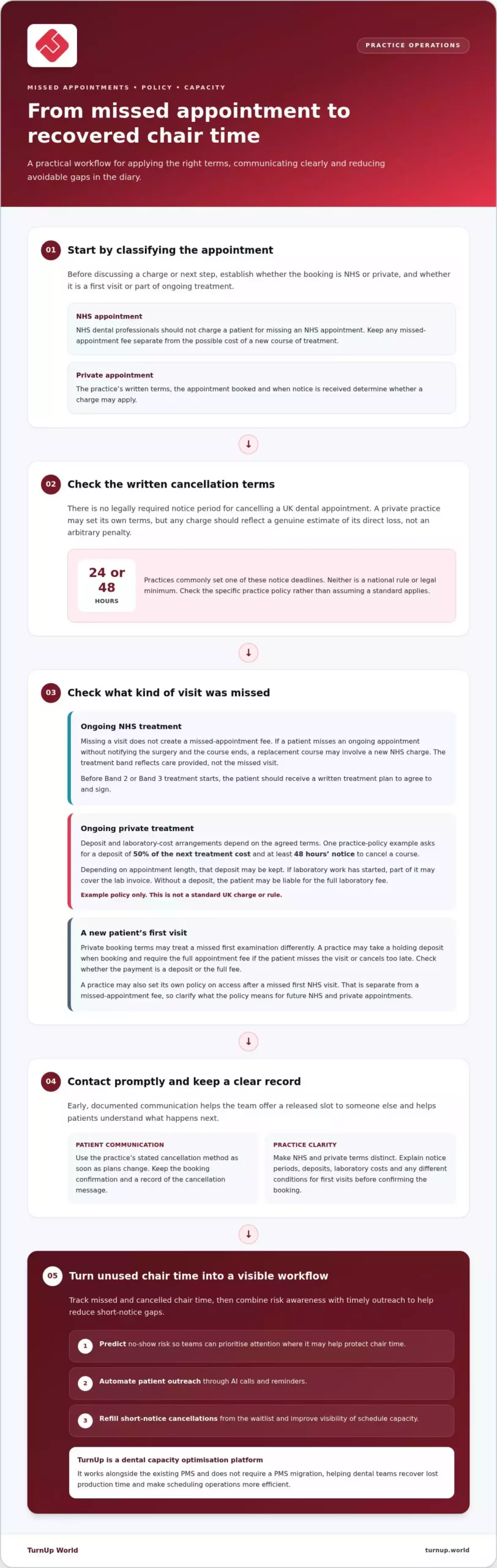
For NHS treatment, a missed appointment and the cost of restarting treatment are separate issues. NHS dental professionals should not charge patients for missing an NHS appointment. However, someone who misses an ongoing NHS appointment without notifying the surgery may need to pay for a new course of treatment. Tell the practice as soon as possible if you can’t attend, so the slot can be offered to someone else.
The band reflects the treatment provided, not the missed appointment. Before Band 2 or Band 3 treatment starts, patients should receive a written plan to agree to and sign. This records the proposed course of treatment and its charge.
Missing a treatment visit can interrupt the agreed course. Contact the surgery promptly to discuss what happens next. If the dentist ends the course, a replacement course may involve a new NHS charge. Keep your appointment and treatment-plan details together so you can distinguish a missed-appointment fee from payment for new treatment.
Private treatment may work differently. One practice policy example asks patients booking further treatment to pay a deposit of 50% of the next treatment cost. It may require at least 48 hours’ notice to cancel a course; depending on appointment length, the deposit may be kept. If laboratory work has started, a proportion may cover the lab invoice. Without a deposit, the patient may be liable for the full laboratory fee.
Does travel insurance, health insurance or a dental plan cover missed-appointment fees in the UK? It depends on the policy wording: a plan that covers dental treatment doesn’t necessarily cover a missed-appointment fee. The practice’s charge and the cost of restarting treatment are separate.
Before booking, confirm whether treatment is NHS or private, read the cancellation terms, and ask how deposits and laboratory work are handled if you miss a visit. This helps you understand the potential costs before treatment begins.
Charges for missed new-patient appointments
A missed first visit can carry different consequences from an established patient’s appointment. NHS dental professionals in the UK should not charge patients a fee for missing an NHS appointment. In England, practices lost the ability to charge for missed appointments when the current NHS dental contract began in April 2006.
Terms for new private patients can vary. For example, a private practice may take payment when booking a first examination as a holding deposit. Its policy may require the full appointment fee if the patient misses the visit or cancels too late. This is a practice-specific policy, not a standard UK fee. Read the booking terms before paying and check whether the payment is a deposit or the full appointment charge.
For a new NHS patient, missing the first appointment may also affect access at that surgery. One practice policy says the patient won’t be offered another NHS appointment there and will only be seen privately afterwards. That is separate from a missed-appointment fee. Ask the practice whether its decision applies to future NHS appointments, private treatment, or both.
If a charge is unclear, keep the booking confirmation, payment record and cancellation messages. Raise the issue with the practice first, giving the appointment date and the term you’re querying. For an NHS complaint in England, the Parliamentary and Health Service Ombudsman is the final stage after the practice and ICB complaint processes have been exhausted. Complete those stages before approaching the Ombudsman.
Private-treatment complaints have a separate route. The Dental Complaints Service generally handles issues within 12 months of treatment or of the patient becoming aware of the problem. Include the appointment details and the practice’s written fee policy when explaining the dispute. For practice teams, clear booking terms should distinguish an NHS missed visit from a private first-appointment charge, so patients understand the financial conditions before confirming.
Can a private dentist charge a cancellation or no-show fee?
Yes. A private practice can set cancellation terms, but any charge should reflect a genuine estimate of its direct loss. There’s no legally required notice period for cancelling a UK dental appointment. Practices commonly set a 24- or 48-hour deadline, but neither is a national rule or legal minimum.
The practical step is to read the booking terms and contact the practice as soon as your plans change. Use its stated cancellation method, such as calling or replying to a reminder, and keep a record of your message. Giving notice early gives the team more time to offer the slot to someone else and may prevent an avoidable charge under the practice’s policy.
For a practice, a missed appointment leaves booked chair time unused and can disrupt the day’s schedule. Staff costs and the opportunity to provide treatment remain relevant, but a fee shouldn’t simply be an arbitrary penalty. A BDA representative reported that one in seven NHS patients missed appointments at his practice over a year, with an estimated practice cost of £56,000. The example shows how missed slots can affect operations, not what a private patient will be charged.
Deposit and refund arrangements depend on the agreed terms and costs already incurred. For example, if laboratory work has started, a practice may retain part of a deposit to cover the lab invoice. Under some terms, a patient who hasn’t paid a deposit may be liable for the full laboratory fee. The policy should explain how it handles cancellations, deposits and lab costs.
Missed visits also affect access to care. An empty slot can delay another patient’s appointment, while repeated NHS non-attendance can have wider consequences. In England, one missed NHS appointment alone isn’t grounds for removing a patient from a practice, but NHS England may ask someone who continues to miss appointments to find another surgery. Clear reminders, prompt cancellation and an accessible way to rearrange can reduce disruption and fee disputes.
Missed appointment fees for private patients
The cost of missed dental appointments depends on the private practice’s written terms, the appointment booked and when the cancellation is received. There isn’t one standard fee for private patients across the UK. Check separately for terms covering missed visits, late cancellations and rearrangements, as each may have different conditions.
Compare your booking confirmation with the practice’s cancellation policy. Note the required notice period, accepted ways to cancel and whether a deposit reserves the appointment or contributes towards treatment. If you need to rearrange, use the contact method stated in the terms and keep a record of your message. That makes it easier to establish whether the practice received notice in time.
Practice managers can make policies clearer by explaining how each appointment category is handled. A new-patient examination, routine review and longer treatment visit may have different booking conditions. Explain what happens to deposits after cancellation and how costs are handled if laboratory work has started. Clear distinctions help staff answer questions consistently and reduce uncertainty at booking.
For a practice, understanding the cost of missed dental appointments means examining the operational impact as well as any fee collected. Record the appointment type, notice given, whether the slot was reused and any direct costs incurred. A dental practice scheduling audit can help reveal where cancellation communication or waitlist processes leave chair time unfilled.
Patients can reduce confusion by saving the policy with their appointment details and cancelling as soon as their plans change. Practice teams can review how often late cancellations leave gaps, then refine how they offer those openings to waiting patients. Explore ways to reduce missed appointments and recover chair time.
TurnUp World: Dental capacity optimisation platform for dental practices and multi-site DSOs
TurnUp World helps dental practices and multi-site DSOs protect chair time and recover capacity lost to no-shows and cancellations. Its platform predicts no-show risk and supports automated prevention, while its AI Call Center confirms, cancels and rebooks appointments. Automated waitlist management helps teams refill short-notice gaps.
Consider this approach when missed visits and late cancellations leave chairs unused, or when your team needs clearer visibility of scheduling capacity. TurnUp works alongside an existing practice management system, with no PMS migration required. It goes beyond reminders by connecting appointment outreach with cancellation recovery and more efficient scheduling.
Explore how TurnUp World can support your practice’s capacity by booking a demo.
Turn missed appointments into a capacity plan
The cost of missed dental appointments is more than a fee on a patient account. Unused chair time can also reveal where scheduling workflows need attention. Review patterns by appointment type, cancellation timing and whether the slot was refilled. Use those insights to focus your team’s effort on protecting capacity.
TurnUp World supports this work with dental capacity optimisation, no-show and failure-to-attend prediction, automated prevention, and an AI Call Center for appointment confirmation, cancellation and rebooking. These capabilities connect appointment outreach with schedule recovery, rather than treating every empty slot as an isolated event.
Choose a practical starting point: identify the recurring gaps, decide how the team will respond, then monitor whether those slots are recovered. A clearer process gives staff a consistent way to manage changes and helps keep care moving. Contact TurnUp World to discuss appointment capacity and take the next step towards a more resilient schedule.
Frequently asked questions
Can an NHS dentist charge you for a missed appointment?
In England, an NHS dentist cannot charge simply because you missed an appointment. Missing ongoing treatment without notifying the surgery may mean paying for a new course of treatment, which is separate from a missed-appointment fee. If you receive a bill, check whether it relates to attendance or treatment. Ask the practice to explain the charge and identify the relevant treatment plan or booking record.
Do NHS dentists charge a fee for missed or cancelled appointments in the UK?
Rules differ across the UK. NHS patients in England should not be charged for a missed appointment. NHS Inform Scotland says a Scottish dentist can charge when a patient misses an appointment without due notice. In Northern Ireland, official guidance says Health Service dentists can charge for missed appointments. Contact the surgery promptly if you can’t attend, and check its policy alongside the guidance for your nation.
Can private dentists charge patients for missed dental appointments in the UK?
Yes, a private practice may charge under its appointment terms. The fee and notice deadline depend on the booking conditions, so compare the policy with your confirmation before disputing a charge. Check whether the terms cover a late cancellation, a missed visit, or both. If the amount seems inconsistent, ask the practice to explain how it calculated the charge under those terms.
What are typical missed appointment fees at private dental practices in England, Scotland, Wales and Northern Ireland?
There is no single typical fee for private practices across England, Scotland, Wales and Northern Ireland. Fees depend on each practice’s terms and the appointment. Compare the booking policy, notice period and calculation method rather than assuming a set charge applies locally.